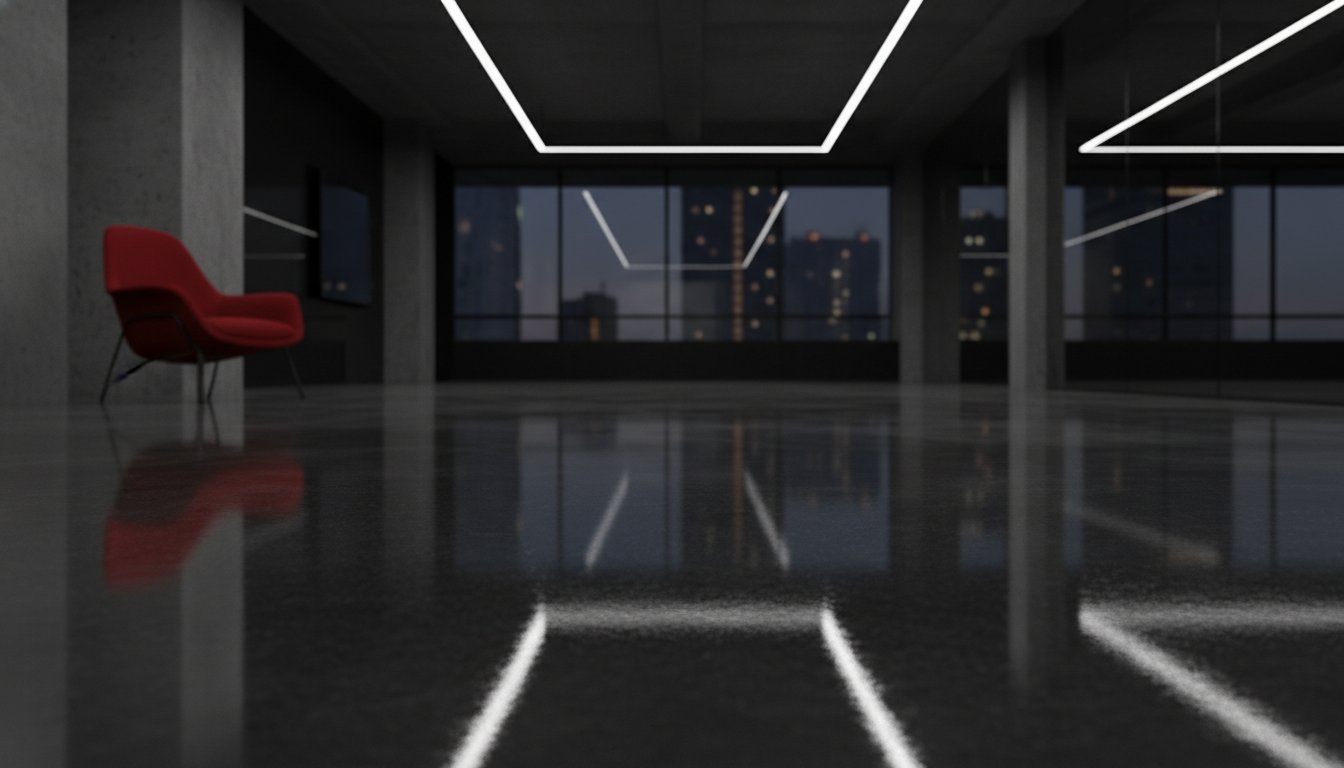
Why does one property owner get a "polished" floor that dulls within months while another enjoys a mirror-like finish for twenty years? If you're hunting for the average cost of polished concrete floors per sq ft, you've likely encountered a confusing spread of quotes that leave you wondering what's actually included. Most people fear paying for a premium finish only to end up with hidden cracks or a surface that's just a temporary coating. We believe a floor is a mechanical transformation rather than a quick fix; your budget should reflect the craftsmanship required to turn an old slab into a gallery-quality asset.
It's natural to feel overwhelmed by technical jargon and the wide pricing gaps found in the current market. You want a solution that's low-maintenance and rugged enough for a high-traffic garage or a busy commercial showroom. This guide will master the variables of concrete pricing so you can balance your upfront investment with long-term performance. You'll discover the vital difference between "sealed" and "polished" surfaces, learn if your current slab is ready for the grind, and walk away with a clear framework to plan your project with total confidence.
Key Takeaways
- Learn how the average cost of polished concrete floors per sq ft is shaped by the number of mechanical grinding stages and your desired level of aggregate exposure.
- Identify the specific slab conditions, such as deep cracks or stubborn adhesives, that can increase your initial preparation costs before the polishing begins.
- Compare the upfront investment of a mechanical polish against the long-term durability of garage floor epoxy or the outdoor versatility of Vuba stone.
- Discover why chemical densifiers and moisture testing are non-negotiable steps for preventing premature wear and maintaining a dust-free, gallery-quality environment.
- Master the variables of professional grinding to ensure your project balances industrial-strength resilience with a high-end aesthetic that stands the test of time.
Understanding the National Average Cost of Polished Concrete Floors
Polished concrete isn't a product you simply buy off a shelf and pour onto your slab. It's a rigorous, multi-step mechanical process of grinding, honing, and polishing that physically transforms raw, porous concrete into a dense, architectural asset. Before diving into the numbers, it's vital to understand What is Polished Concrete? in a technical sense. Unlike a topical coating that sits on top, this process uses industrial-grade diamonds to refine the surface until it glows. Because this is a labor-intensive craft, the average cost of polished concrete floors per sq ft is dictated by the number of passes required to reach your desired shine.
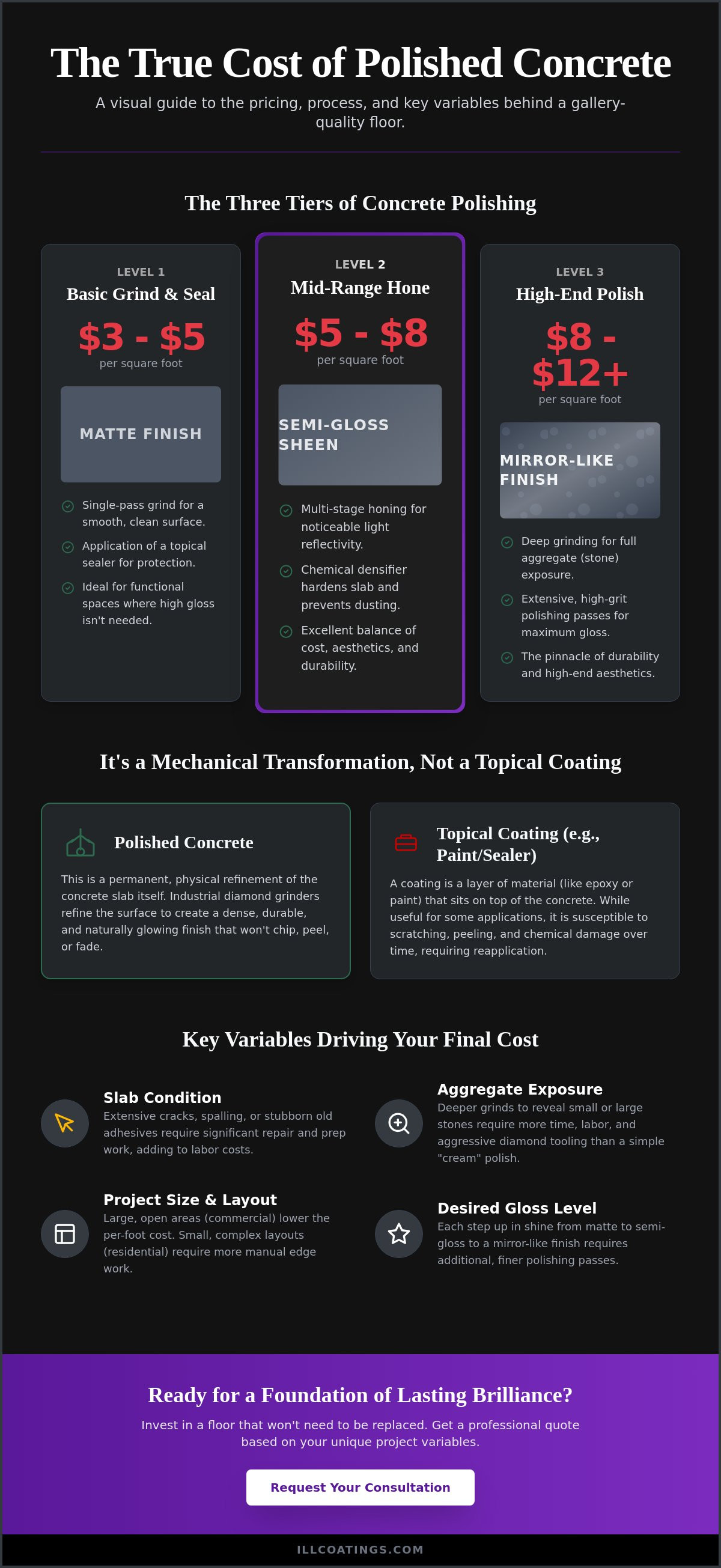
As we move through 2026, the national market has stabilized into three distinct pricing brackets. A basic finish typically ranges from $3 to $5 per square foot. If you're looking for a mid-range hone with more depth, expect to see quotes between $5 and $8. For those seeking a high-end, mirror-like finish with full aggregate exposure, prices often reach $8 to $12 or more. Square footage remains the primary driver of price efficiency. If you have a massive open area, we can utilize heavy, planetary grinders that cover ground quickly, driving down the unit cost. Small, chopped-up floor plans require smaller equipment and more manual labor, which naturally keeps the price at the higher end of the spectrum.
Residential vs. Commercial Pricing Dynamics
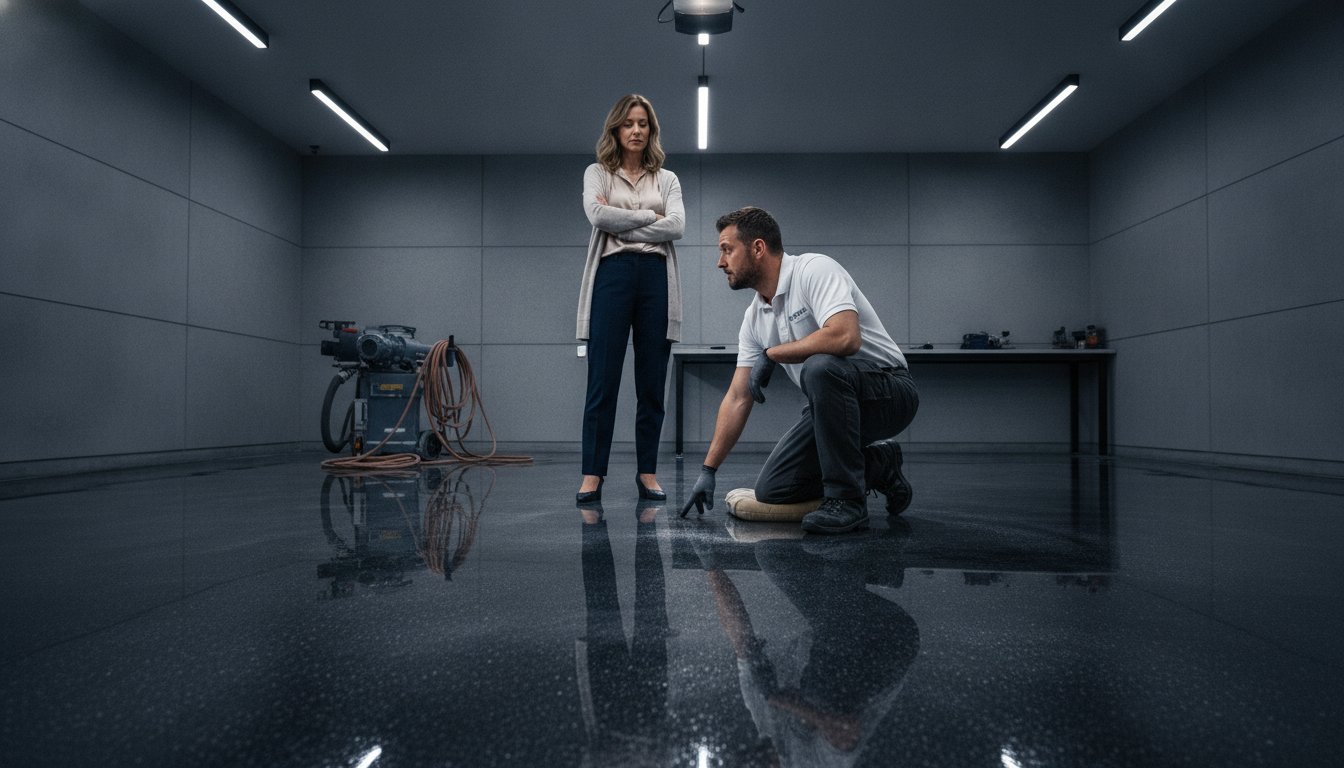
The environment where we work changes the math instantly. Residential projects often carry a higher price per square foot because they're filled with "edge work." Our teams have to get into tight closets, around kitchen islands, and along baseboards where the big machines can't reach. This requires hand-grinding, which is slow and meticulous. Conversely, commercial projects like warehouses or retail shells offer economies of scale. These large, unobstructed slabs allow us to maximize the speed of our equipment. If your project is under a certain size, you might also encounter a minimum mobilization fee. This covers the cost of transporting heavy machinery and a professional crew to your site, regardless of the total square footage.
The Three Tiers of Concrete Polishing
- Level 1 (Basic): This involves a single-pass grind that results in a smooth, matte finish. It's often paired with a topical sealer to protect the surface without the high-gloss look.
- Level 2 (Mid-Range): We perform multi-stage honing to achieve a semi-gloss sheen. This tier includes a chemical densifier to harden the slab and prevent dusting.
- Level 3 (High-End): This is the pinnacle of the craft. It requires deep grinding to achieve full aggregate exposure followed by high-grit polishing passes for a mirror-like, high-gloss finish.
When you choose a professional grind, you're investing in a permanent transformation. The average cost of polished concrete floors per sq ft reflects the reality that you're paying for a floor that won't need to be replaced in a decade. It's a calculated balance between immediate investment and a lifetime of industrial-strength beauty.
Key Variables That Drive Your Square Foot Pricing
The starting point of your project dictates the final bill. If your concrete is riddled with cracks, spalling, or deep-set carpet glue, the labor required to prepare that surface will climb quickly. While industry reports provide a baseline for the average polished concrete floor cost, these figures don't always account for the intensive labor of structural repairs. Every hour our crew spends patching divots or injecting cracks is an hour that moves the project further from a simple grind and toward a custom restoration.
Your choice of aggregate exposure is another massive price driver. This ranges from a "cream" finish, where the surface remains mostly untouched, to a "large stone" exposure, where we grind deep into the slab to reveal the rock beneath. Deeper grinds require more aggressive diamond tooling and significantly more time on the machine. Similarly, shine isn't just a spray-on finish. It's the result of progressive passes with increasingly fine diamond abrasives. Each jump in gloss level represents another round of labor and material, which is why a mirror-like finish pushes the average cost of polished concrete floors per sq ft toward the higher end of the spectrum.
Complexity kills efficiency. A wide-open warehouse is a dream for our heavy machinery, but a residential floor with six doorways, tight corners, and floor penetrations requires extensive manual work. These variables directly impact the average cost of polished concrete floors per sq ft for both residential and commercial clients because small, detailed spaces often carry a premium.
Surface Preparation and Concrete Grinding
Removing old thin-set or failing epoxy isn't optional; it's the only way to ensure the new finish bonds properly. We also have to account for the hardness of your slab. Soft concrete eats through diamond tools like sandpaper on wood, while extremely hard concrete requires specialized metal-bond diamonds just to make a scratch. Diamond grinding is the essential mechanical foundation that prepares a slab for a high-end, durable finish.
Design Enhancements: Dyes, Stains, and Scores
Transforming a gray slab into a custom masterpiece often involves dyes, stains, or decorative saw cuts. Solvent-based dyes offer vibrant, consistent color, while reactive stains provide a mottled, organic look that mimics natural stone. These choices, along with hand-tooling edges where our large machines can't reach, elevate the project from simple utility to true craftsmanship. If you're ready to see how these variables apply to your specific space, our specialists at Illuminated Coatings can help you navigate the technical details of your floor's transformation.
Cost Comparison: Polished Concrete vs. Epoxy and Resin-Bound Stone
Choosing between a mechanical grind and a chemical coating is a strategic decision about the life of your property. While the average cost of polished concrete floors per sq ft is often competitive with high-end coatings, the long-term ROI tells a different story. If you choose to polish, you are refining the existing material to a rock-hard finish that requires no additional layers. If you opt for garage floor epoxy, you are adding a protective, high-performance shield. Over a ten-year period, polished concrete typically wins the total cost of ownership battle because it eliminates the need for periodic re-coating that resin systems eventually require in high-friction environments.
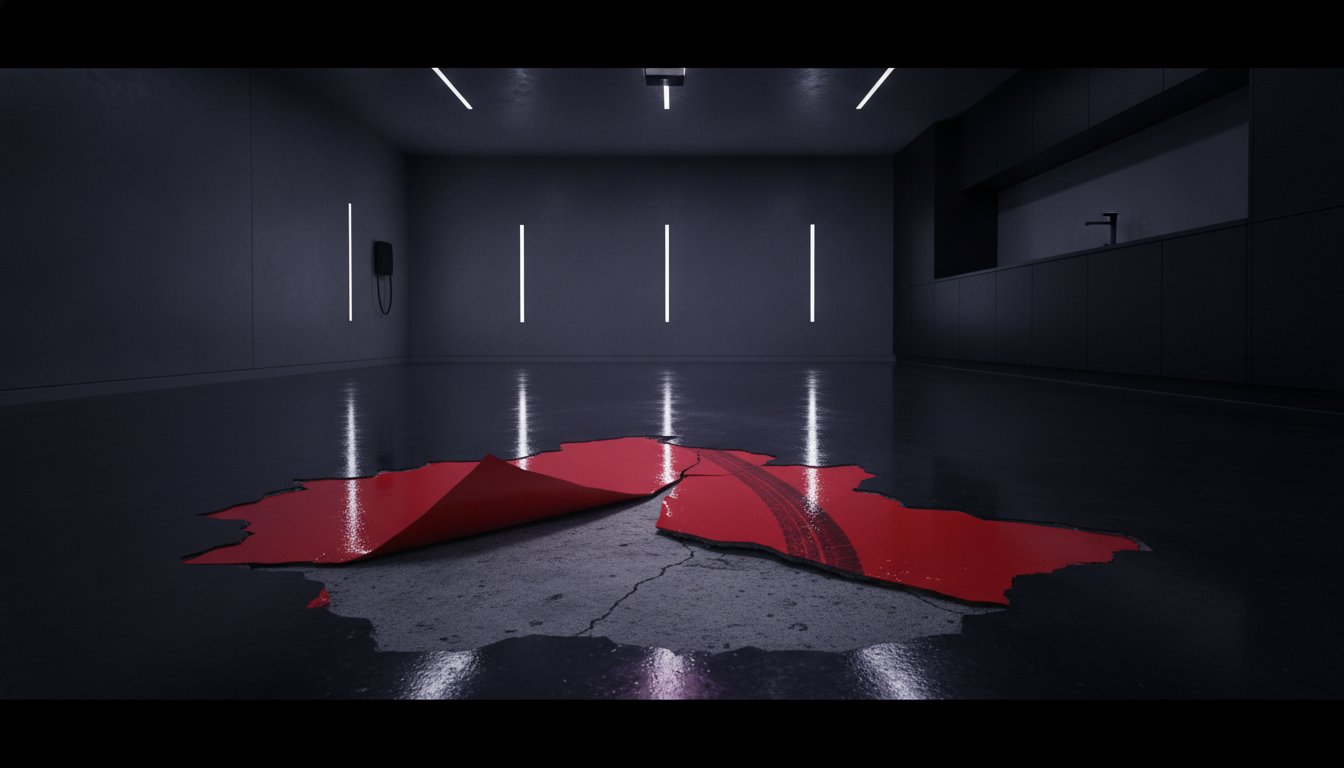
The aesthetic trade-offs are equally significant for the discerning property owner. Polished concrete offers an industrial-chic, gallery-quality look that highlights the natural, raw character of the slab. High-performance coatings, however, allow for a seamless, colorful, and highly customized aesthetic that can hide unsightly repairs or deep stains that polishing might otherwise expose. This makes coatings a powerful tool for transformation when the original concrete is too damaged to stand on its own.
Polished Concrete vs. High-Performance Coatings
If your facility handles harsh chemicals or experiences high moisture levels, then epoxy is often the clear winner. Polished concrete is a breathable system, which is excellent for preventing vapor pressure issues, but it remains a porous material at its core. Resin systems create a non-porous moisture barrier that is vital for food processing areas or heavy industrial labs. In a standard high-traffic garage, both systems offer extreme durability, but the "breathability" of a polished slab makes it less prone to delamination in damp climates where moisture might push up from beneath the slab.
The Vuba Stone Alternative for Outdoor Resurfacing
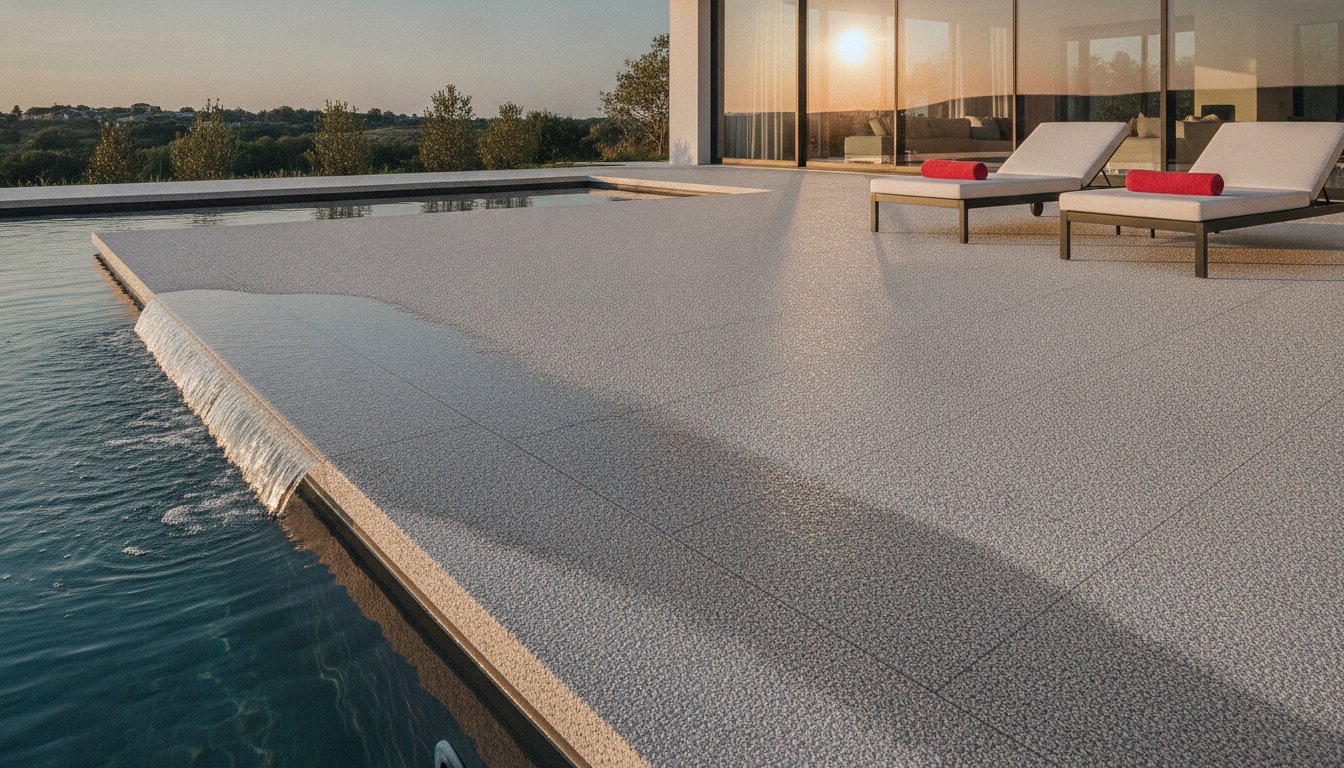
Polishing outdoor concrete is often impractical due to significant slip hazards. Once wet, a high-gloss polished slab becomes incredibly dangerous for pool decks or patios. This is where resin-bound stone, specifically Vuba stone, becomes the superior choice. If your outdoor slab is weathered, spalled, or simply unattractive, grinding it into a polish won't solve the safety issue. Vuba stone provides a porous, slip-resistant surface that looks like natural gravel but stays firmly in place. It's an aesthetic powerhouse that handles the elements without the maintenance headaches of loose stone or the hazards of polished concrete. Choosing the right material means balancing the visual impact with the physical reality of how the space is used every day.
The sticker price on a quote rarely tells the whole story of a floor's future. If you only focus on the average cost of polished concrete floors per sq ft, you might overlook the technical steps that prevent a professional project from becoming a long-term liability. True value is built into the invisible stages of the process, particularly the application of chemical densifiers. This secret weapon penetrates the concrete's pores to create a permanent chemical bond, hardening the surface from the inside out. Without this step, your floor remains a ticking clock of dusting and premature wear.
Moisture testing and vapor barriers represent another hidden but vital investment. These steps typically add $1 to $2 per sq ft to a professional quote, but they serve as an insurance policy against high vapor emission. If you skip testing, you risk efflorescence or moisture-driven failures that can ruin the finish. From a sustainability standpoint, utilizing your existing slab is the ultimate "green" choice. It qualifies for various LEED credits by reducing the need for new raw materials and minimizing the carbon footprint associated with manufacturing and transporting traditional flooring products.
Avoiding the 'Cheap' Contractor Trap
Low-ball quotes often indicate a contractor who plans to cut corners on the grinding stages. This leads to "ghosting," where the shine looks uneven or blotchy under professional lighting because the previous grit scratches weren't fully removed. Many property owners also confuse a "sealed" floor with a "polished" one. A sealed floor is simply a topical plastic layer that will peel and scratch, whereas a true polish is a mechanical refinement of the stone itself. Professional densification is mandatory for a dust-proof surface. If a contractor claims you don't need it, they are likely selling you a temporary fix rather than a permanent architectural asset.
Maintenance Costs: The Real Savings
The long-term ROI of polished concrete is most visible in your monthly overhead. While commercial carpet requires a replacement cycle every seven years, a properly polished floor can easily last 20 years or more. Daily maintenance is remarkably simple. You don't need to strip and wax these floors; a simple microfiber mop and neutral cleaner are usually sufficient. In high-gloss environments, a periodic mechanical burnishing will restore the original luster without expensive chemicals. Additionally, the high light reflectivity of a polished slab can actually reduce your facility's lighting costs by maximizing the efficiency of overhead fixtures. It's a rare example where the most aesthetic choice is also the most fiscally responsible.
If you're ready to invest in a floor that pays you back through durability and lower maintenance, contact our team at Illuminated Coatings to discuss your project's technical requirements.
Transforming Your Concrete with Illuminated Coatings
At Illuminated Coatings, we don't just see a floor; we see a canvas that demands industrial-strength integrity. We approach every project as blue-collar artisans, fusing the grit of hard manual labor with a refined eye for gallery-quality aesthetics. While the average cost of polished concrete floors per sq ft provides a baseline for your budget, our focus is on the technical precision that ensures your investment survives for decades. If you choose a specialist mindset over a generalist approach, then you secure a floor that serves as a point of pride for your home or business. We take immense pride in our craftsmanship because we know our professional survival depends on the brilliance we bring to your space.
Our team utilizes state-of-the-art planetary grinders to achieve a perfectly level finish that smaller, inferior machines simply cannot match. This equipment allows us to grind, hone, and polish with surgical accuracy, removing the dips and waves that often plague DIY attempts or budget installs. Whether you require the chemical resilience of garage floor epoxy or the sophisticated, porous elegance of Vuba stone for an outdoor patio, we bring national-level expertise to every local slab. We don't just provide a service; we deliver a mechanical transformation that elevates a dull gray surface into an architectural asset.
The Illuminated Coatings Process
Every successful project begins with initial slab diagnostics. We identify the hardness of your concrete and any underlying moisture issues before we ever start our machines. This step is vital for determining the best system for your specific environment. Our commitment to a dustless grinding process means we utilize high-performance vacuum systems to maintain a clean installation environment, protecting your property's air quality. You have total control over the final look, with customization options that allow us to tailor gloss levels and aggregate exposure to your exact vision. If you want a specific "salt and pepper" look or a high-gloss mirror finish, then we have the technical tools to make it happen.
Ready to Elevate Your Surfaces?
Choosing a professional installation is an investment in your property's long-term value. We understand the high stakes involved in property management and home ownership, which is why we operate with a singular focus on accountability and excellence. As a family-owned business, we provide the peace of mind that comes from a team that is personally invested in your satisfaction. We don't just finish floors; we Illuminated Coatings them to ensure they withstand the test of time and traffic. If you are ready to stop guessing about your budget and start building a durable, beautiful foundation, then it is time to consult with the experts.
Get a precision quote for your polished concrete project today
Build a Foundation of Lasting Brilliance
Mastering the average cost of polished concrete floors per sq ft is the first step toward a total property transformation. You now understand that a true mechanical polish is an investment in durability rather than a temporary aesthetic mask. By prioritizing proper slab preparation and professional-grade densification, you ensure your floor avoids the common pitfalls of dusting and premature wear. Whether you choose the industrial strength of high-performance epoxy or the breathable elegance of a diamond-ground finish, your decision today dictates your maintenance costs for the next twenty years.
Our family-owned team brings a specialist mindset to every project, combining national-level expertise with the integrity of local artisans. We specialize in Vuba Stone and high-performance epoxy coatings that turn neglected slabs into gallery-quality assets. If you're ready to move beyond confusing price ranges and secure a precision finish, then we are ready to bring our craftsmanship to your site. Get Your Custom Concrete Resurfacing Quote today and watch us bring life to your dull spaces. Your property deserves a floor that stands as a point of pride.
Frequently Asked Questions
Is polished concrete cheaper than epoxy per square foot?
Polished concrete often has a lower upfront price point compared to high-performance epoxy systems, but the real savings appear in the lifecycle. While epoxy provides a chemical-resistant shield, it eventually requires a re-coat. In contrast, a mechanically polished slab is a permanent transformation of the stone itself. If you prioritize long-term ROI, then polishing wins because it eliminates the recurring cost of replacing failing topical layers.
Can any old concrete slab be polished effectively?
Not every slab is a candidate for a high-gloss finish. If your concrete is excessively soft, porous, or structurally compromised by deep spalling, then a mechanical grind may not achieve the desired brilliance. In these cases, we often recommend high-performance coatings or resin-bound stone to provide the necessary structural integrity. A professional diagnostic is the only way to determine if your specific slab can handle the pressure of industrial grinders.
How much does it cost to polish a standard 2-car garage floor?
The total investment for a 2-car garage depends heavily on the condition of your slab and the level of aggregate exposure you desire. Residential garages often require extensive hand-tooling along the edges where large planetary grinders cannot reach. This manual labor, combined with the removal of old oil stains or adhesives, influences the final quote. If you choose a high-gloss finish, the number of diamond abrasive passes will also increase the project's complexity.
Does polished concrete get slippery when wet?
High-gloss polished concrete can become slippery when wet, similar to polished marble or ceramic tile. If safety is your primary concern in a high-moisture area, then we recommend a matte finish or the use of anti-slip additives during the final treatment stages. For outdoor applications like pool decks, we avoid polishing entirely and suggest resin-bound stone, which offers superior slip resistance and a porous, safe surface for your family.
What is the difference between sealed concrete and polished concrete?
Sealed concrete is a topical application where a protective liquid is spread over the surface, while polished concrete is a mechanical refinement using diamond abrasives. A sealed floor relies on a plastic layer that can peel or scratch over time. A polished floor is a physical change to the concrete's density. This distinction is a major factor in the average cost of polished concrete floors per sq ft, as polishing requires significantly more labor and specialized equipment.
How long does the concrete polishing process take for a residential home?
A typical residential project usually spans three to five days. The first phase involves aggressive grinding to remove surface contaminants and open the pores of the slab. Following this, we move through multiple honing stages and apply a chemical densifier to harden the stone. If you choose a high-end finish, the final polishing and burnishing passes take additional time to ensure a perfectly level, gallery-quality shine that meets our standards of craftsmanship.
Are there hidden costs like moisture testing or crack repair?
Yes, structural repairs and moisture testing are the most common variables that aren't included in a basic square foot estimate. If your slab has deep cracks or failing thin-set from old tile, the labor to restore that surface is a separate requirement. We also perform vapor emission testing to ensure the slab won't push moisture through the finish. Addressing these technical details upfront prevents the heartbreak of a failing floor and protects your long-term investment.
How often does a polished concrete floor need to be refinished?
One of the greatest benefits affecting the average cost of polished concrete floors per sq ft is that it rarely needs to be fully refinished. With simple microfiber mopping and neutral cleaners, a residential floor can maintain its brilliance for over 20 years. In high-traffic commercial environments, a mechanical burnishing every few years can restore the original luster. This durability is why we consider our work a form of architectural survival for your property's environment.