The cheapest way to fix a crack is often the most expensive mistake you'll make for your home this year. You've likely stared at those jagged, grey veins spreading across your backyard and wondered if a twenty-dollar tube of filler from the hardware store will actually do the trick. It's frustrating to watch your outdoor sanctuary lose its luster, especially when DIY patches leave behind ugly, mismatched lines that look worse than the original damage. If you want to stop the cycle of recurring cracks and temporary fixes, then you need to understand the true cost to fix a cracked concrete patio and why professional resurfacing is the only way to achieve a seamless, gallery-quality finish.
We know that your home is your pride, and a crumbling patio feels like a personal failure. In this 2026 guide, we'll break down the real-world expenses of different repair methods and show you how to distinguish a harmless hairline fracture from a serious structural threat. You'll discover why investing in a durable, industrial-strength coating provides a far better return than a standard patch job. We're going to pull back the curtain on labor rates, material lifespans, and the specific steps required to transform your weathered slab into a point of pride for your family.
Key Takeaways
- Identify the critical differences between surface-level hairline fractures and deep structural settlement before you spend a dime on repairs.
- Discover the real-world cost to fix a cracked concrete patio in 2026, including a side-by-side comparison of linear foot patching versus full-slab resurfacing.
- Learn why professional mechanical grinding is the only way to guarantee a permanent bond that won't peel or flake under pressure.
- Calculate the true five-year value of choosing a transformative resurfacing solution over the cycle of cheap, recurring patches.
- See how advanced resin-bound stone systems can bridge old cracks and turn a weathered slab into a stunning, industrial-strength masterpiece.
The Real Cost to Fix a Cracked Concrete Patio in 2026
If you see a jagged line spreading across your slab, you aren't just looking at an eyesore; you're looking at a structural countdown. Most homeowners assume the cost to fix a cracked concrete patio is simply the price of a bag of filler and a few hours of work. This is a dangerous misconception. A true fix requires a calculated blend of industrial-strength materials and specialized labor hours. If you hire a professional, you're paying for their ability to diagnose the root cause of the failure, not just their ability to smear goop into a gap. In 2026, labor remains the primary driver of your estimate, often accounting for 70% or more of the total project price because the preparation work is so intensive.
We believe that every repair should be a transformation. If you simply fill a crack, you've created a visible scar that reminds you of the damage every time you step outside. A professional approach involves grinding the concrete to create a mechanical bond, ensuring the repair actually lasts. This level of craftsmanship elevates a basic maintenance task into a property-value-boosting upgrade. Before you sign a contract or buy a DIY kit, you must understand exactly what kind of damage you're facing.
Identifying Your Crack Type Before You Pay
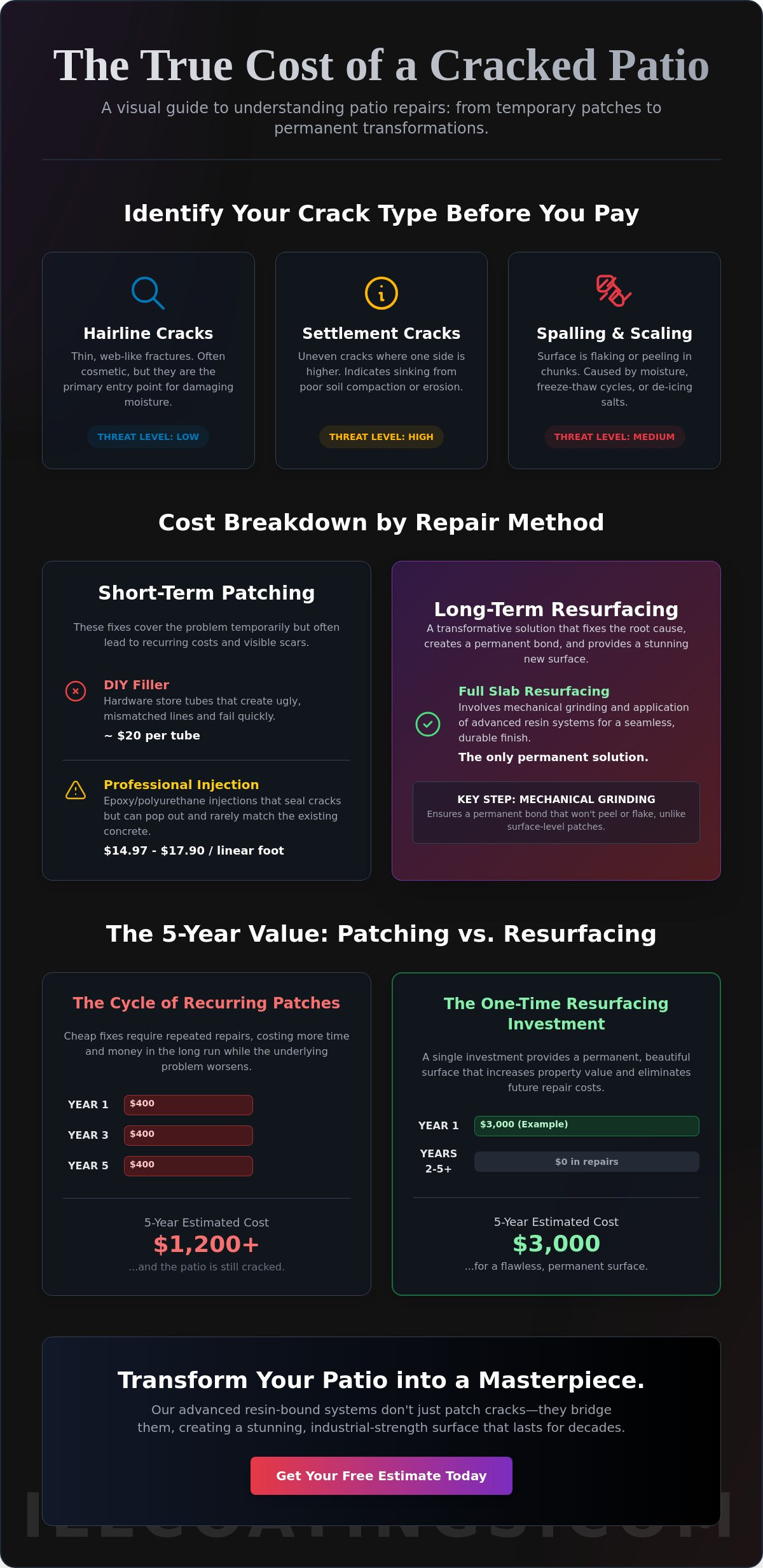
- Hairline Cracks: These thin, web-like fractures are often cosmetic. They usually stem from surface tension or rapid drying during the original pour. While they don't threaten the slab's integrity yet, they are the primary entry point for moisture.
- Settlement Cracks: If one side of the crack is higher than the other, your patio is sinking. This indicates poor soil compaction or sub-base erosion. These require more than just a surface fix; they often need slab leveling or poly-jacking.
- Spalling and Scaling: If the surface layer is flaking off in chunks, your concrete is literally shedding its skin. This is common in regions with harsh winters where salt and de-icers have eaten away at the finish.
The Hidden Danger of "Wait and See"
Water is the absolute enemy of your foundation. Once a crack opens, gravity pulls moisture deep into the sub-base, washing away the dirt and gravel that supports your patio. In colder climates, this moisture freezes and expands with incredible force. This cycle acts like a slow-motion jackhammer, turning a minor $300 hairline fracture into a $3,000 total slab replacement within just a few seasons. Understanding the causes of concrete degradation proves that cracks are rarely "just" cosmetic. If you ignore these warning signs, you aren't just risking the beauty of your backyard; you're inviting safety liabilities and dragging down your home's total appraisal value. Addressing the cost to fix a cracked concrete patio today is the only way to prevent a financial catastrophe tomorrow.
Pricing Breakdown: Cost by Concrete Repair Method
Choosing the right repair method is a balance between your current budget and the future value of your home. If you select a temporary patch for a structural problem, you're essentially throwing money into a sinking hole. In 2026, the cost to fix a cracked concrete patio varies wildly based on whether you're addressing surface aesthetics or deep-seated instability. Professionals typically approach these projects with a tiered strategy, starting with localized injections and moving toward full-scale transformations that protect the slab for decades.
Minor Fixes: Filling and Patching
For small, non-moving cracks, localized injection is the entry-level solution. This involves pumping epoxy or polyurethane resins into the gap to seal out moisture and prevent further erosion. While you can find plenty of guides on how to fix cracks in concrete for a few dollars in materials, professional-grade injections ensure the material actually penetrates the full depth of the slab. Expect to pay between $150 and $800 for professional crack repair, with costs often calculated between $14.97 and $17.90 per linear foot as of early 2026. However, be warned: patches are rarely invisible. Because new concrete never perfectly matches the weathered texture and color of an old slab, these fixes often look like mismatched scars across your backyard. In regions with high temperature swings, these rigid patches frequently pop out within a year as the slab expands and contracts.
Structural Fixes: Leveling and Slab Jacking
When a crack is accompanied by a vertical drop, you've got a trip hazard that requires more than a simple filler. Mudjacking, the traditional method of pumping a grout slurry under the slab to lift it, remains a common choice and usually costs between $500 and $1,200. Modern crews often prefer poly-leveling, which uses lightweight expanding foam. While foam is often more expensive than mudjacking, it lasts significantly longer and requires smaller injection holes, preserving the look of your stone. Most professional leveling crews have a minimum call-out fee to cover their equipment and travel, so even small jobs will start at a base price point. If your patio is beyond leveling, the "nuclear option" of demolition and removal can cost upwards of $2 to $6 per square foot before you even pay for the new pour.
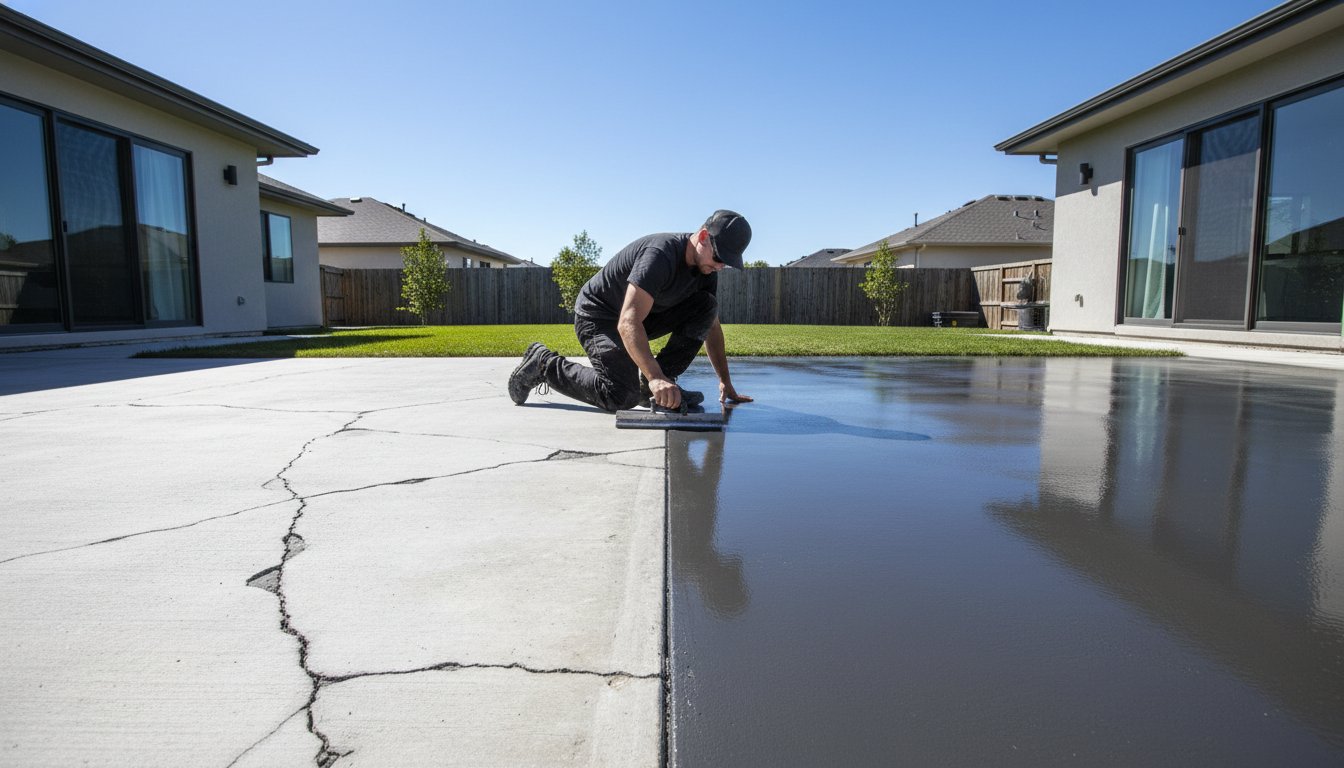
If you want to skip the cycle of ugly patches and avoid the massive expense of a full tear-out, professional patio resurfacing offers the most durable middle ground. Resurfacing covers the entire area with a high-performance overlay, effectively bridging existing cracks and providing a fresh, uniform canvas that looks brand new. It's the difference between a band-aid and a total skin graft for your outdoor living space.
Factors That Drive Your Patio Repair Estimate
If you receive three different quotes for the cost to fix a cracked concrete patio, the disparity usually lies in the invisible work. Most homeowners focus on the price of the resin or the total square footage. However, a professional estimator looks at the labor hours required to ensure that repair stays put for the long haul. If the contractor doesn't mention mechanical preparation, they are planning a temporary fix that will likely fail within a few seasons.
Accessibility is the first logistical hurdle. Can we get a 600-pound planetary grinder through your side gate? If your patio is tucked behind a narrow garden path or sits on a steep grade, the labor costs will reflect the manual effort required to move industrial machinery into place. We also have to account for existing coatings. If your patio was previously painted or treated with a failing sealer, we must strip that material back to the raw substrate. You cannot build a masterpiece on a crumbling foundation, and removing old "DIY fixes" often takes more time than the actual repair itself.
Surface Preparation and Grinding
Mechanical grinding is non-negotiable for a permanent bond. We follow strict standards for the Concrete Surface Profile (CSP) to ensure the repair material doesn't just sit on top of the slab. Industrial diamond grinding opens the "pores" of the concrete, creating a texture similar to 80-grit sandpaper. This allows our specialized resins to root themselves deep into the stone. While a simple pressure wash is cheap, it does nothing to create a mechanical bond. Grinding is the most labor-intensive part of our professional quote, but it's the only way to guarantee your surface won't peel or flake under pressure.
Material Quality and Performance
Don't confuse professional-grade polyaspartic or resin systems with the epoxy kits found at big-box hardware stores. Outdoor patios face brutal UV exposure and constant thermal shock. If you use a cheap, hardware-store resin, it will yellow, become brittle, and eventually pop out of the crack. We utilize industrial-strength materials specifically engineered for outdoor stability and flexibility. This is the "price of peace of mind." By choosing a professional installation, you're investing in a system backed by a warranty and the expertise of a specialist who understands the chemistry of a lasting finish. Our blue-collar artisan approach ensures your patio isn't just patched; it's reinforced for a lifetime of use.
Patch vs. Resurface: Choosing the Best Long-Term Value
Most homeowners view the cost to fix a cracked concrete patio as a one-time line item on a budget. This perspective is a financial trap. If you choose a basic patch, you're likely committing to a recurring expense every eighteen to twenty-four months. Over a five-year period, the cumulative cost of repeated patching, combined with the inevitable degradation of the surrounding slab, often equals the price of a professional resurfacing. You aren't just paying for the material; you're paying for the frustration of watching the same cracks reappear season after season. A $5,000 transformation might seem steep compared to a $500 patch, but the long-term return on investment is undeniable when you factor in durability and property value.
The Aesthetic Failure of Patching
New concrete never matches the soul of old, weathered stone. When you fill a crack with standard hardware-store materials, you create a "scar" that draws the eye directly to the damage. This visual scarring does more than just annoy you during a backyard barbecue; it actively lowers your home's appraisal value. Potential buyers see patches as a red flag for underlying structural neglect. There is a profound psychological benefit to stepping out onto a patio that feels brand new. A seamless surface suggests a home that is meticulously maintained, whereas a patched slab signals a property in a state of slow-motion collapse.
Resurfacing as a Structural Shield
Professional resurfacing does more than hide cracks; it bridges them. We use high-performance coatings that possess the tensile strength to handle the natural thermal expansion and contraction of the earth. While a rigid patch will snap when the ground shifts, our industrial-grade resins remain flexible enough to move with your slab. This flexibility is what prevents old fractures from migrating through to the new surface. Resurfacing creates a seamless, impenetrable barrier that prevents water from reaching the substrate and causing further erosion. By sealing the entire patio, you're cutting off the moisture supply that fuels the freeze-thaw cycle and sub-base washouts.
If you're tired of looking at a broken backyard and want a solution that lasts for decades, it's time to elevate your expectations. Our specialized concrete coatings turn a liability into a luxury asset that you'll be proud to show off. We don't just fix concrete; we transform your environment into a gallery-quality space that stands the test of time.
Transform Your Patio with Illuminated Coatings
If you're tired of calculating the cost to fix a cracked concrete patio every other spring, it's time to shift your focus from repair to revolution. We don't just fill gaps; we redefine the surface. Standard repairs leave behind visible scars, but our resin-bound stone systems create a seamless, textured landscape that makes those old fractures vanish. This isn't a temporary band-aid. It's a permanent aesthetic upgrade that handles the brutal realities of outdoor exposure with grace. If you want a backyard that feels like a high-end retreat rather than a construction zone, you need a solution that addresses both structural integrity and visual brilliance.
The Vuba Stone Advantage
Vuba stone represents the pinnacle of resin-bound technology and stands as the ultimate crack-masking solution. The science is simple but effective: we mix high-quality natural stones with a clear, UV-stable resin. This creates a porous matrix that allows water to flow directly through to the ground. This natural drainage is vital because it eliminates the standing water that fuels the freeze-thaw cycle and erodes your sub-base. Because the surface is composed of millions of tiny stone facets, any minor future movement in the slab is absorbed and hidden. Unlike a flat epoxy which would simply crack again, this system remains resilient. You get a slip-resistant, cool-to-the-touch finish that elevates your pool deck or patio into a gallery-quality environment. With various customization options available, you can perfectly match your home’s aesthetic with natural stone hues that never fade.
Expert Installation and Craftsmanship
Our commitment to craftsmanship is rooted in a blue-collar artisan mindset. We know that the beauty of a resin-bound finish is only possible because of the grueling work that happens before the first stone is laid. Meticulous surface prep and industrial diamond grinding are our baseline. We take a specialist approach because we understand that the quality of our output is tied to our professional survival. We don't just want to finish a job; we want to create a point of pride for your family. This is the "Illuminated" difference. We turn a routine maintenance chore into a transformative experience that restores your confidence in your property. We provide a precision estimate that accounts for every factor, ensuring there are no surprises on your path to a durable, beautiful outdoor space. We believe your patio should be a sanctuary, not a source of stress.
Ready to stop patching and start transforming? Get your quote today!
Secure a Masterpiece for Your Backyard
If you're ready to stop the endless cycle of temporary fixes, then it's time to choose a solution that prioritizes both structural integrity and artistic excellence. We've shown that the real cost to fix a cracked concrete patio isn't just about the initial labor; it's about the value you gain over decades of use. A professional transformation bridges existing damage and creates a seamless barrier that protects your home's foundation and its market value. Don't settle for another year of staring at jagged lines and mismatched patches that only hide the problem.
At Illuminated Coatings, we bring family-owned integrity and national-level expertise to every project. We are specialists in high-performance Vuba stone, delivering industrial-strength durability with a refined, gallery-quality finish. We don't just work on concrete; we craft outdoor environments that you'll be proud to share with your friends and neighbors. Every project is a testament to our dedication to craftsmanship and our commitment to your home's long-term beauty. Your dream patio is within reach, and we have the specialized tools to make it a reality.
Get a Professional Quote to Transform Your Cracked Patio
Common Questions About Concrete Patio Repair
Is it cheaper to repair or replace a concrete patio?
Repairing a slab is almost always more affordable than a total replacement. If you choose a professional resurfacing system, you can effectively manage the cost to fix a cracked concrete patio while achieving a result that looks brand new. Replacement involves high costs for demolition and disposal, whereas a high-performance coating reinforces your existing structure without the mess of a full tear-out.
Can I fix a large crack in my concrete patio myself?
You can apply a temporary filler, but a DIY fix for a large crack will almost certainly fail within a few seasons. Hardware store kits don't offer the industrial-strength flexibility needed to handle constant thermal expansion. If you want a result that doesn't look like an ugly scar across your backyard, professional mechanical grinding and resin injection are required to create a permanent, seamless bond.
How much does it cost to resurface a concrete patio per square foot?
The cost to fix a cracked concrete patio through resurfacing is determined by the total square footage and the intensity of the mechanical grinding needed. If your slab has existing coatings or deep spalling, the labor hours for preparation will increase. Investing in a premium system ensures you aren't just paying for a temporary fix but for an industrial-strength transformation that adds genuine beauty to your property.
Will a concrete patch stop a crack from growing?
A standard rigid patch won't stop a crack because it cannot move with the natural shifts of the earth. If the ground moves or the temperature drops, a stiff patch will simply snap or pop out of the gap. Professional solutions use flexible polyaspartic or resin-bound systems that act as a bridge, absorbing the tension and preventing the fracture from spreading further across your outdoor living space.
What is the best material for filling deep concrete cracks?
Industrial-grade polyurethane or epoxy injections are the gold standard for deep structural repairs. These materials are engineered to penetrate the full depth of the slab and bond the two sides together. For the ultimate finish, covering these repairs with a resin-bound stone system provides a porous, durable surface that masks the damage by turning a repair into a luxury upgrade.
How long does a professional concrete patio repair last?
A high-quality professional repair can last 15 to 20 years or more when properly maintained. The longevity depends entirely on the preparation; if the crew performs industrial diamond grinding, the bond is essentially permanent. Choosing a UV-stable coating ensures the surface won't yellow or become brittle, providing a long-term return on your investment that far outlasts cheap, recurring DIY patches.
Does a cracked patio affect my home appraisal?
Visible damage significantly lowers your home's curb appeal and can lead to a lower appraisal value. Appraisers and potential buyers often view cracks as a sign of underlying structural neglect or poor drainage. If you invest in a professional transformation, you turn a liability into a high-end asset that boosts your home's marketability and justifies a higher asking price during a future sale.