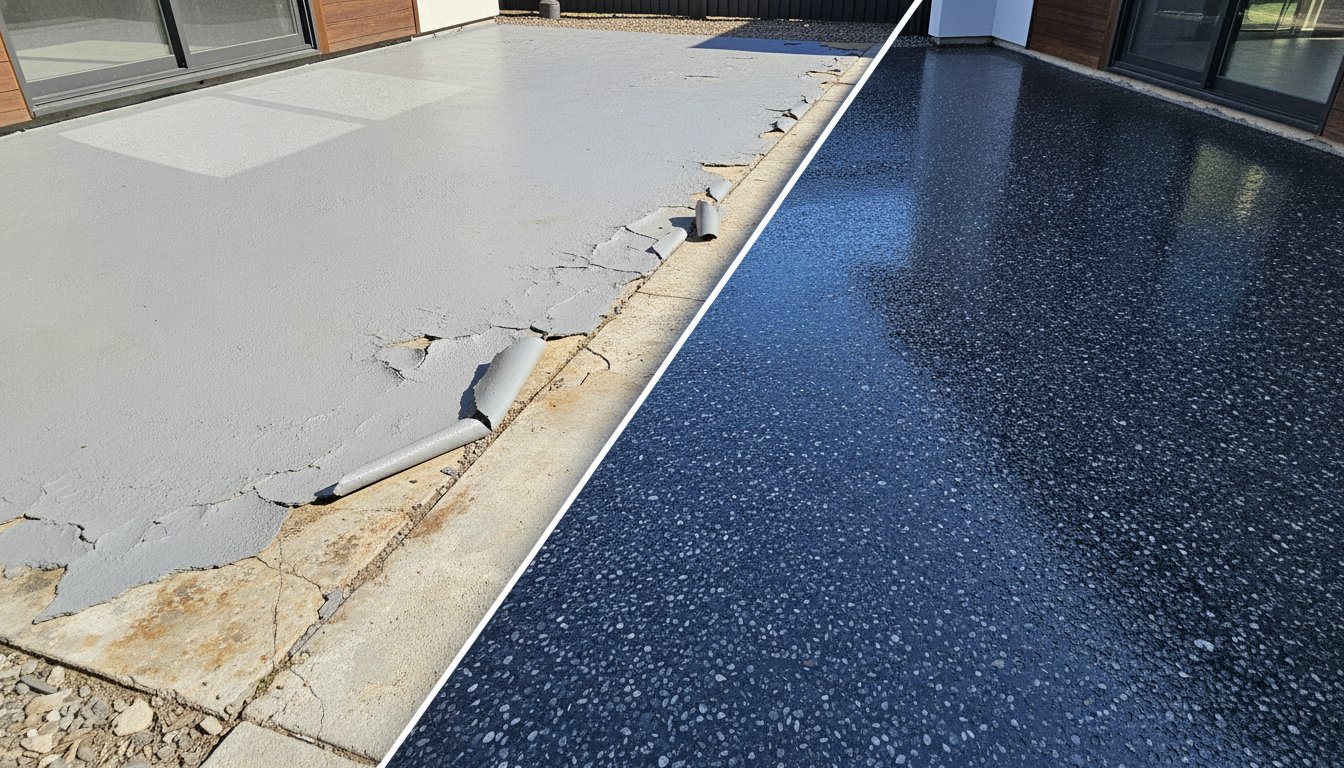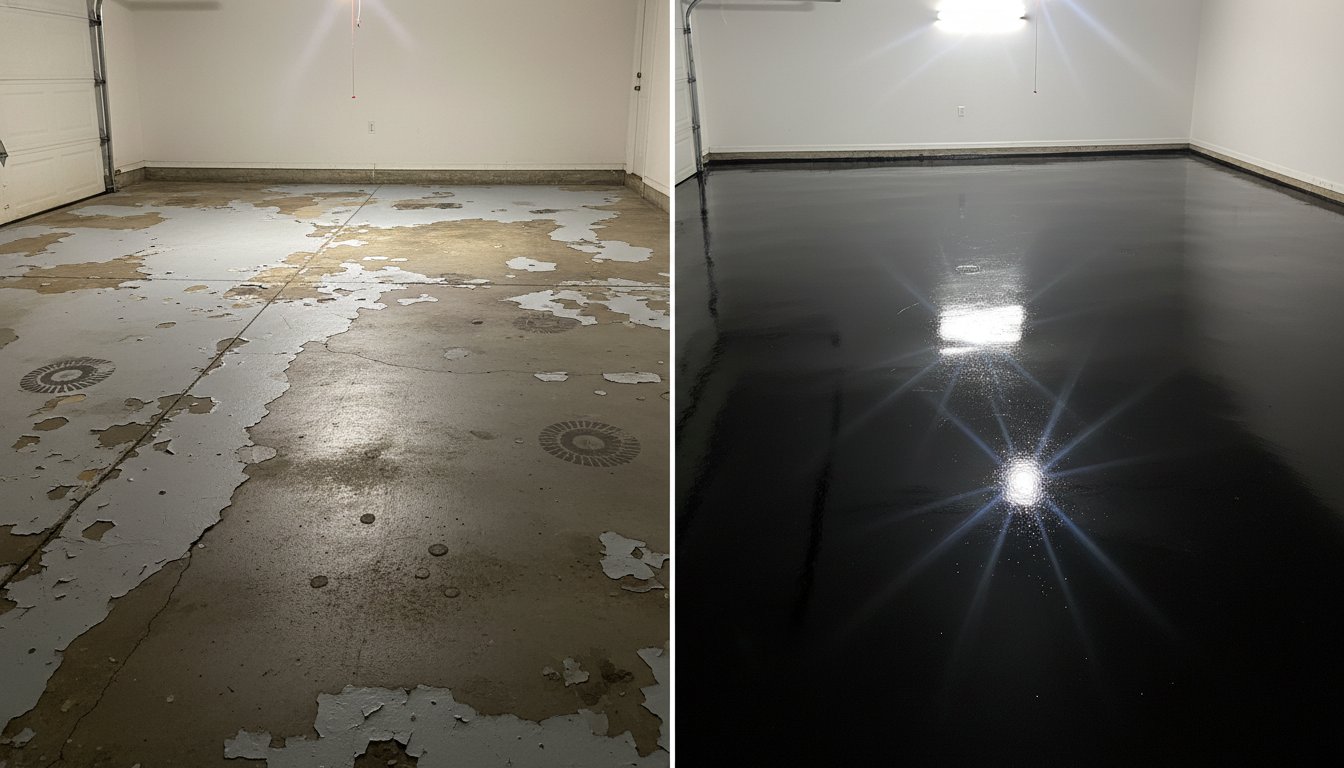
That unsightly peeling under your car isn't a tire problem; it's a fundamental chemistry failure of a coating that wasn't built for the heat. If you've ever pulled your high-performance vehicle into the garage only to find the floor sticking to your tread the next morning, you know the sting of a DIY project gone wrong. You aren't alone. Industry data from June 2026 shows that 30% to 50% of DIY epoxy kits fail because they lack the bond strength to survive modern rubber compounds. Learning how to prevent hot tire pickup on epoxy starts with moving past retail-grade water-based paints and embracing the industrial standards used by professionals.
We understand that your garage is more than just a parking spot. It's a point of pride and a sanctuary for your investments. You deserve a floor that mirrors the excellence of the vehicles parked on it. In this guide, we'll explain the technical reasons behind delamination and provide the professional strategies needed to ensure your floor achieves permanent adhesion. We'll explore the critical difference between acid etching and diamond grinding, the superior durability of 100% solids resins, and the exact curing timelines required to transform your space into a high-end gallery that stands the test of time.
Key Takeaways
- Understand the physics of the "vacuum effect" and why cooling tires can pull inferior coatings right off your concrete.
- Discover why 100% solids epoxy provides the industrial-strength bond and chemical resistance that water-based DIY kits lack.
- Learn why mechanical diamond grinding is the non-negotiable standard for creating the surface profile required for permanent adhesion.
- Master the critical curing timeline to distinguish between a floor that is "dry to touch" and one ready for high-performance tires.
- Gain professional-grade insights on how to prevent hot tire pickup on epoxy to ensure your garage remains a point of pride for years.
What is Hot Tire Pickup? The Physics of Garage Floor Failure
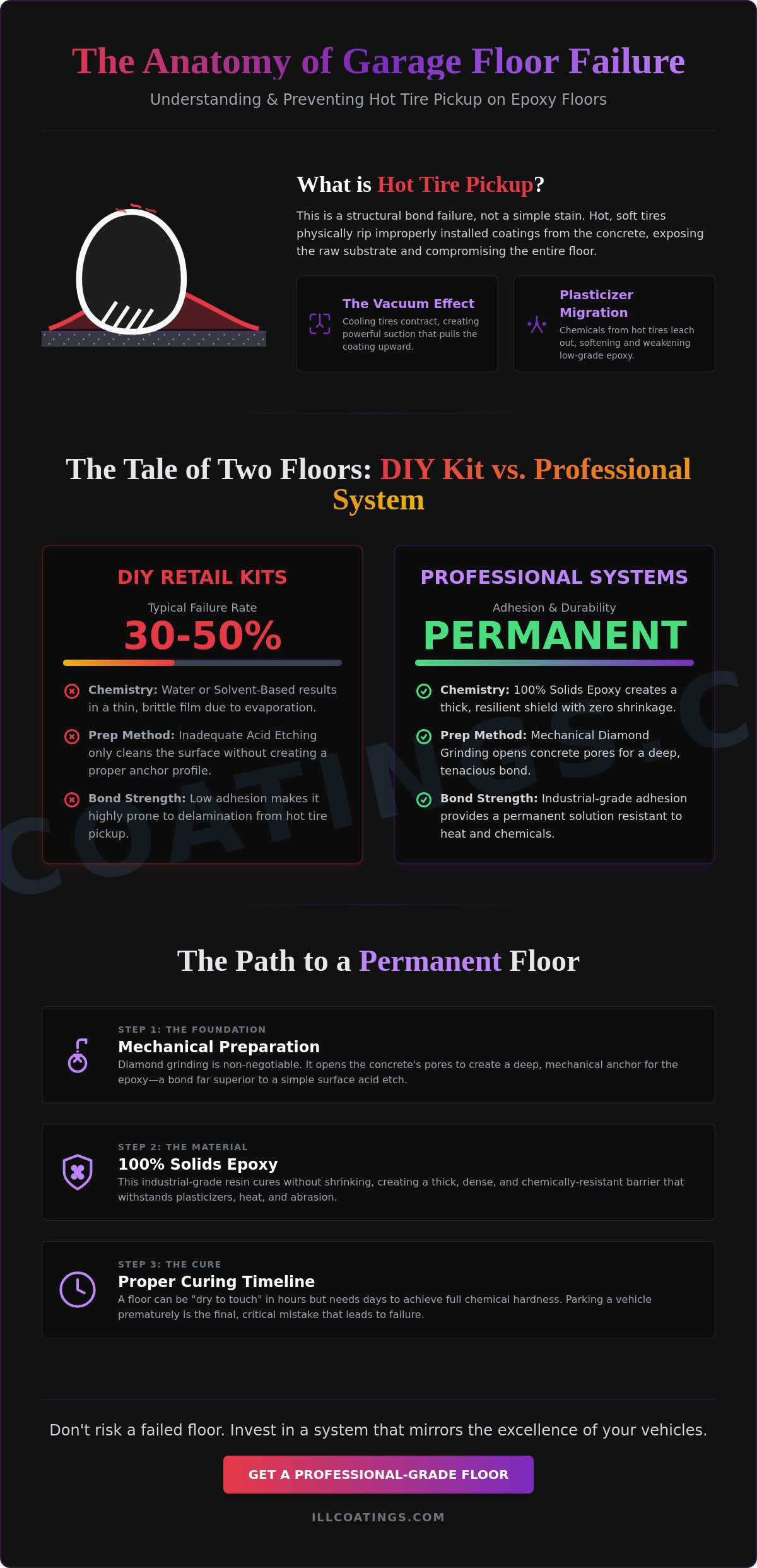
Hot tire pickup isn't just a cosmetic annoyance or a stubborn smudge on your garage floor. It's a structural failure of the coating itself. This phenomenon occurs when a vehicle's tires, heated by the friction of the road, physically bond to the epoxy surface. When you pull the vehicle out of the garage the next morning, the tire's grip is stronger than the epoxy's bond to the concrete. The result is delamination, where chunks of your expensive floor coating are literally ripped away, leaving the raw concrete exposed. If you want to master how to prevent hot tire pickup on epoxy, you first have to respect the physical forces at play.
A primary driver of this failure is the "vacuum effect." As your tires cool down after a drive, they naturally contract. This contraction creates a localized suction against the floor. If the coating has been softened by the heat and chemical interaction, this suction acts like a mechanical lever. It pulls upward on the resin with surprising force. This is why you'll see the most damage under heavy SUVs or high-performance vehicles. These cars use wider tires with softer rubber compounds designed for maximum grip, which increases the surface area and the intensity of the vacuum seal.
It's vital to distinguish between tire staining and structural delamination. Tire marks are simple surface discolorations caused by rubber dust and road grime. They can usually be scrubbed away. Delamination, however, is a total bond failure. Once the coating has lifted, there's no "patching" it effectively. The integrity of the entire system is compromised. Understanding the root cause is the only way to ensure your garage transformation remains a point of pride rather than a source of frustration.
The Role of Plasticizer Migration
Tire manufacturers use chemicals called plasticizers to keep rubber flexible and prevent it from becoming brittle. These oils are designed to stay mobile within the tire. When your tires reach operating temperatures, these plasticizers become even more active and begin to leach out of the rubber. This is known as plasticizer migration. If your floor is coated with a low-solids or water-based DIY kit, these chemicals can actually re-soften the cured resin. The Chemistry of Resistance in professional-grade 100% solids epoxy is specifically engineered to withstand this chemical leaching. Without that industrial-strength cross-linking, the plasticizers turn your floor into a gummy substance that can't resist the weight of your vehicle.
Heat-Induced Adhesion Failure
Friction is a powerful heat generator. During a typical summer drive, your tires can easily exceed 130°F. When you park, that heat is transferred directly into the garage floor. This creates a massive thermal expansion mismatch. Concrete is a heat sink that stays relatively cool, while the thin layer of epoxy absorbs the tire's heat rapidly. This temperature spike causes the epoxy to expand at a different rate than the underlying concrete, creating intense shear stress at the bond line. In single-component floor paints or cheap kits, this "hot-melt" effect effectively liquefies the bond. Learning how to prevent hot tire pickup on epoxy requires a coating that maintains its rigid structural profile even when subjected to these high-temperature cycles.
Professional Grade vs. DIY Kits: The Chemistry of Resistance
The difference between a floor that lasts decades and one that fails in six months lies in the molecules. Most homeowners head to big-box stores for a weekend project, unaware that retail kits are fundamentally different from industrial coatings. These DIY options are usually water-based or solvent-based. As they cure, the liquids evaporate into the air. This evaporation causes the coating to shrink, which creates microscopic internal tension within the resin. This tension makes the floor brittle and prone to cracking. If you use a retail kit, then hot tire pickup is almost an inevitability because the thin, low-density film simply cannot withstand the heat of a high-performance tire.
Professional-grade materials utilize a 100% solids chemistry. This means that every ounce of product applied stays on the floor as a durable shield. There is no evaporation and no shrinkage. If you are researching how to prevent hot tire pickup on epoxy, you must understand that the battle is won or lost during the chemical cure. The resulting dry film is significantly thicker and more resilient than any retail alternative. A denser molecular structure, known as cross-linking, creates a surface that is nearly impenetrable by the plasticizers and heat that we discussed in the previous section. If you prioritize long-term durability over a cheap weekend fix, then a professional garage floor epoxy is the only logical choice.
The Solids Content Difference
When we talk about 100% solids, we're describing a resin that maintains its full volume during the curing process. If a professional applies a 10-mil layer, you get a 10-mil finished floor. In contrast, a water-based kit might shrink by 50% or more, leaving you with a film no thicker than a few sheets of paper. This thin layer is easily compromised by chemical penetration. High-solids systems maintain their structural integrity at the high temperatures where retail paints begin to soften and fail. This density is what prevents the "vacuum effect" from gaining a foothold on your concrete.
Polyaspartic and Polyurea Alternatives
While epoxy is a powerhouse, polyaspartic and polyurea coatings are the gold standard for those seeking the ultimate garage transformation. These materials offer a much higher Heat Deflection Temperature (HDT). This means they stay rigid and unyielding even when a 140°F tire is parked directly on them. Beyond their heat resistance, they offer a rapid return-to-service. You can often park your vehicle within 24 hours without fear of delamination. Choosing these advanced resins is the most effective way to master how to prevent hot tire pickup on epoxy while ensuring a gallery-quality finish that stands up to the heaviest SUVs.
The Foundation of Prevention: Mechanical Preparation and Diamond Grinding
Ninety percent of hot tire pickup cases aren't caused by the tires or even the resin. They're caused by a failure to prepare the substrate. A smooth concrete surface is the absolute enemy of a permanent bond. If your concrete is as smooth as a sidewalk, the epoxy has nothing to grab onto. It simply sits on the surface like a sheet of plastic. When you're trying to figure out how to prevent hot tire pickup on epoxy, the answer starts with creating a mechanical bond that is physically inseparable from the slab.
A chemical bond relies on the adhesive properties of the resin alone. A mechanical bond, however, occurs when the epoxy penetrates deep into the open pores of the concrete. It's the difference between laying a sticker on glass and pouring liquid into a sponge. Once that liquid hardens, it becomes a structural part of the floor. This is why professional garage transformations always begin with heavy machinery. We don't just clean the floor; we re-engineer the surface to accept the coating. If you bypass this step, you're merely painting your floor, not protecting it.
Why Acid Etching Fails
Many DIY kits suggest acid etching as a sufficient preparation step. This is a dangerous misconception. While acid can remove laitance, which is the weak, milky layer on top of new concrete, it often leaves behind more problems than it solves. Acid etching introduces moisture and salts into the concrete. If this moisture is trapped beneath your new coating, it can lead to outgassing, where bubbles and blisters destroy the finish from below. Most importantly, acid cannot achieve the necessary Concrete Surface Profile (CSP) of 2 or 3. Without that specific sandpaper texture, the coating is destined to fail under the weight and heat of modern vehicle traffic.
The Diamond Grinding Standard
Professional installers use planetary diamond grinders to mechanically open the concrete's pores. These heavy, multi-head machines shave away the top layer of concrete to reveal the strong, porous aggregate underneath. This process creates the ideal CSP-3 profile, which provides the maximum surface area for the resin to anchor itself. If the concrete feels like 60-grit sandpaper, then the epoxy will have the teeth it needs to resist the pulling force of a cooling tire. Our process includes industrial dust containment systems to ensure the substrate is surgically clean before the first drop of resin is applied. This level of craftsmanship is the only way to guarantee a floor that remains a point of pride for decades. Mastering how to prevent hot tire pickup on epoxy is impossible without this industrial foundation.
Curing Realities: Protecting Your Investment During the Critical Phase
Patience is the final ingredient in a gallery-quality garage floor. Many homeowners mistake a floor that is "dry to touch" for one that is ready for heavy vehicle traffic. If you rush the clock, then you risk undoing all the precision of the diamond grinding and high-solids application. Dry to touch simply means the surface is no longer tacky. Walk-on time usually occurs within 12 to 24 hours, allowing you to move through the space on foot. However, parking a vehicle requires a full chemical cure. Full cure is the point where the polymer matrix reaches its maximum Shore D hardness. For professional epoxy systems, this typically requires 3 to 5 days, whereas polyaspartic coatings can often handle vehicle traffic in just 24 hours.
Temperature and humidity are the silent variables that dictate your project's success. If the ambient temperature is too low, the chemical reaction slows down, extending your wait time significantly. High humidity can be equally treacherous. It can interfere with the cross-linking process and lead to surface blushing or a loss of gloss. We monitor these environmental conditions with professional-grade sensors to ensure the resin hits its structural milestones. If you want a floor that survives your heavy SUV without the wait, contact us for a professional concrete coatings installation.
The 24-Hour Cure Myth
The "24-hour drive-on" promise found on many retail kits is a primary reason why DIY projects fail. These products are often water-based and don't achieve the necessary density to resist heat in such a short window. Prematurely loading the floor with a vehicle causes permanent microscopic deformation in the resin. Even if the floor doesn't peel immediately, the bond is weakened. You can perform a simple "thumb test" by pressing your thumb firmly into the resin in an inconspicuous corner. If it leaves even a faint print, the floor is not ready for tires. Learning how to prevent hot tire pickup on epoxy means respecting the chemistry of the cure.
Temporary Protective Strategies
The first 14 days are the most critical for your new floor's long-term survival. If you must park in the garage before the two-week mark, use tire runners or clean strips of cardboard as a temporary barrier. This prevents direct contact between the cooling rubber and the still-maturing resin. Never use plastic tarps or non-breathable mats. These trap moisture and outgassing chemicals, which can cloud the finish or cause blisters. We also recommend avoiding "hot parking" during the first week. If you've just finished a long highway drive, let your tires cool in the driveway for ten minutes before pulling onto the new coating. These small steps ensure your floor remains a point of pride for years to come.
The Ultimate Solution: Professional Installation Standards
A "hot-tire proof" garage floor is never an accident. It's the calculated result of a multi-stage industrial system that retail kits simply cannot replicate. If you want to know how to prevent hot tire pickup on epoxy for the long term, then you must look beyond the top layer. Professional installation starts with a high-quality moisture vapor barrier. This specialized primer penetrates deep into the concrete capillaries to block hydrostatic pressure. Without this barrier, moisture rising from the earth can push the coating off the slab from underneath. By the time we apply the base coat, the foundation is already structurally superior to any DIY project.
At Illuminated Coatings, we treat every garage floor as a work of craftsmanship. We don't just apply a product; we Illuminated Coatings your space into a high-performance gallery. Our survival as a local business depends on the quality of our bond, and we take that responsibility personally. If you invest in a professional multi-layer system, then the threat of delamination disappears. While a DIY kit might last two to five years, our professional-grade installations are engineered to provide a service life of 10 to 20 years. This level of durability is achieved through a rigorous four-layer process: primer, base coat, decorative flake, and a high-performance topcoat.
The Value of a Multi-Layer System
The decorative flake layer is more than just an aesthetic choice. These vinyl chips provide "bite" and structural reinforcement to the coating system, increasing the total thickness and impact resistance. This layer is then sealed with a UV-stable polyaspartic topcoat. This final shield is the gold standard for resisting tire staining and chemical spills. Because professional systems are applied at a much higher mil thickness than water-based paints, they can absorb the thermal shock of a 130°F tire without softening or losing their grip on the concrete.
Long-Term Maintenance and Care
Maintaining a professional floor is remarkably simple. Because the surface is non-porous and chemically resistant, a neutral pH cleaner and a soft squeegee are all you need to keep the finish brilliant. Regular cleaning prevents abrasive grit from wearing down the topcoat over time. Beyond the daily functionality, a high-end garage transformation significantly increases property value and eliminates the recurring costs of patching failed DIY kits. If you are ready for a floor that won't peel, it's time to move past the hardware store solutions. Get a professional quote from Illuminated Coatings and experience the peace of mind that comes with permanent adhesion and industrial strength.
Take Command of Your Garage Transformation
You've invested time and passion into your vehicles; your garage floor should reflect that same level of excellence. Achieving a surface that stands up to high-performance tires requires moving beyond the hardware store aisle. By prioritizing mechanical diamond grinding and industrial-grade resins, you eliminate the bond failures that plague DIY projects. Understanding how to prevent hot tire pickup on epoxy isn't just about chemistry; it's about a commitment to professional-grade standards that last for decades.
Our family-owned business brings elite craftsmanship and commercial-grade diamond grinding equipment to every local project. We use only high-solids polyaspartic and epoxy systems to ensure your floor remains a point of pride for years to come. If you're ready to stop the peeling and start the transformation, transform your garage with a professional-grade coating from Illuminated Coatings. Let us Illuminated Coatings your space into a resilient masterpiece that matches the quality of the vehicles parked on it.
Frequently Asked Questions
Will hot tire pickup happen on every epoxy floor?
Hot tire pickup is not an inevitability for every floor. If you invest in a professional 100% solids resin and mechanical diamond grinding, your floor will resist the heat and suction of cooling tires. This failure is almost exclusively found in water-based DIY kits that lack the molecular density to withstand modern rubber compounds and high operating temperatures.
Can I fix an epoxy floor that has already started peeling from tires?
You cannot effectively patch a floor that has already begun to delaminate. If the bond has failed under the tire tracks, the integrity of the surrounding coating is likely compromised as well. The only permanent solution is to mechanically grind the surface back to raw concrete and apply an industrial-grade system that can handle the thermal stress of your vehicle.
How long should I wait to park my car on a new epoxy floor?
You should wait at least 72 to 120 hours before parking a vehicle on a standard professional epoxy floor. While the surface might feel dry to the touch within 24 hours, the internal polymer matrix is still maturing. If you are using a high-performance polyaspartic system, this window can often be shortened to just 24 hours for full vehicle traffic without risk of damage.
Do tire mats actually prevent hot tire pickup?
Tire mats act as a temporary barrier but do not address the root cause of coating failure. While they prevent direct contact between hot rubber and the resin, they can also trap moisture and road salts against the floor, leading to clouding or blisters. If you are looking for how to prevent hot tire pickup on epoxy, a permanent industrial coating is a far more reliable investment than a rubber mat.
What is the best type of coating for a garage with high-performance tires?
Polyaspartic coatings are the superior choice for garages housing high-performance vehicles. These systems offer a much higher heat deflection temperature than traditional epoxy, meaning they won't soften when a 140°F tire is parked directly on them. They also provide a faster return-to-service, allowing you to get back into your garage without the typical week-long wait required by lower-grade materials.
Does the color of the epoxy affect its heat resistance?
The pigment or color of your floor has no impact on its ability to resist heat. The structural integrity of the coating is determined by its solids content and the quality of the chemical cross-linking. Whether you choose a light gray or a dark decorative flake, the performance depends entirely on the resin's chemical grade and the precision of the concrete preparation.
Is diamond grinding necessary for every garage floor project?
Mechanical diamond grinding is a non-negotiable requirement for a permanent, "hot-tire proof" finish. Acid etching simply cannot provide the deep surface profile (CSP-2 or CSP-3) that modern high-solids resins require for a structural anchor. If you skip the grinder, you are essentially relying on a surface-level sticker that will eventually peel under the weight and friction of your vehicle.
How does humidity affect the curing process of garage epoxy?
High humidity can severely compromise the curing process by introducing moisture into the chemical reaction. If the air is too damp, it can lead to surface blushing, loss of gloss, or a failure of the resin to reach its maximum Shore D hardness. We use specialized environmental sensors to ensure the conditions are perfect for a flawless, industrial-strength cure that stands the test of time.