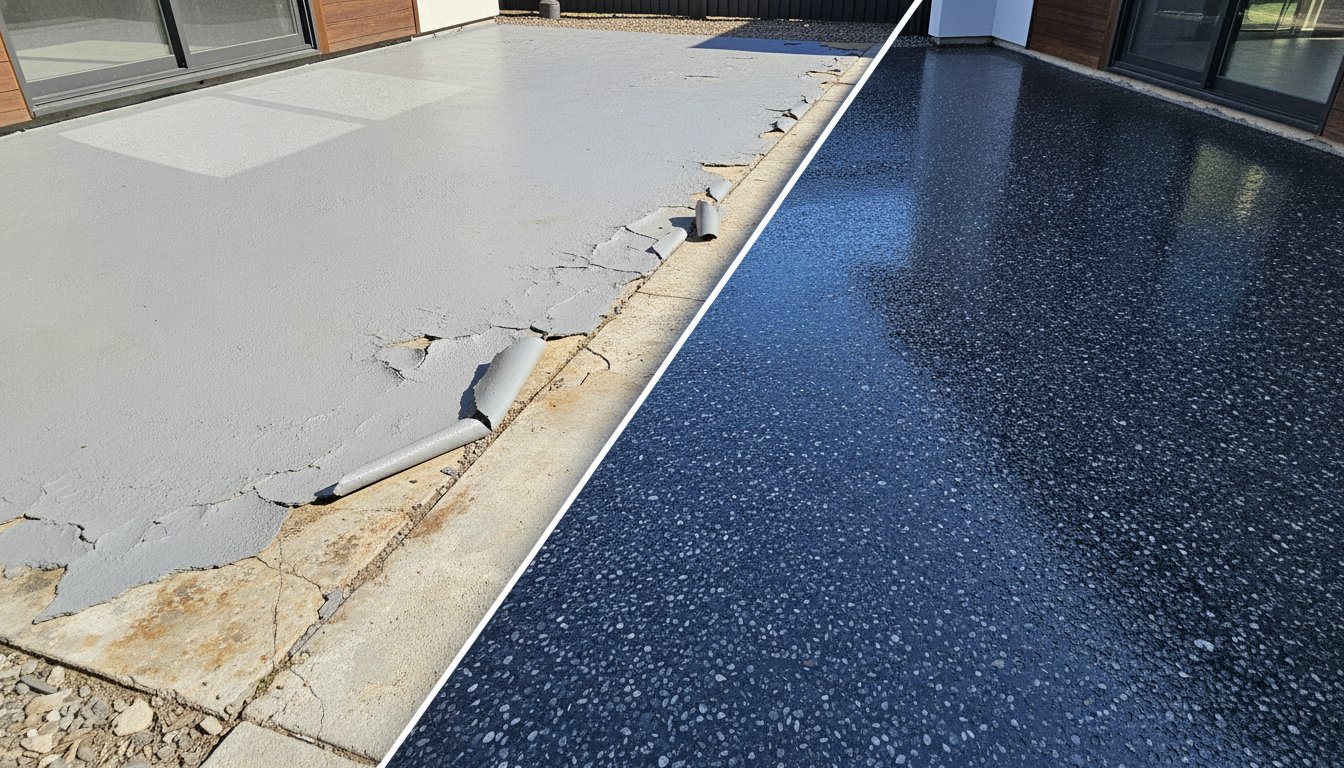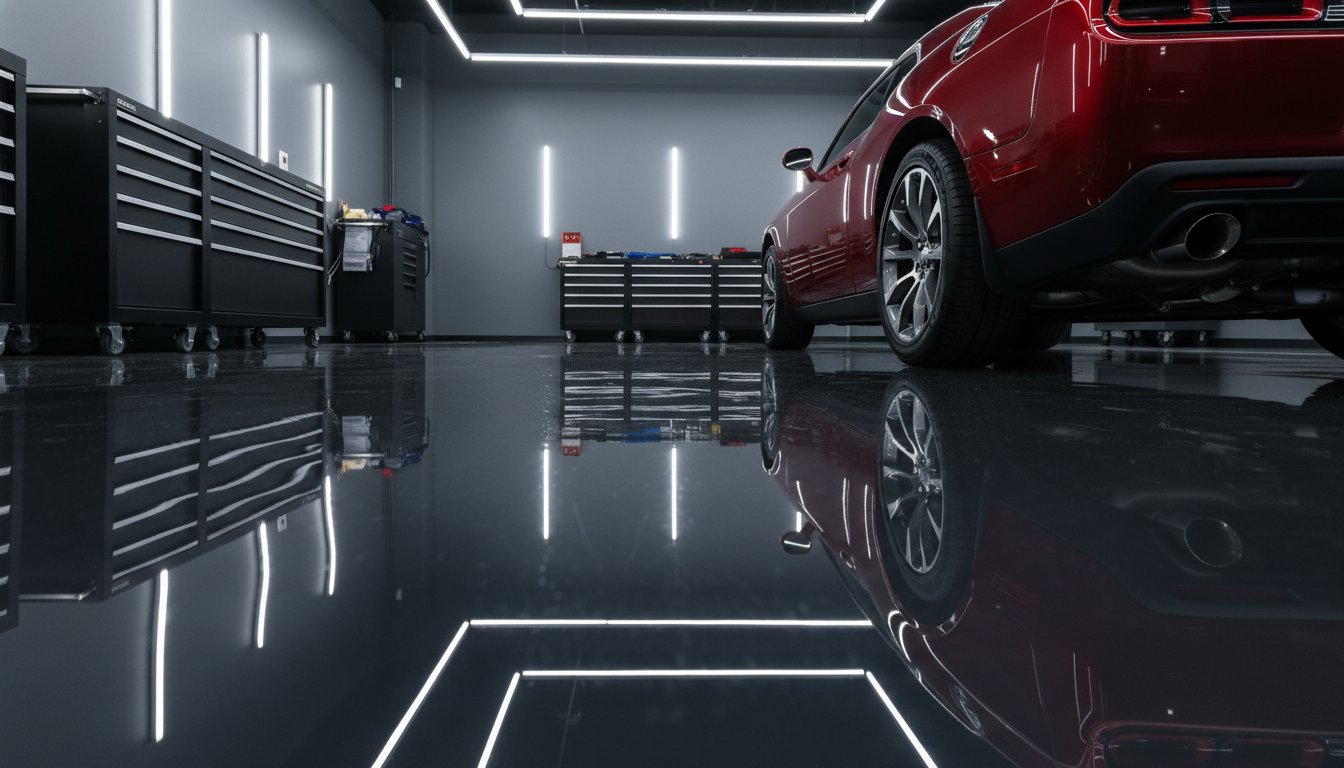
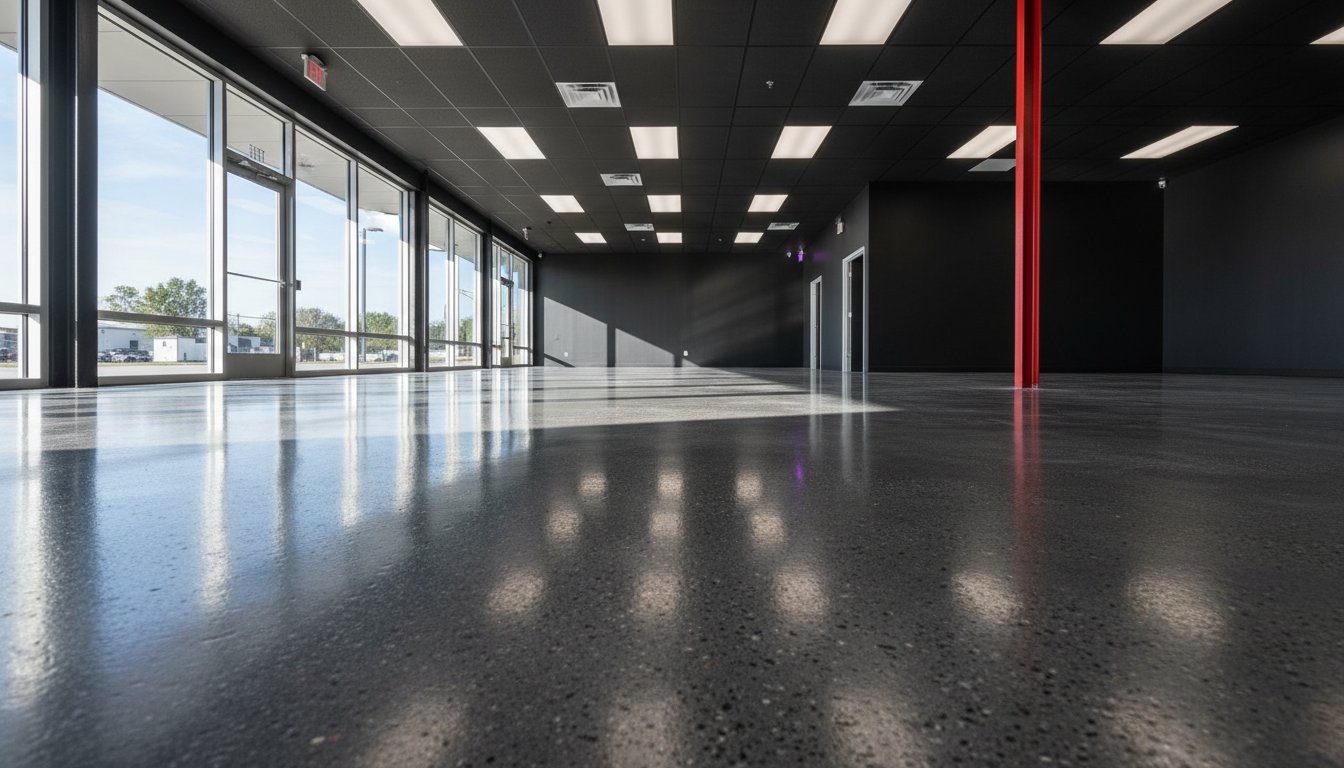
What if the dusty, grey slab in your garage or retail space wasn't an eyesore you had to hide, but the most valuable architectural asset in your building? If you're tired of tracking fine silica dust into your clean spaces, then you understand why raw concrete is a liability rather than a feature. Most property owners in 2024 are frustrated by porous surfaces that soak up oil stains and refuse to stay clean no matter how much they scrub. Because our work is our livelihood, we believe your floor is a canvas, and professional concrete polishing is the only way to turn a gritty, "ugly" slab into a durable masterpiece that reflects your pride of ownership.
In this guide, you'll discover how mechanical grinding transforms industrial floors into high-performance, showroom-quality surfaces that can reduce your maintenance costs by up to 60 percent. We'll clear up the persistent confusion between a temporary sealer and a true mechanical polish so you can avoid costly mistakes. You'll learn exactly how to achieve a slip-resistant, high-gloss finish that turns heads in Tampa and St. Petersburg. This is your roadmap to an architectural transformation that builds real property value through artisan craftsmanship and precision.
Key Takeaways
- Learn how to transform "ugly" raw slabs into showroom-quality masterpieces using industrial diamonds and mechanical refinement.
- Discover why professional concrete polishing is the ultimate solution for "dust-proofing" your space and ending the cycle of constant cleaning.
- Understand the critical role of vapor transmission and why a breathable floor outperforms traditional epoxy in high-moisture environments.
- Avoid the "DIY Trap" by learning why heavy-duty planetary equipment is the only way to prevent "cornrows" and uneven grinding.
- Master the 5-step mechanical process that elevates manual labor into a durable form of craftsmanship designed to turn heads.
What is Concrete Polishing? Turning "Ugly" Slabs into Masterpieces
If you're staring at a dusty, gray slab, you're looking at a hidden asset. Many homeowners in Tampa and St. Petersburg assume an "ugly" floor needs to be covered up with carpet or tile. We disagree. At Illuminated Coatings, we believe every slab has the potential to become a masterpiece. What is polished concrete? It's a rigorous mechanical process where we use industrial diamonds to refine the surface. We don't just slap on a shiny coating. Topical sealers sit on the surface and eventually flake off; true concrete polishing penetrates the material. This process creates a dense, rock-hard surface that can withstand heavy traffic for 20 years or more.
It's also the most eco-friendly flooring choice available. By repurposing 100% of your existing slab, you avoid the waste and carbon footprint of manufacturing new materials. The result is an "Illuminated" effect that reflects light to brighten your space. This often reduces the need for overhead lighting by 15% or more, saving you money on energy bills. We take great pride in this work because it's our livelihood, and we know a durable floor is the foundation of a beautiful home.
The Aesthetic Range: From Matte to High-Gloss
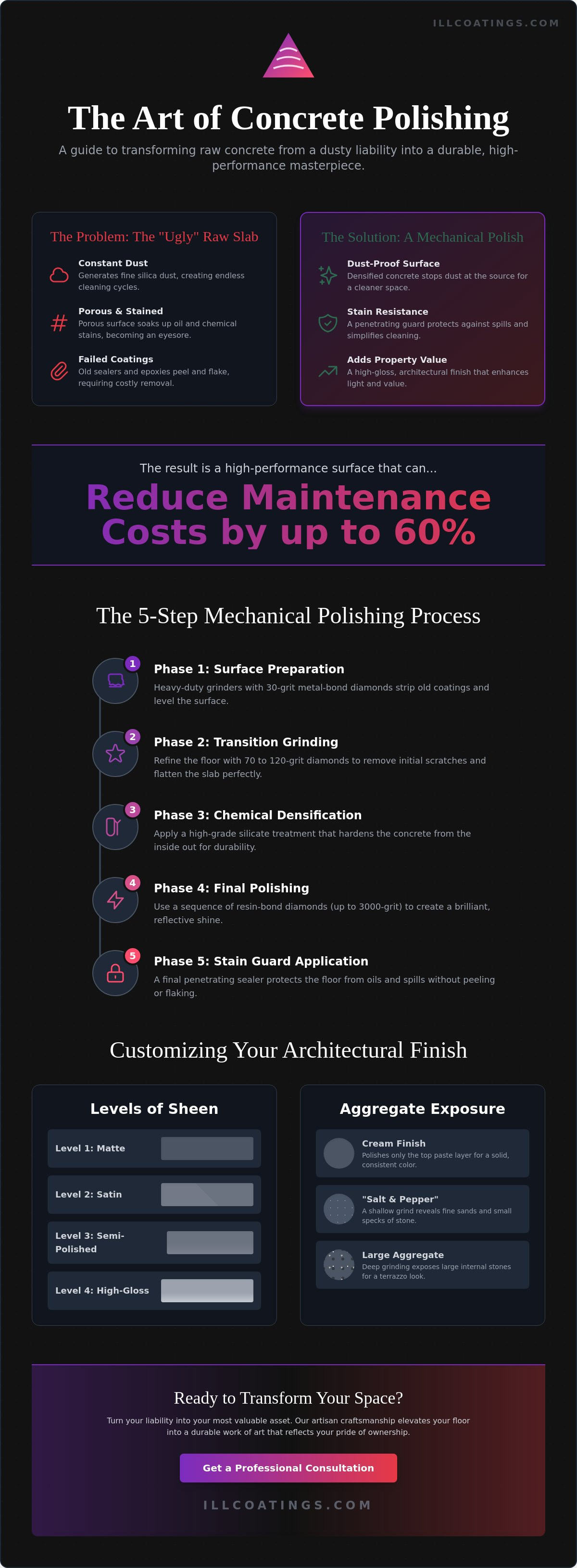
Your floor should match your lifestyle. We offer four distinct levels of sheen to achieve the exact look you want. Level 1 provides a flat, matte finish that hides surface imperfections. Level 2 offers a satin look with a subtle, creamy glow. For those who want to turn heads, Level 3 is semi-polished and clearly reflects objects and people. Level 4 is the ultimate high-gloss finish, achieving Gloss Units (GU) over 70 for a mirror-like shine. We measure light reflectivity using RA (Roughness Average) values to ensure every square foot meets our professional standards. A high-gloss finish is perfect for a modern residential living room, while a satin finish is often better for a high-traffic industrial shop in Spring Hill.
Aggregate Exposure: Customizing the "Stone" Look
The visual texture of your floor depends on how deep we grind into the surface. A "cream finish" only polishes the very top layer, maintaining a consistent, solid color with almost no visible stone. If we grind slightly deeper, we reach the "salt and pepper" stage, revealing fine sands and small specks that add character. For a bold, high-end look, we perform a deep grind to expose "large aggregate." This reveals the internal stones and rocks within the concrete mix, creating a look similar to expensive terrazzo. Aggregate exposure is a permanent design choice that defines the character of your floor for its entire lifespan. Once we've revealed the stones, they become a permanent, beautiful part of your property's architecture.
The 5-Step Mechanical Polishing and Grinding Process
Turning a dull, porous slab into a high-performance architectural feature requires more than just a quick pass with a machine. Our team treats every project as a potential masterpiece. We follow a strict 5-step mechanical protocol to ensure your concrete polishing investment lasts for decades. This isn't just a job for us; it's our livelihood, and we don't cut corners. If you want a floor that stays brilliant under heavy traffic, you must respect the mechanical process.
- Phase 1: Surface Preparation. We use heavy-duty planetary grinders equipped with 30-grit metal-bond diamonds to strip away old coatings, "ugly" adhesives, and surface imperfections.
- Phase 2: Transition Grinding. We refine the floor using 70 to 120-grit diamonds. This step is critical for removing the aggressive scratches left by the initial grind. We adhere to industry best practices to ensure the slab is perfectly flat before the polishing stages begin.
- Phase 3: Chemical Densification. We apply a high-grade silicate treatment that hardens the concrete from the inside out, preparing it for a high-gloss finish.
- Phase 4: Final Polishing. This is where the shine emerges. We use a sequence of resin-bond diamonds, often reaching 3000-grit, to close the surface and create a brilliant reflection.
- Phase 5: Stain Guard Application. The final layer is a penetrating sealer. It protects the floor from oils and acidic spills without the risk of peeling or flaking like traditional paints.
The Role of Concrete Densifiers
Untreated concrete is naturally soft and prone to "dusting" because of its porous structure. We fix this by applying lithium or sodium silicates during the grinding process. These chemicals react with the calcium hydroxide in the cement to create new calcium silicate hydrate (CSH) structures. This reaction fills the microscopic voids, making the surface up to 40% harder than an untreated slab. If you want a floor that is truly dust-proof and durable, densification is the essential "secret sauce" that separates a professional job from a DIY attempt.
Grit Sequences: The Science of the Shine
The clarity of a polished floor depends entirely on the grit sequence. We start at a coarse 30 grit for heavy stock removal and work our way up through a precise progression to a 3000 grit resin bond for a mirror finish. If a contractor skips even one grit level, the result is a cloudy, uneven surface with visible scratches trapped under the shine. We take the time to ensure a uniform scratch pattern across the entire floor. This level of precision is how we transform residential garages into spaces that truly turn heads.
Polished Concrete vs. Epoxy and Vuba Stone: Which is Right for You?
Choosing the right finish for your floor isn't just about picking a color. It's a technical decision based on the health of your slab and your daily environment. If your concrete is structurally solid and you want a floor that lasts a lifetime, concrete polishing is the gold standard. This mechanical process doesn't add a layer to your floor; it transforms the material you already own into a high-performance masterpiece.
The primary technical difference lies in breathability. Concrete is porous and naturally moves moisture. If you seal a high-moisture slab with a non-breathable coating, the hydrostatic pressure can reach 1,200 pounds per square inch, causing the finish to bubble and peel. Because we adhere to professional concrete polishing standards during the grinding process, the floor remains vapor-permeable. This allows your house to "breathe" while maintaining a showroom shine that won't delaminate.
When to Choose Polished Concrete
If you're aiming for a "modern industrial" or "minimalist" residential aesthetic, polishing is your best bet. It's the most durable option for interior spaces with 24/7 foot traffic and minimal chemical exposure. It's also the smartest financial move for large open-concept homes. Since there's no topical product to wear away, you don't have to worry about "traffic patterns" appearing in high-use hallways. If your slab has a moisture vapor emission rate (MVER) exceeding 3.0 lbs per 1,000 sq. ft., polishing is often the only safe choice to prevent future floor failure.
When a Coating (Epoxy or Resin-Bound) is Superior
There are times when even the best concrete polishing can't save an "ugly" floor. If your slab has extensive cracking, deep oil stains, or mismatched pours from a 1995 renovation, polishing will only highlight those flaws. In these cases, a 100% solids epoxy coating or a resin-bound system is the superior solution.
- Garages and Workshops: If you're working with battery acid, motor oil, or harsh degreasers, epoxy wins. It creates a chemical-resistant barrier that keeps toxins from soaking into the concrete.
- Outdoor Patios and Pool Decks: Polished concrete is too slippery for wet outdoor areas. We recommend Vuba Stone, a resin-bound stone system that's 100% UV stable and slip-resistant. It's the king of Florida outdoor living.
- Heavily Damaged Slabs: If the concrete is structurally sound but visually a mess, a flake epoxy system hides the imperfections and turns a "lemon" slab into a durable masterpiece.
Our livelihood depends on your satisfaction. If your slab is solid, we'll polish it to a mirror finish. If it's seen better days, we'll transform it with a high-end coating that will turn heads for years.
Durability and Maintenance: Is Polished Concrete High-Maintenance?
Many property owners worry that a showroom shine requires constant pampering. That's a total myth. If you choose professional concrete polishing, you're actually investing in the most low-maintenance flooring on the market today. We take pride in turning "ugly" slabs into masterpieces that don't demand your entire weekend to keep clean. Our team views every project as our livelihood, so we ensure the result is as tough as it is beautiful.
One of the biggest wins is the total elimination of concrete dust, also known as efflorescence. Raw concrete naturally "dusts" as it wears down, but the concrete polishing process densifies the surface and locks those particles down forever. You won't just see the difference; you'll breathe it too. This makes it a top choice for families in Spring Hill and Tampa who want cleaner air and fewer allergens in their homes.
Safety is another area where these floors excel. Many people assume a high-gloss finish is a slip hazard, but data proves otherwise. The National Floor Safety Institute (NFSI) certifies many polished surfaces as "high traction." When tested against ANSI A137.1 standards, professionally polished floors frequently exceed the 0.42 Dynamic Coefficient of Friction (DCOF) requirement for wet environments. Over a 20-year lifecycle, you'll save significantly. Industry reports from 2021 show that polished concrete costs roughly $0.50 to $1.50 per square foot annually to maintain, while carpet can soar past $3.50 per square foot when factoring in deep cleaning and replacement costs.
The Daily and Weekly Care Routine
Keeping your floor a masterpiece is simple. Use a microfiber dust mop every day to remove fine grit. If you let dirt sit, it acts like sandpaper under foot traffic and dulls the finish over time. When it's time for a wet mop, only use pH-neutral cleaners. Don't ever touch vinegar, bleach, or citrus-based products. These acids eat through the densified surface and ruin the shine. If a spill happens, wipe it up within 15 minutes to prevent etching in the surface.
Long-Term Refurbishment
A floor from Illuminated Coatings is built to last 20 years or more. You won't need to strip or wax it ever. If you notice the luster fading in high-traffic zones after 5 or 10 years, a simple high-speed burnish with a diamond-impregnated pad usually brings it back. If the surface is deeply scratched after a decade of heavy use, a professional re-polishing can restore the original "turn heads" quality without a full tear-out. It's a sustainable, permanent solution for homeowners in St. Petersburg who value quality craftsmanship.
The Professional Difference: Why Your Slab is Our Livelihood
Your floor is more than just a surface; it's a reflection of your property's value. Many homeowners fall into the "DIY Trap" by renting light-duty grinders from local hardware stores. These rental units usually weigh less than 200 pounds and run on standard 110v power. They lack the mass and torque required for true concrete polishing. When you use underpowered equipment, you often end up with "cornrows," which are unsightly ripples and uneven spots that ruin the aesthetic of the slab. We don't use toys. Our team operates 800-pound planetary grinders that utilize three or four spinning heads to create a perfectly flat, mirror-like finish.
Artisan expertise is the bridge between a construction site and a showroom. We use the Mohs scale of mineral hardness to test every slab before a single diamond touches the floor. If your concrete ranks as a 7 (hard), we use a soft-bond diamond to ensure the tool keeps cutting. If it's a 3 (soft), we use a hard-bond diamond to prevent the machine from eating through your floor. Getting this wrong leads to "glazing" or "excessive wear," both of which result in a failed project. At Illuminated Coatings, we treat every garage, warehouse, and living room as a prestige project because our name is attached to every square inch.
Precision Grinding and Edge Work
Quality is won or lost at the wall. A floor can look 90% perfect, but if the edges are dark or rough, the entire job looks unfinished. We spend nearly 35% of our project time on our hands and knees using specialized hand grinders. This manual labor ensures the perimeter and corners match the sheen of the main floor perfectly. We also prioritize your health and property. We use industrial HEPA-filtered vacuums that capture 99.97% of dust particles down to 0.3 microns. You won't find a layer of white dust on your shelves when we're done; you'll only find a floor that shines.
Turning Your Vision into a Masterpiece
Our consultation process is designed to find the exact balance of durability and beauty for your specific space. We'll help you decide between a "Cream Polish" for a modern, consistent look or a "Salt and Pepper" finish that exposes the small aggregates within the slab. You can choose from four distinct sheen levels, ranging from a subtle matte to a 3,000-grit high-gloss reflection. As a family-owned business, we don't just provide a service; we provide a transformation. We care about the "before and after" because your satisfaction is our survival. We don't just finish floors; we create durable masterpieces that turn heads for years to come.
Ready to transform your concrete? Get a quote for professional polishing today
Transform Your Property Into a High-Performance Masterpiece
Your slab shouldn't just be a floor; it's the foundation of your property's aesthetic. Choosing professional concrete polishing provides more than just a temporary shine. It utilizes a rigorous 5-step mechanical grinding process that increases surface density and light reflectivity. According to the Concrete Polishing Council, a properly maintained polished floor can last over 20 years, making it one of the most cost-effective architectural finishes available today. We understand that your home or business is your biggest investment. That's why we bring an artisan-level focus to every project we touch.
Illuminated Coatings is a family-owned and operated business. We don't just provide a service; we stake our livelihood on the quality of our work. We're specialists in high-performance architectural finishes who believe that even the most "ugly" concrete has the potential to become a showroom-quality centerpiece. Our team combines technical expertise with a passion for durable transformations that truly turn heads. It's time to stop looking at a dull slab and start seeing a work of art. Turn your dull concrete into a head-turning masterpiece, contact Illuminated Coatings today.
We look forward to bringing brilliance to your space and proving why our dedication to craftsmanship makes all the difference.
Frequently Asked Questions
Is polished concrete too slippery for homes with pets or children?
Polished concrete isn't more slippery than traditional tile or hardwood and often exceeds safety standards. According to the National Floor Safety Institute, high-gloss concrete must maintain a static coefficient of friction greater than 0.60 to be classified as high traction. If you're a homeowner in Tampa or St. Petersburg, you'll find this surface provides a stable grip for paws and running feet alike. We focus on specific grit levels to ensure your floor is a safe masterpiece for your family.
Can any concrete floor be polished, regardless of age or condition?
Most slabs can undergo concrete polishing if they meet a minimum structural strength of 2,500 PSI. If your floor is 30 years old or shows surface wear, we can likely transform it into a showroom finish. We test the slab using the Mohs hardness scale, looking for a rating of 5 or higher to ensure the material is dense enough to sustain a shine. We don't polish slabs that are crumbling or have severe structural integrity issues, as these require different resurfacing methods.
How much does professional concrete polishing cost compared to tile or epoxy?
Professional concrete polishing is frequently the most cost-effective long-term flooring solution available. Industry data shows that the 20-year lifecycle cost of polished concrete is approximately 60% lower than traditional carpeting or modular tile. You won't deal with the recurring expenses of grout cleaning or the eventual delamination seen with low-quality epoxy. It's a direct investment into your property that turns an ugly slab into a durable, high-value asset.
Does polished concrete make a room feel colder?
Polished concrete doesn't create cold, but it does have high thermal mass. This means the floor absorbs and holds the temperature of the surrounding environment. If your home in Spring Hill gets plenty of natural sunlight through windows, the slab will store that heat and release it slowly. During a 90-degree Florida afternoon, the floor stays refreshingly cool, which can actually help reduce your home's cooling load and improve energy efficiency.
How long does the concrete polishing process take for a standard-sized room?
A standard 1,000 square foot project typically takes our team 3 to 5 business days to complete. This timeline includes the multi-stage grinding process, the application of chemical densifiers, and the final polishing passes. If your floor requires extensive crack repair or custom staining, we'll add 1 or 2 days to the schedule. We work with an efficient rhythm to ensure we protect your livelihood and return your space to you as quickly as possible.
Will polishing hide cracks and patches in my existing concrete?
Polishing won't hide cracks, but our specialized repair process integrates them into the floor's aesthetic. If your slab has cracks wider than 1/16 of an inch, we use color-matched polyurea fillers to seal them before the final concrete polishing steps. This creates a seamless, smooth surface that won't collect dust or debris. We treat every imperfection with the eye of an artisan, ensuring the final result looks like a deliberate, handcrafted work of art.
Can I polish my outdoor patio or driveway?
You shouldn't use a high-gloss polish for outdoor areas because rain can make the surface dangerously slick. Instead, we recommend a honed finish, which stops the mechanical grinding at the 200-grit or 400-grit level. This provides the same transformative beauty as an indoor floor while maintaining the slip resistance needed for Florida's weather. It's the perfect way to turn heads in your neighborhood while ensuring your driveway remains functional and safe.