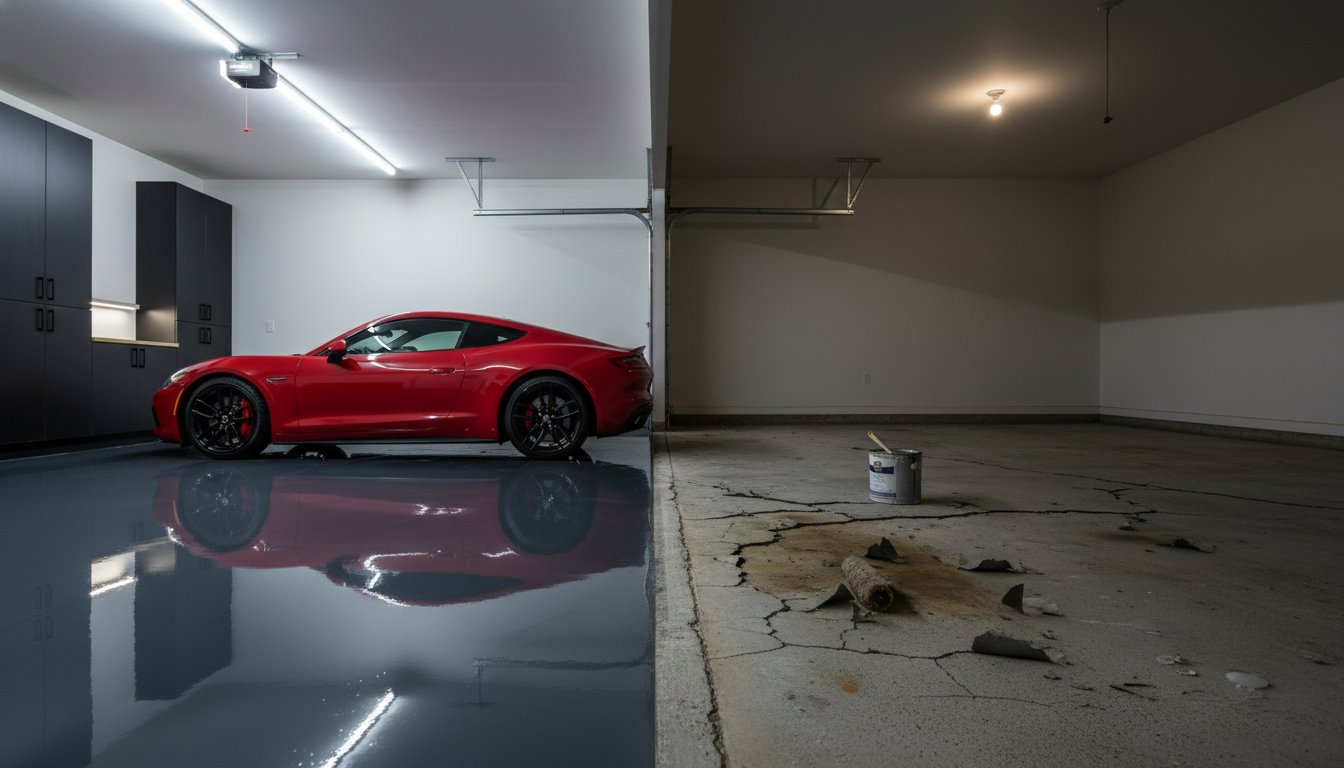
Nearly 90% of DIY epoxy coatings in humid climates fail within the first two years, often bubbling or peeling the very first time you park a warm car in the stall. It's an exhausting cycle to spend your weekend on a project that's destined to flake away. You want a garage that looks like a professional showroom, but it's easy to feel confused by the conflicting claims of retail kits versus industrial-grade systems. Comparing the professional garage floor coating cost vs DIY requires looking past the initial sticker price to see the long-term value of your home.
If you prioritize a permanent transformation over a temporary fix, then you need to understand the structural differences between a thin coat of paint and a fused industrial system. This guide reveals the hidden costs of failed projects and explains why mechanical diamond grinding is the only way to ensure your floor doesn't lift. We'll break down the massive performance gap between water-based retail products and 100% solids polyaspartic coatings. You'll learn how to secure a finish that offers zero maintenance for over ten years while significantly boosting your property's resale value.
Key Takeaways
- Understand why industrial-grade 100% solids coatings provide a structural bond that retail "garage paints" simply cannot match.
- Discover how mechanical diamond grinding prevents the common peeling and bubbling failures associated with standard DIY acid etching kits.
- Evaluate the true professional garage floor coating cost vs DIY by factoring in equipment rentals, labor hours, and the high price of professional removal if a DIY kit fails.
- Learn how advanced polyaspartic systems eliminate issues like hot tire pick-up and UV yellowing to ensure a showroom finish for over a decade.
- Identify how a professional installation acts as a strategic home investment, boosting resale value while removing the burden of floor maintenance.
The Price of a Weekend Project: DIY Kits vs. Professional Systems
If you've ever walked down the paint aisle of a big-box retailer, you've seen the colorful boxes promising a showroom floor in a single afternoon. These kits are marketed as a convenient weekend project, but there is a massive gap in material science that separates "garage paint" from a true industrial system. When homeowners weigh the professional garage floor coating cost vs DIY, they are often comparing two entirely different categories of chemistry. A DIY kit is typically a water-based or solvent-based product designed for ease of application, not for twenty years of heavy traffic.
As specialists, we view floor coating as a form of craftsmanship where the final result is only as good as the molecular bond. If the material can't penetrate the concrete surface, then it's just a cosmetic mask waiting to peel. The emotional stakes are high. You want your garage to feel like a high-end gallery for your vehicles, not a failed experiment that flakes off under a hot tire. True durability starts with 100% solids chemistry, something retail kits simply don't offer.
What Really Comes in a Store-Bought Kit?
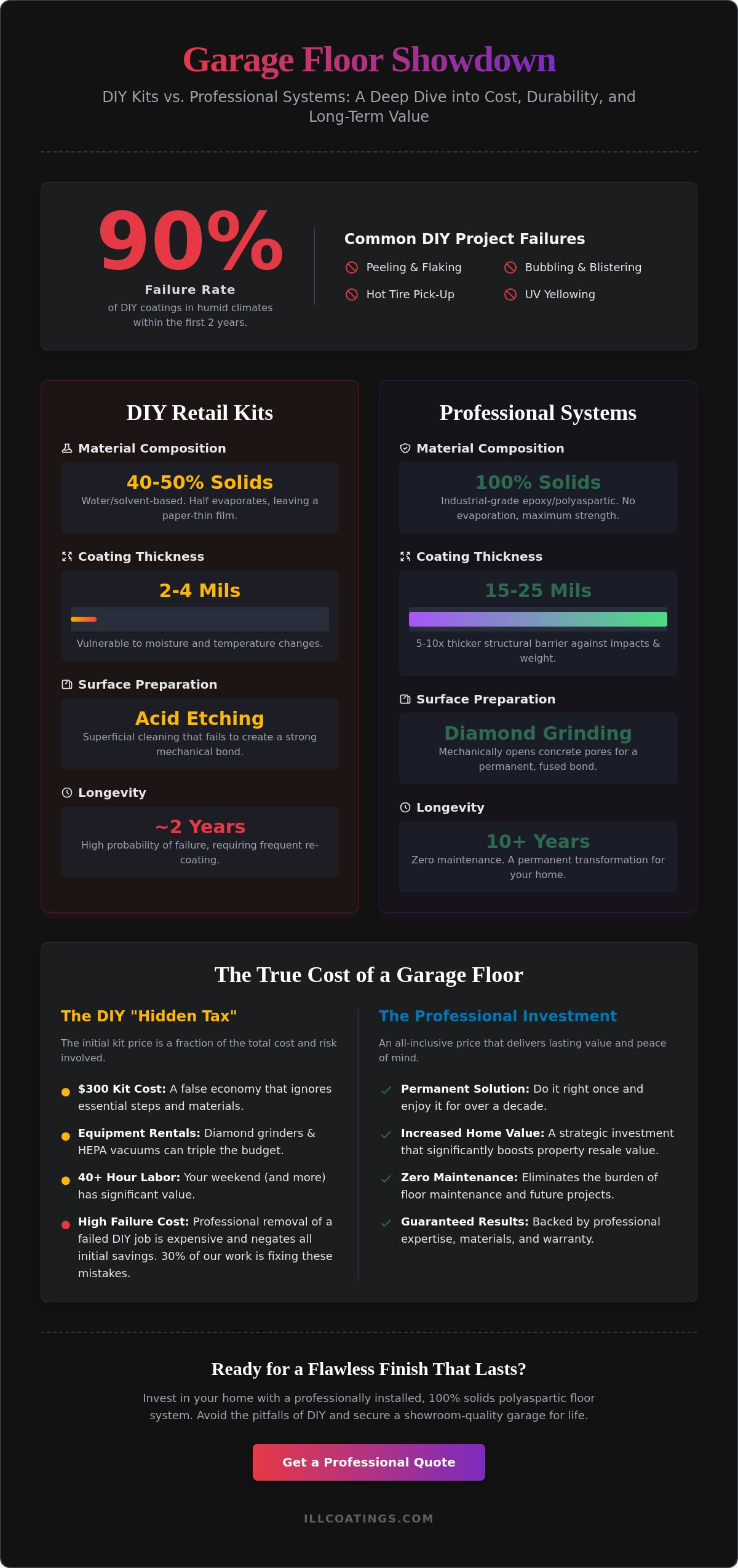
The primary issue with retail kits is the "shrinkage" factor. These products often contain only 40% to 50% solids. This means that as the floor dries, half of the material evaporates into the air, leaving behind a film that is paper-thin. A typical DIY application results in a thickness of only 2 to 4 mils. Additionally, the decorative flakes included in these boxes are often insufficient for a full-coverage finish, leaving you with a sparse, uneven look. These thin coatings fail to penetrate the concrete pores, making them vulnerable to moisture and temperature changes.
The Professional Grade: Industrial-Strength Resilience
Professional-grade systems utilize 100% solids epoxy or advanced polyaspartic resins. Because there are no carriers to evaporate, the thickness you apply is the thickness that remains. This creates a seamless polymer flooring that is 15 to 25 mils thick, providing a structural barrier that is five to ten times more substantial than DIY alternatives. This thickness is what allows the floor to withstand the weight of heavy vehicles without cracking.
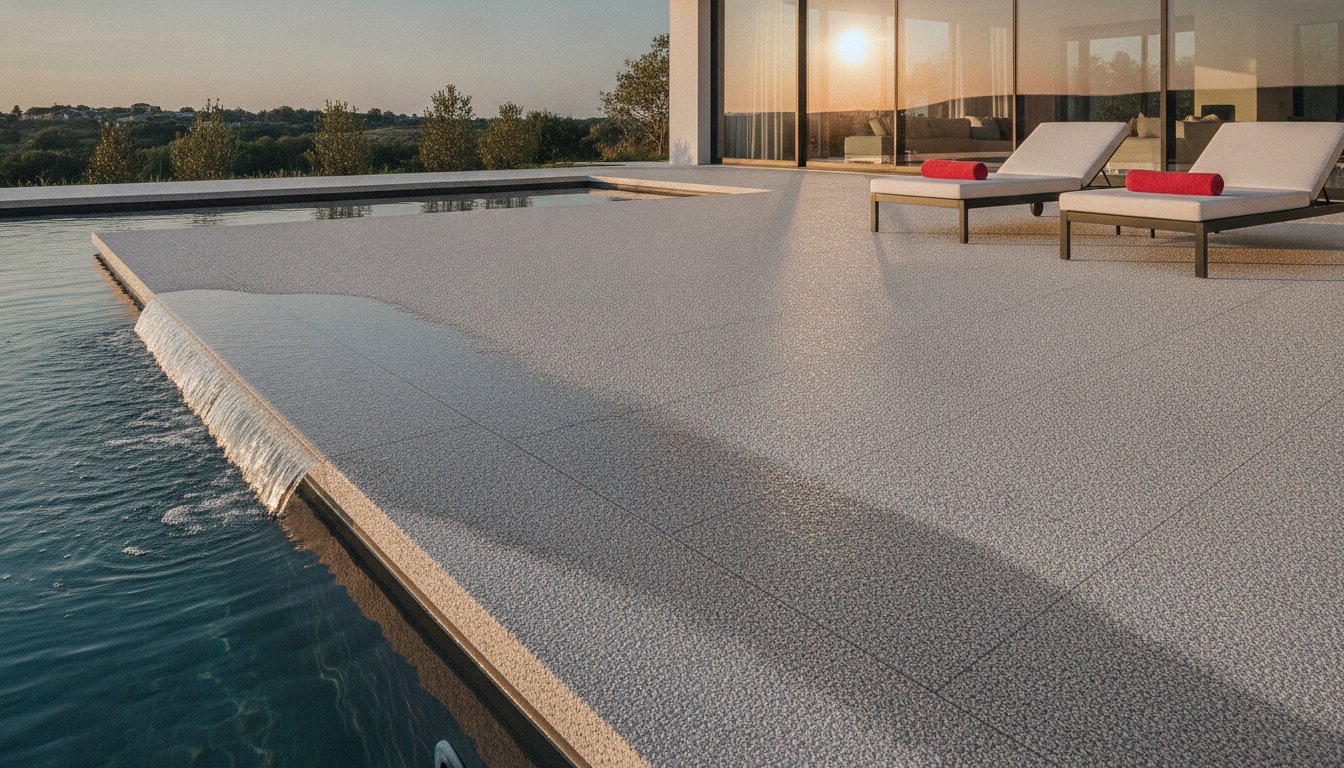
We also incorporate specialized moisture vapor barriers that act as a shield against the hydrostatic pressure common in humid regions. This isn't just about aesthetics; it's about engineering a surface that survives. When you look at the professional garage floor coating cost vs DIY, you're investing in a system that includes resin-bound stone options, metallic finishes, and the industrial-strength resilience required to withstand heavy machinery and chemical spills without flinching.
Breaking Down the Numbers: A Comprehensive Cost Comparison
Evaluating the professional garage floor coating cost vs DIY requires a calculator and a healthy dose of realism. A $300 kit from a home improvement store creates a false sense of economy. It ignores the "Hidden DIY Tax" that accumulates before you even open the first can of resin. When you factor in the equipment rentals and the probability of failure, the initial savings often vanish.
True surface preparation accounts for 30% to 40% of a professional project's total cost. If you're doing it yourself, you can't skip this step. You'll need to rent a walk-behind diamond grinder and purchase the diamond segments. You'll also need an industrial HEPA vacuum system to manage the silica dust. These rentals alone can quickly triple your initial budget before you've even bought the coating materials.
Then there's the time cost. A proper installation isn't a simple weekend project. It's a 40-plus hour commitment when you factor in cleaning, grinding, crack repair, and the multi-stage application process. If your time has any value, the DIY route becomes an expensive hobby. When you calculate the total professional garage floor coating cost vs DIY, the professional option often wins on longevity and saved labor alone.
We see the results of these shortcuts every week. Approximately 30% of our business involves grinding concrete to remove failed DIY coatings. Fixing a flaking floor costs significantly more than doing it right the first time because you have to pay for the labor and tooling required to strip the old material. It is a high-stakes gamble with your home's foundation.
The DIY Expense Checklist
- Diamond grinder rental and sacrificial diamond tooling for proper profiling.
- Industrial HEPA vacuum and dust containment shrouds to protect your home's air quality.
- Personal protective equipment including respirators, chemical-resistant gloves, and eye protection.
- Professional-grade rollers, squeegees, and spiked shoes for a level application.
The Professional Investment Framework
When you hire a specialist, you're paying for more than just labor; you're investing in a 10 to 20 year lifecycle. Labor typically accounts for 50% to 60% of the total project cost in regions with high humidity. This pays for expert technicians who understand moisture vapor emission rates and have access to industrial-strength resins that aren't sold to the general public. You're buying the security of a long-standing business and a floor that won't require a redo in three years.
Beyond the Surface: Why Professional Preparation Outperforms DIY Etching
If the preparation is skipped, then the coating will inevitably peel. This is the hard truth that retail kit manufacturers rarely emphasize. Most homeowners analyzing professional garage floor coating cost vs DIY focus on the application of the resin, yet the secret to a lifetime floor lies in the hours spent before the first drop of epoxy touches the concrete. While DIY kits rely on a quick chemical wash known as acid etching, professionals utilize industrial-grade mechanical grinding to ensure a permanent fusion.
Acid etching is often a cosmetic shortcut. It involves pouring a mild acid solution over the floor to clean the surface, but it rarely penetrates deep enough to create a lasting bond. If the concrete has old sealers, oil stains, or a weak top layer known as laitance, acid simply cannot remove them. This leaves the coating sitting on top of the concrete rather than becoming part of it. When you weigh the professional garage floor coating cost vs DIY, you're paying for the specialized machinery that transforms your garage floor into a porous, receptive surface ready for industrial-grade resins.
Mechanical Grinding vs. Chemical Etching
We use diamond tooling to achieve a specific Concrete Surface Profile (CSP). In the world of professional coatings, a CSP 2 or 3 is the gold standard. This profile creates a texture similar to 60-grit sandpaper, which allows the resin to anchor into the slab. Our dust-free grinding technology captures nearly all silica dust at the source, keeping your home clean while we remove years of contaminants and old sealers that a DIY acid wash would simply ignore. This mechanical process is the only way to guarantee the coating won't lift under the pressure of hot tires.
The Bonding Phase: Chemical vs. Mechanical
A professional installation relies on a mechanical bond. We use high-solids resins that are engineered to wick deep into the open pores of the concrete. Before we begin, we conduct moisture vapor transmission tests to ensure the slab is dry enough for the coating to survive. If moisture levels are too high, we apply a specialized moisture-mitigating primer to prevent future bubbling. This level of technical scrutiny is why professional coatings don't just sit on the surface; they become a structural component of the floor itself. We also debunk the 24-hour cure myth. While some kits promise you can drive on the floor the next day, rushing the chemical cross-linking process is a recipe for early failure. We prioritize a controlled, thorough cure that ensures maximum hardness and chemical resistance.
The True Lifecycle Cost: Maintenance, Longevity, and Resale Value
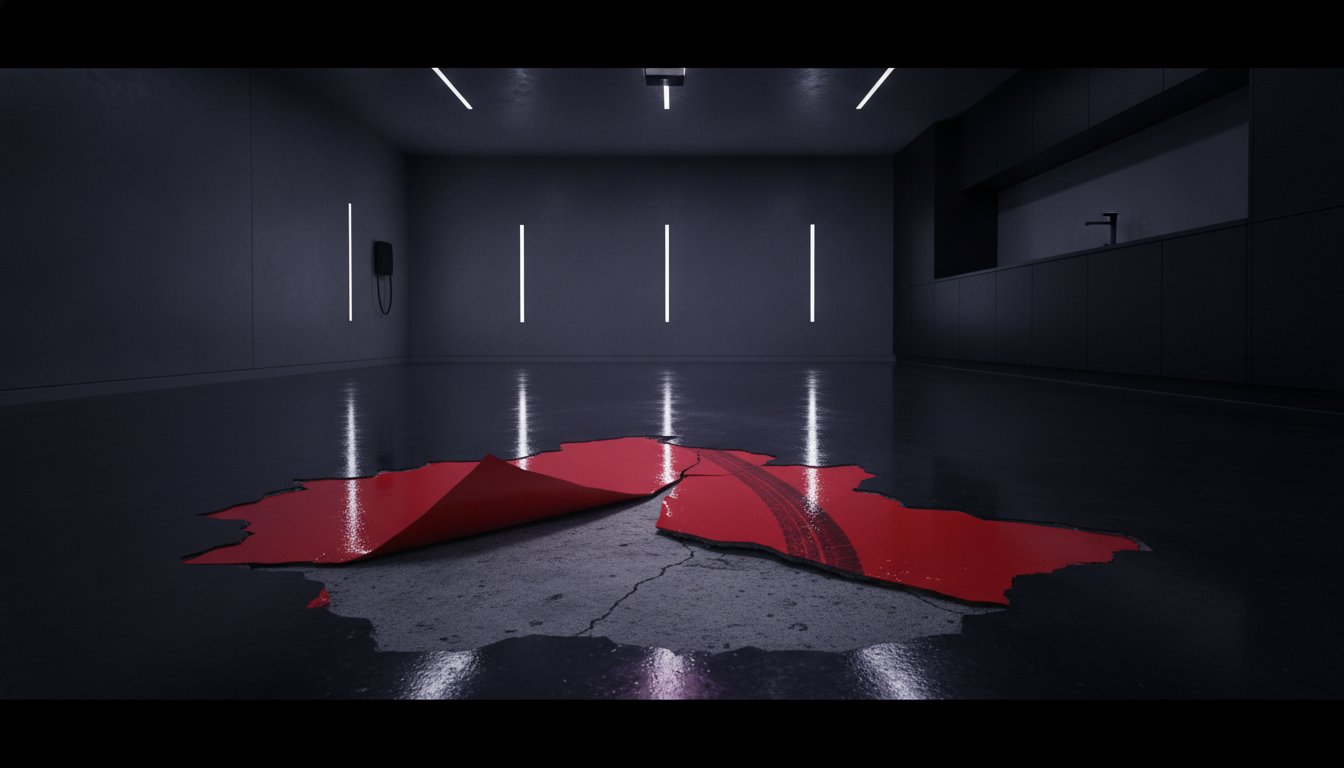
Hot tire pick-up is the silent killer of the weekend warrior project. It occurs when your tires, heated from the road, soften a low-quality coating and literally pull it off the concrete as they cool. This is the primary failure mode for water-based retail kits. If you choose a retail product, then you're accepting a two to five year expiration date. When calculating the professional garage floor coating cost vs DIY, you must account for the fact that professional polyaspartic systems are chemically engineered to resist this thermal bonding, offering a lifespan of 10 to 20 years.
UV stability is another critical factor that separates a gallery-quality finish from a yellowing eyesore. Standard DIY epoxies are notorious for ambering when exposed to sunlight through an open garage door. Professional-grade polyaspartic topcoats remain crystal clear for decades. This durability transforms your garage from a cluttered storage area into a legitimate selling feature. In homes valued over $350,000, a professional floor can see a resale value recovery of 50% to 80%. Conversely, a flaking DIY floor often becomes a "buyer's repair" item that can actually hurt your home's appeal during a showing.
Durability Benchmarks
- Chemical Resistance: Industrial systems withstand battery acid, road salt, and oil spills without staining.
- Impact Protection: High-solids coatings absorb the shock of dropped tools that would shatter a thin DIY film.
- Vuba Stone Performance: For those seeking an alternative to flakes, resin-bound stone offers a unique aesthetic with superior drainage and slip resistance.
The Financial Impact of a Professional Warranty
What happens when a DIY floor fails? The financial hit is double. You've already spent the money on the kit and the time on the labor. Now, you must pay for professional removal. Stripping a failed coating can cost between $400 and $1,200 for a standard two-car garage. This "redo tax" is why a professional installation is the smarter investment from day one. Our systems come with the accountability of a locally-rooted business structure. We don't just provide a service; we provide a transferable guarantee that adds tangible value to your property. Maintenance becomes effortless. A simple mop with mild soap keeps the industrial-grade surface shining, whereas porous DIY floors often trap dirt and require aggressive scrubbing just to look decent.
Elevating Your Space: The Illuminated Coatings Professional Advantage
Transforming a dull, oil-stained slab into a residential masterpiece requires more than just a bucket of resin. It demands an uncompromising focus on the details that general contractors often overlook. At Illuminated Coatings, we don't dilute our expertise by offering unrelated construction services. We are specialists. Our dedication to the craft is personal; the quality of our work is tied to our professional survival. When you evaluate the professional garage floor coating cost vs DIY, you aren't just buying material. You're investing in a specialist mindset that views your garage as a gallery. We are here to Illuminated Coatings your dull concrete into a brilliant point of pride.
Our process starts with precision grinding concrete to open the pores of the slab. This isn't a quick sweep with a broom. It's a mechanical transformation. We then apply high-solids industrial coatings that fuse with the substrate. This creates a surface that doesn't just sit on top but becomes part of the foundation. If you want a floor that stands as a point of pride, then you need a team that understands the specific chemistry required for long-term brilliance. We bridge the gap between industrial strength and artistic excellence.
The Artisan Approach to Industrial Durability
We believe manual labor is a form of craftsmanship. This is why we utilize premium materials like Vuba stone and industrial-grade epoxy that retail stores simply don't carry. Homeowners across the region trust our precision because they know we treat every square foot with artisan care. It's a blue-collar work ethic fueled by a refined eye for aesthetics. Every project we touch is a testimonial of our quality and personal commitment. We don't just finish a floor; we elevate your entire home environment.
Your Path to a Showroom Floor
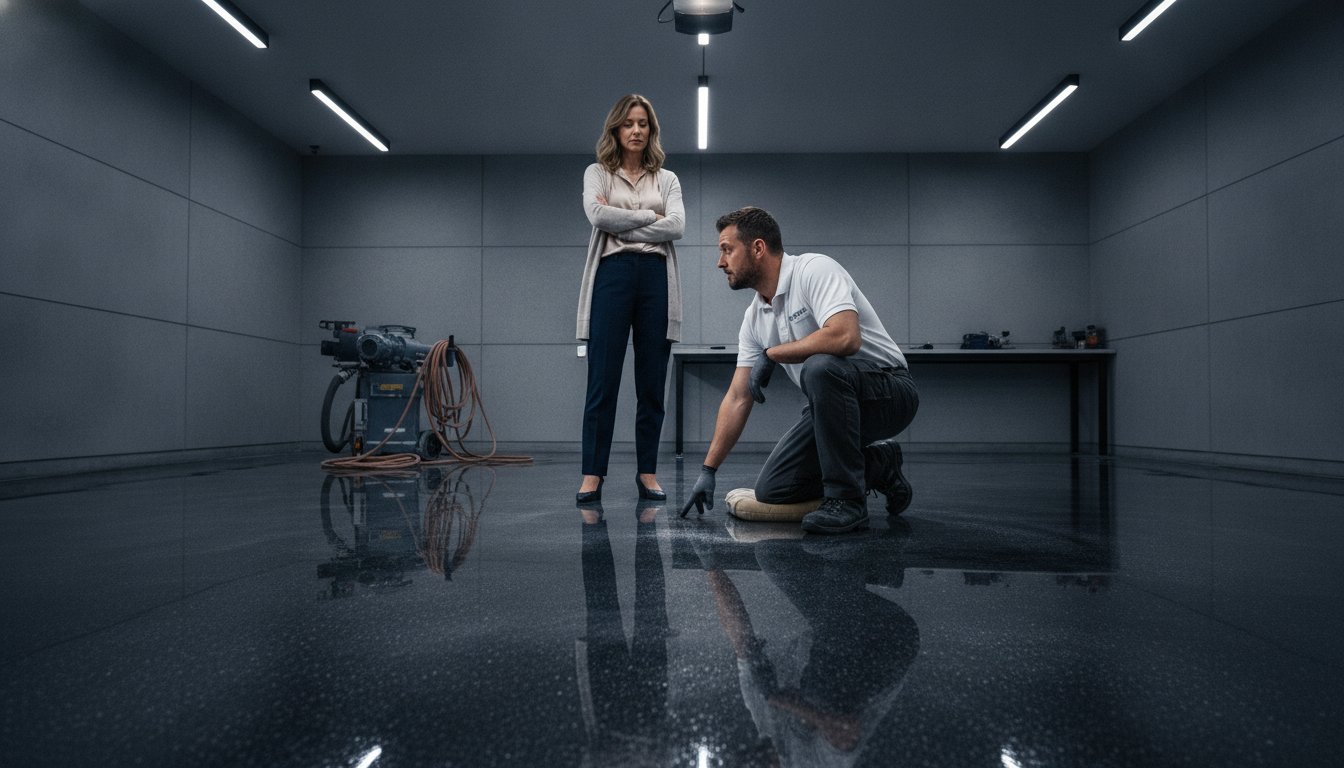
The journey to a showroom-quality finish begins with a detailed consultation. We identify the specific needs of your floor, from moisture vapor emission rates to existing structural damage. During the installation window, our expert technicians work with a singular, unwavering priority: your floor's transformation. We move rapidly and efficiently to minimize disruption, delivering a result that looks like a high-end gallery. Don't settle for a temporary fix that will flake away in two years. Make the smartest investment for your home today. Get your professional garage coating quote from Illuminated Coatings today!
Secure Your Home’s Foundation with a Gallery-Quality Finish
Choosing to evaluate the professional garage floor coating cost vs DIY is the first step toward a permanent home upgrade. A showroom-quality floor isn't created by a weekend kit; it's forged through industrial diamond grinding and high-solids chemistry. If you prioritize a surface that resists hot tire pick-up and stays clear for decades, then an industrial system is the only logical choice. You're moving beyond a temporary cosmetic mask and investing in a structural bond that fuses with your concrete slab.
At Illuminated Coatings, we've been family-owned and operated since 2021, bringing a specialist mindset to every project. We focus exclusively on high-performance coatings like Vuba stone and industrial epoxy to ensure your space becomes a genuine point of pride. Our team treats manual labor as a refined craft, delivering the durability your vehicles require and the aesthetics your home deserves. Don't settle for a floor that flakes away under pressure. It's time to bring brilliance to your property with a finish that stands the test of time.
Request Your Free Professional Floor Transformation Quote
Frequently Asked Questions
Is it cheaper to do garage epoxy yourself?
While a store-bought kit costs less at the register, it's rarely cheaper in the long run. Between renting industrial grinders and the high probability of a redo, the professional garage floor coating cost vs DIY gap narrows quickly. Nearly 70% of DIY coatings fail within twenty-four months. When you factor in the labor and the eventual cost of professional removal, the initial savings are often completely erased by the need for a total floor restoration.
How much does a professional garage floor coating typically cost?
National averages for professional installation range from $3 to $12 per square foot depending on the system complexity. A standard two-car garage typically falls between $1,500 and $5,000 according to 2026 market data. These figures include industrial surface preparation and premium materials. While DIY kits are significantly cheaper upfront, they lack the structural thickness and chemical bonding required to survive a decade of heavy use or humid climate conditions.
Why do DIY garage floor kits often peel?
DIY kits usually peel because they rely on acid etching rather than mechanical grinding. Acid etching fails to open the concrete pores enough for the resin to anchor, causing the coating to sit on the surface. When you park a car with hot tires, the heat softens the thin 2-4 mil coating, pulling it right off the slab. Professional systems avoid this by using diamond grinding to create a deep, permanent mechanical bond.
What is the difference between garage floor paint and professional epoxy?
Garage floor paint is a thin, water-based product that dries through evaporation, leaving a fragile film behind. Professional epoxy is a 100% solids industrial resin that undergoes a chemical reaction to harden. This results in a finish that is five to ten times thicker than paint. While paint is a temporary cosmetic fix, professional epoxy is a structural upgrade designed to withstand chemical spills, heavy impacts, and extreme temperatures.
Can I apply a professional-grade coating over a failed DIY kit?
You cannot apply a new coating directly over a failed DIY kit without total removal. The new resin will only be as strong as the failing layer beneath it. To ensure a permanent bond, we must use mechanical grinding to strip the old material and reach the raw concrete. Professional removal of a failed coating typically costs between $1 and $4 per square foot, which is why doing it right the first time is essential.
How long does a professional garage floor coating last compared to DIY?
A professional industrial-grade system typically lasts between 10 and 20 years with minimal maintenance. In contrast, most DIY coatings begin to show signs of wear, staining, or peeling within 2 to 5 years. This longevity difference is a major factor when weighing the professional garage floor coating cost vs DIY. Investing in a specialist installation means you won't have to spend your weekends stripping and reapplying a failing floor every few years.
Is professional garage floor coating worth the investment for home resale?
Professional coatings are a high-value selling feature that can recover 50% to 80% of their cost in homes valued over $350,000. Potential buyers view a professional floor as a finished, maintenance-free asset. A DIY floor, however, is often perceived as a future repair project if it shows any signs of flaking. A showroom-quality finish elevates the entire property and makes your garage a point of pride during a home showing.
What is the '24-hour cure' myth in garage coatings?
The '24-hour cure' myth suggests you can drive on a new floor the very next day. While some DIY kits and fast-curing polyaspartics offer quick return-to-service times, standard epoxy requires several days to reach full chemical hardness. Rushing this process can lead to permanent tire marks or delamination. We prioritize a controlled curing schedule to ensure the resin reaches its maximum industrial strength before it ever sees a vehicle's weight.