What if the lowest quote sitting on your desk is actually a blueprint for a mid-project disaster? It's a common trap in the world of floor restoration. You likely expect a straightforward price for a smooth surface, but the hidden costs of concrete grinding often lurk in the technical details that less experienced crews ignore. If you prioritize a cheap upfront price over proper surface prep, then you're likely inviting dust contamination or premature coating failure into your space.
We believe that every slab tells a story, and our job is to ensure yours has a masterpiece ending. This article reveals the logistical "gotchas" and safety requirements, such as the current OSHA-mandated silica dust controls, that separate a professional transformation from a messy headache. You'll gain the confidence to select a contractor who treats your property with the dedication of a local artisan. We're giving you the tools to secure a transparent quote and a floor that delivers industrial strength alongside artistic excellence for decades to come.
Key Takeaways
- Learn why the lowest bid often masks the true hidden costs of concrete grinding through bait-and-switch pricing on essential consumables.
- If your concrete is unexpectedly soft, then your budget may increase due to faster tool wear. Learn how the Mohs Hardness Scale identifies these invisible price factors.
- Recognize that OSHA-compliant silica dust extraction is a non-negotiable safety requirement that protects your environment and prevents legal liabilities.
- Discover how professional grinding acts as a diagnostic tool to reveal and repair structural skeletons like old tile patterns before they ruin your finish.
- Secure a gallery-quality result by treating surface preparation as a necessary insurance policy for your final garage floor epoxy or polished surface.
Beyond the Quote: Why the Lowest Bid Often Hides the Highest Costs
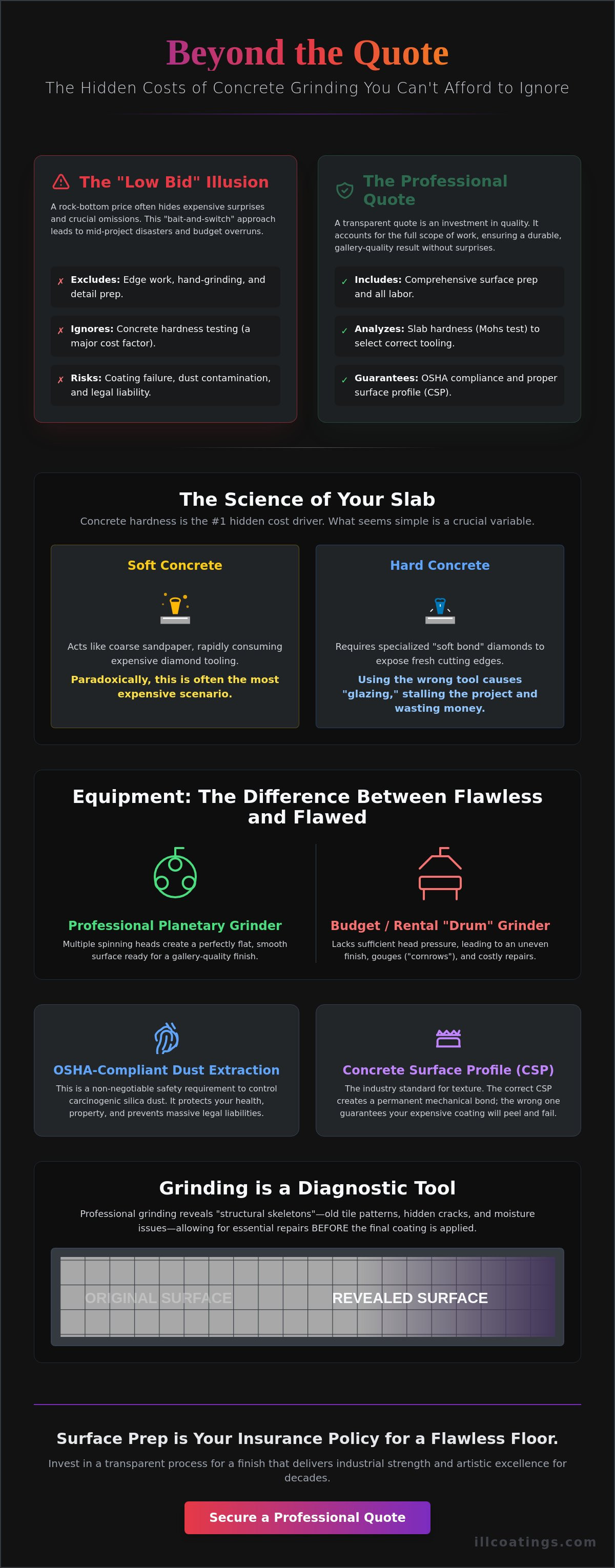
Concrete grinding is not a simple "clean-up" or a quick sweep with a machine. It's a precision mechanical refinement process that creates the literal foundation for your property's transformation. If a contractor views this as a secondary task, then the hidden costs of concrete grinding will inevitably surface through peeling coatings or uneven surfaces. Many low-ball bids rely on a "bait-and-switch" tactic. They offer a rock-bottom price to get through the door, only to tack on massive surcharges for diamond tooling or "unexpected" concrete hardness once the work begins. A true blue-collar artisan knows that the quality of the grind is directly tied to professional survival; if the prep is wrong, the entire project is a failure.
The Illusion of the "All-In" Price
Flat "per square foot" pricing is often a red flag. Without a physical site visit, a contractor cannot see the obstacles that drive up labor. Most budget quotes conveniently exclude edge work, hand-grinding in tight corners, or the removal of deep, ancient oil stains. These tasks are labor-intensive and require specialized small-scale equipment. A professional quote should always account for the required Concrete Surface Profile (CSP). A Concrete Surface Profile (CSP) serves as the industry standard for determining the specific roughness required to achieve a permanent mechanical bond between the slab and its new finish. If this profile isn't achieved, even the most expensive garage floor epoxy will eventually flake off, costing you thousands in repairs.
The Cost of Inexperience and Improper Equipment
The difference between a gallery-quality finish and a ruined slab often comes down to the machine. Lightweight rental units or "drum" grinders lack the head pressure needed for a level finish. These inferior tools can easily gouge your floors, creating "cornrows" that require expensive self-leveling underlayments to fix. Professional-grade planetary grinders use multiple spinning heads to ensure a flat, smooth surface. Using the wrong Concrete grinder can also lead to "glazing." This happens when diamond tooling gets clogged or overheated on hard concrete, rendering the tools useless and stalling your project. We prioritize the right equipment from the start because we believe your floor should be a point of pride, not a source of mid-project invoices. Understanding these variables is the first step in avoiding the hidden costs of concrete grinding that catch so many homeowners off guard.
The Science of Surface Prep: How Hardness and PSI Drive Your Budget
Your concrete floor may look like a solid, uniform slab; however, beneath the surface lies a chemical profile that dictates every dollar of your project. The most significant hidden costs of concrete grinding often stem from the "invisible" hardness of the concrete itself. We don't just start the machines and hope for the best. A professional artisan approaches a slab like a sculptor, first identifying the material's resistance to ensure the final finish is a point of pride for the owner. If a contractor fails to test your slab's PSI and hardness, then they're essentially guessing with your budget.
The Mohs Scale and Diamond Tooling Consumption
Before striking a single spark, a qualified specialist uses a Mohs Hardness Test kit to scratch the surface. This determines where your floor sits on a scale of one to ten. It sounds counterintuitive, but "soft" concrete is often significantly more expensive to grind than industrial-strength, high-PSI slabs. Soft concrete acts like sandpaper, eating through expensive diamond tooling at an alarming rate. To combat this, we must use "hard bond" diamonds designed to resist wear. Conversely, hard concrete requires "soft bond" diamonds that shed their metal matrix quickly to expose fresh cutting edges. If the contractor uses the wrong bond, they'll either "glaze" the diamonds or melt through them in minutes. This technical mismatch is a primary driver of the hidden costs of concrete grinding, as inexperienced crews will pass these tool-replacement fees directly to you.
Aggregate Exposure Levels and Aesthetic Costs
The depth of the grind determines the "look" of your floor, but it also dictates the labor hours and material waste. We categorize aggregate exposure into three distinct levels:
- Cream Finish: A light, superficial grind that preserves the smooth, "buttery" look of the original pour.
- Salt and Pepper: A medium grind that reveals the fine sands and small pebbles just below the surface.
- Large Aggregate: A deep, aggressive grind that exposes the large structural stones within the mix.
Moving from a cream finish to a large aggregate exposure can increase diamond consumption and labor time by 20% to 40%. This deeper refinement also generates a massive volume of dust. Managing this waste requires strict adherence to OSHA's respirable crystalline silica standard to keep your property safe. Whether you're preparing for a high-end concrete polishing project or a heavy-duty coating, the aggregate level you choose must align with your aesthetic goals and your budget. Selecting the right exposure level early ensures you aren't surprised by the logistical costs of heavy material removal.
Environmental and Logistical Overhead: The Price of Dust and Debris
Transformation isn't just about the finish; it's about the discipline required to keep your property safe and clean during the process. If a contractor treats dust as a minor nuisance rather than a hazardous byproduct, then the hidden costs of concrete grinding will haunt your air ducts and carpets for years. We view site protection as a form of craftsmanship. A professional setup involves more than just a machine; it requires industrial air scrubbers, precision masking, and a commitment to maintaining a gallery-quality environment from start to finish. Ignoring these logistical realities is how a "budget" project turns into a long-term liability.
Dust Mitigation and Health Liability
A standard shop vac is a recipe for a respiratory and cleaning disaster. These consumer-grade units lack the filtration to trap microscopic particles, effectively turning a vacuum into a dust-spreading cannon. Professional crews utilize industrial HEPA-filtered vacuums that capture 99.97% of particles. Concrete dust contains crystalline silica, a known carcinogen that requires strict containment to meet safety standards. According to data from the Grit Insurance Group, approximately 2.3 million U.S. workers are exposed to silica on the job. We prioritize high-end extraction because your health and our professional survival depend on it. If you see a contractor cutting corners on dust control, you aren't just saving money; you're inviting a toxic environment into your home or workspace.
Power Access and Generator Costs
Heavy-duty planetary grinders are hungry for power. These machines cannot run on standard 110V residential outlets without tripping breakers or damaging the motors. Most professional-grade equipment requires 220V or even 480V three-phase power to achieve the torque necessary for a level grind. If your site lacks this specialized service, a "generator rental" fee often appears as a surprise line item on the final invoice. Furthermore, the distance between the power source and the workspace matters. Voltage drop over long extension cords can burn out expensive equipment, leading to project delays. We assess your power capacity during the initial consultation to ensure our grinding concrete services proceed without technical hitches or hidden surcharges.
Debris Removal and Site Logistics
The volume of material removed during a deep grind is staggering. When we grind a slab to expose large aggregate, we're essentially turning the top layer of your floor into hundreds of pounds of fine powder or heavy slurry. Research shows that construction debris removal averages around $800 per project. This cost covers the weight, volume, and specialized disposal fees required for concrete waste. A low-ball quote often leaves the "cleanup" to the homeowner, forcing you to deal with heavy bags and disposal logistics. We include comprehensive debris management in our process because a job isn't finished until your space is pristine and ready for its new life.
Remedial Reality: When Grinding Reveals Structural Skeletons
Grinding is often the first time a property owner sees the raw truth of their slab. We view the initial passes of our machines as a diagnostic tool rather than just a cosmetic step. Once we peel back layers of old paint, carpet glue, or linoleum, the "structural skeletons" of the building begin to emerge. If your slab has been hidden for decades, then the hidden costs of concrete grinding often involve repairing what those previous floor coverings were designed to conceal. We approach these discoveries with a specialist mindset, ensuring that every repair adds to the industrial strength and artistic excellence of the final result.
Adhesive and Coating Removal (The "Mastic" Factor)
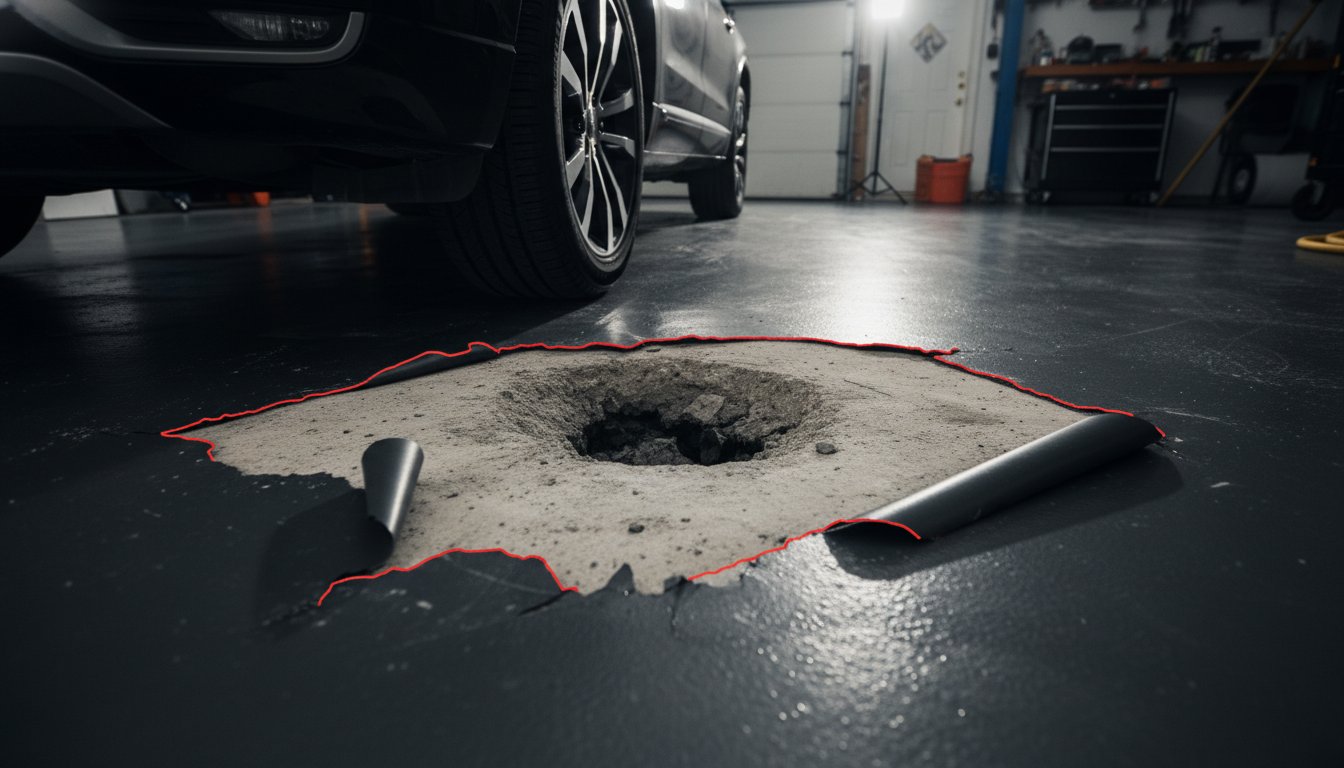
Removing old black mastic or thick, failing epoxy is significantly more labor-intensive than grinding raw concrete. Standard diamond segments will often gum up or "smear" when they hit these rubbery adhesives, leading to project delays and ruined tooling. To handle this, we must switch to specialized PCD (Polycrystalline Diamond) tooling. These aggressive "scrapers" are designed to sliced through thick coatings without generating excessive heat, but they come with a higher operational price tag. Additionally, we remain vigilant regarding older adhesives that may contain asbestos. If a slab requires abatement before we can safely proceed with grinding concrete, it's a critical safety step that protects both our crew and your family.
Crack Repair and Joint Stabilization
Grinding also reveals "ghosting," which are old tile patterns or wood grain etched into the concrete by years of chemical leaching. Removing these patterns requires a deeper grind, often moving into the aggregate exposure levels discussed earlier. Beyond aesthetics, we frequently find cracks that demand immediate attention. While cosmetic hairline cracks are common, structural "moving" cracks require us to "chase" the fracture with a hand-grinder and inject high-modulus epoxy to prevent future shifting. Research indicates that basic surface repairs for sealing cracks average approximately $2 per square foot, but ignoring them is a recipe for failure. Proper joint stabilization is especially vital if you plan on installing a high-end Vuba stone system, as any movement in the slab can telegraph through the new finish.
Finally, we must account for moisture vapor transmission. A slab that looks dry on top can still be "breathing" moisture from the soil below, which is the primary cause of coating delamination. We use professional-grade sensors to check these levels before we commit to a final finish. If we detect high moisture, we'll recommend a specialized vapor barrier. It's an extra step, but it's the only way to ensure your floor lasts for decades. If you want a transparent assessment of your slab's health, contact our specialist team today to schedule a professional site consultation.
Strategic Budgeting: Ensuring ROI with Professional Grinding
Professional grinding is far more than a preparation step; it is the ultimate insurance policy for your property. If you view the mechanical refinement of your slab as an optional expense, then you're likely setting the stage for a catastrophic floor failure. We approach every project with the mindset of a blue-collar artisan, where industrial strength meets gallery-quality aesthetics. By identifying the hidden costs of concrete grinding during the budgeting phase, you secure a floor that serves as a point of pride for decades rather than a source of regret.
Grinding as the Foundation for High-Performance Coatings
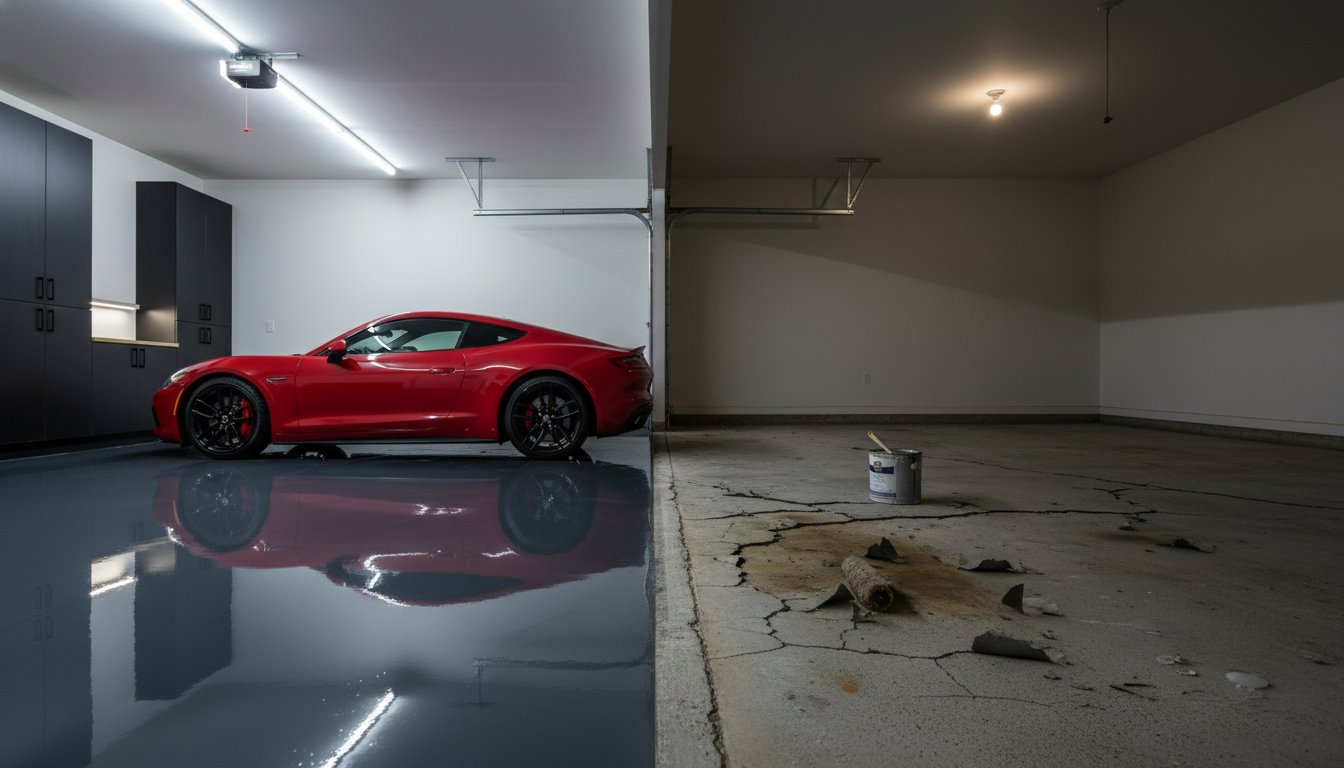
The success of any high-end finish depends entirely on the mechanical bond created during the grind. A proper profile allows materials like garage floor epoxy to "bite" into the concrete, creating a unified structure that resists heavy traffic and chemical spills. Without this precision work, you risk delamination, which is the technical term for your expensive coating peeling away from the slab. A "cheap" grind might save a few dollars today, but if the surface profile is insufficient, it often leads to a total floor failure costing thousands to strip and redo. We prioritize the correct Concrete Surface Profile (CSP) because we know that a job done right the first time is the only way to ensure long-term ROI.
The Illuminated Coatings Guarantee: No Hidden Surprises
We believe in total transparency from the moment we walk onto your site. Our process begins with comprehensive pre-project slab testing, including moisture mapping and hardness evaluations. This diagnostic approach allows us to identify potential remedial needs, such as the crack repairs or mastic removal discussed earlier, before the first diamond hits the floor. We communicate these variables clearly so you can budget with confidence. If you're ready to invest in a surface that combines durability with artistic brilliance, Transform your worn concrete into a masterpiece—Get a Transparent Quote Today.
Your Final Estimate Checklist
Before you sign a contract, ensure your estimate is not masking hidden costs of concrete grinding. A professional, transparent quote should explicitly include the following items:
- Specific CSP Target: A declaration of the surface profile depth required for your specific coating.
- Dust Containment: Confirmation of HEPA-filtered extraction and air scrubbing equipment.
- Tooling and Consumables: A clear statement that diamond wear is included in the base price.
- Debris Management: Responsibility for the weight and volume of concrete waste removal.
- Power Requirements: Explicit mention of whether the contractor provides a generator or requires specific site voltage.
Choosing a contractor based on expertise rather than the lowest bid is a strategic move that protects your investment. We treat every slab as if our professional survival depends on its success, because it does. When you balance technical precision with honest communication, the result is a floor that looks stunning and performs flawlessly for a lifetime.
Secure Your Investment with a Foundation of Integrity
A flawless floor begins long before the first coat of resin is applied. By identifying the hidden costs of concrete grinding during the planning phase, you transform a potential financial headache into a calculated investment in your property's future. True craftsmanship means navigating the technical realities of PSI, moisture levels, and rigorous dust mitigation without cutting corners. If you prioritize transparency over the lowest bid, then you're choosing a floor that stands the test of time.
At Illuminated Coatings, we're a family-owned and operated team that brings a specialist's eye to every slab. We focus on high-performance Vuba stone and industrial epoxy; ensuring every project meets OSHA-compliant safety standards for your peace of mind. Our professional survival depends on the brilliance and durability of our work, so we never hide the truth about your concrete's condition. Take the first step toward a total property transformation today.
Request a Professional Site Evaluation and Transparent Quote
We're ready to help you create a space that you'll be proud to showcase for decades to come.
Frequently Asked Questions
Is concrete grinding a messy process?
Concrete grinding is only messy if you lack the proper industrial equipment. Professionals use high-performance HEPA-filtered vacuums that capture nearly all airborne particles at the source. If a contractor uses a standard shop vac, then you'll likely deal with dust settling in every corner of your property. We prioritize a clean workspace to ensure your property remains a point of pride throughout the entire transformation.
How much does concrete grinding typically cost per square foot?
Professional pricing varies based on concrete hardness, desired aggregate exposure, and the complexity of the site. A specialized contractor evaluates these factors to provide a quote that reflects the actual labor and diamond consumption required for your specific slab. To avoid the hidden costs of concrete grinding, ensure your estimate includes line items for edge work, dust containment, and any necessary remedial repairs revealed during the initial passes.
Can I grind my own concrete floor with a rental machine?
While you can rent a machine, DIY grinding often leads to uneven surfaces and poor coating adhesion. Consumer-grade rental units lack the head pressure and planetary rotation of professional equipment, which can result in gouges in your slab. If you don't have experience with diamond bond types, you'll also likely spend more on wasted tooling than you would on a professional service.
What happens if the grinder reveals major cracks in my slab?
If structural fractures appear, we utilize high-modulus epoxy injections to stabilize the slab before proceeding. Grinding acts as a diagnostic step that uncovers these structural skeletons hidden under old flooring. Addressing these issues early prevents your new finish from cracking later. We communicate these remedial needs immediately so you aren't surprised by any changes to the project timeline or budget.
How long does the concrete grinding process take for a standard garage?
A standard residential garage typically requires one full day for a professional grinding and surface preparation pass. If your floor has thick layers of old mastic or requires deep aggregate exposure, the process may extend into a second day. We move rapidly and with purpose to minimize disruption to your routine while maintaining our high standards of industrial strength and artistic excellence.
Do I need to grind concrete before applying epoxy or Vuba stone?
Mechanical grinding is essential for any high-performance system like garage floor epoxy or Vuba stone. This process opens the pores of the concrete to create the necessary surface profile for a permanent chemical bond. If you skip this step, then your new floor is highly likely to delaminate or peel within the first year, leading to expensive and frustrating repairs.
What is the difference between concrete grinding and concrete polishing?
Concrete grinding is a preparation process used to level a slab and open its pores, while concrete polishing is a finishing technique. Polishing involves using increasingly fine diamond grits to achieve a smooth, mirror-like sheen. Grinding is the foundation for coatings; polishing is a standalone aesthetic choice for those who want the natural brilliance of the concrete to shine without a separate topping.
Will grinding remove deep oil stains or old paint?
Grinding is highly effective at removing old paint and superficial oil stains by shaving off the top layer of the slab. If oil has penetrated deep into the concrete, we supplement the grind with specialized degreasers to ensure a pristine bond. We assess the depth of these contaminants during our initial site visit to ensure the final finish bonds perfectly to a healthy foundation.