What if a single facility decision could save you $395,000 over the next ten years? For a 45,000 square foot space, that is the documented reality when you calculate the ROI of commercial polished concrete against traditional vinyl composition tile. You already know the frustration of the endless wax-and-strip cycle. It's a recurring drain on your labor budget and a constant disruption to your daily operations. If you're tired of floors that demand constant attention just to look mediocre, it's time to shift your perspective from a maintenance expense to a high-yield performance asset.
This guide promises to show you exactly how a professional polished finish pays for itself through maintenance elimination, significant energy savings, and long-term asset appreciation. We will explore the lifecycle advantages of a floor designed to last 20 years or more. We also detail how modern grinding and polishing techniques meet the ANSI A326.3 safety standard to protect your business from liability. From light reflectivity that cuts utility bills to a true zero-wax schedule, you're about to see why this industrial-strength solution is the ultimate tool for a facility manager's bottom line.
Key Takeaways
- Calculate the long-term ROI of commercial polished concrete by shifting your focus from initial installation costs to total life-cycle savings.
- Slash your facility’s annual overhead by permanently eliminating the expensive, labor-intensive cycle of waxing and stripping.
- Turn your floor into a functional asset that reduces energy bills through superior light reflectivity and natural thermal regulation.
- Secure your property’s value with a durable, 20-year flooring solution that meets rigorous modern safety standards for slip resistance.
- Learn why professional-grade grinding and polishing are essential to achieving the industrial strength and aesthetic brilliance your facility deserves.
Defining the ROI of Commercial Polished Concrete
Most facility managers treat flooring as a simple line-item expense. This narrow perspective often leads to choosing materials with the lowest upfront cost, but it overlooks the real financial impact on your budget. When you calculate the ROI of commercial polished concrete, you're measuring more than just the day-one price tag. You're analyzing the Life-Cycle Cost (LCC). This calculation includes every dollar spent on labor, chemicals, and eventual replacement over the next two decades.
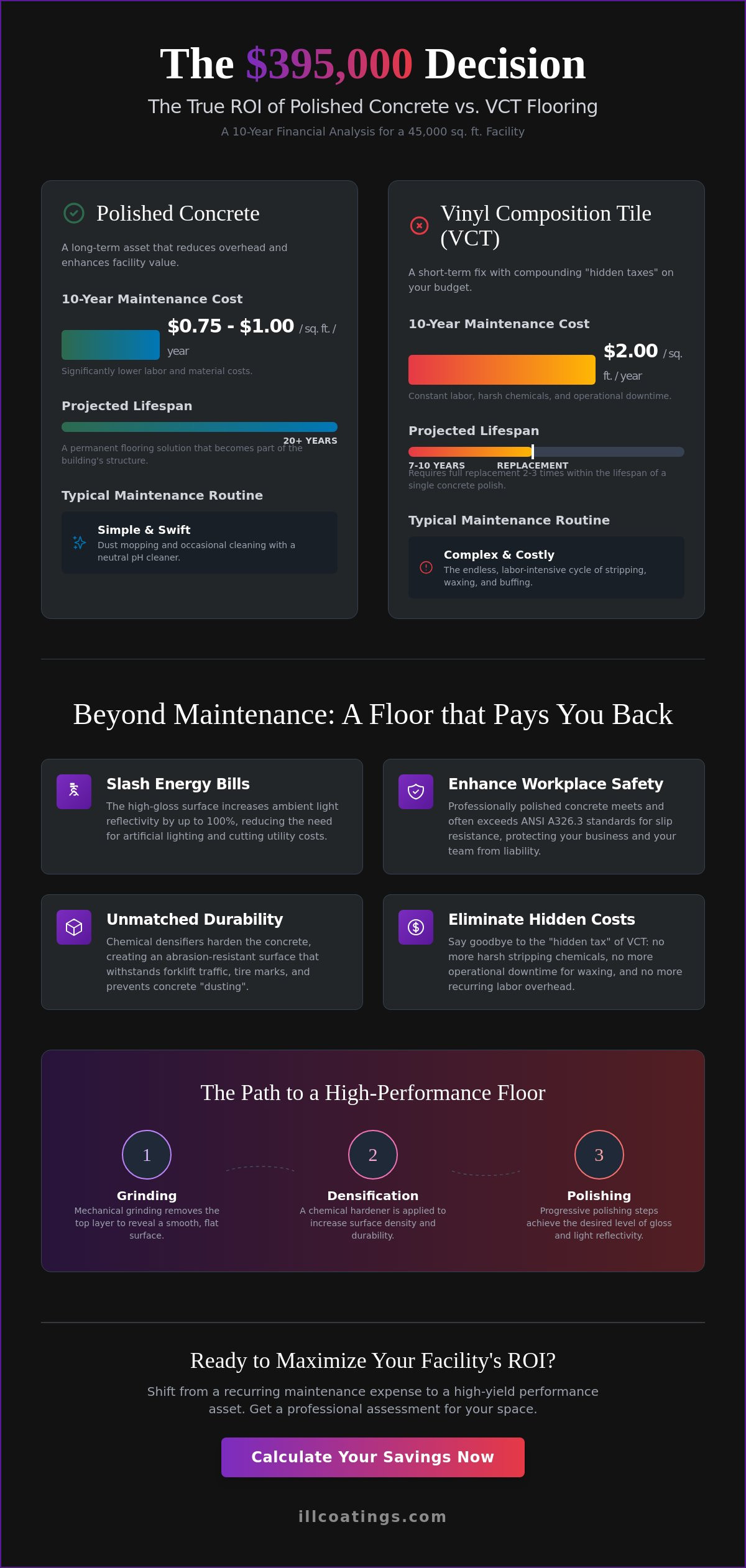
Traditional materials like VCT or industrial carpet carry what we call a "Hidden Tax." This tax is paid every time a crew arrives to strip and wax your floors or when a specialized team must deep-clean stained fibers. According to industry data, the annual maintenance for VCT averages $2.00 per square foot, while polished concrete stays between $0.75 and $1.00. Understanding what is polished concrete involves recognizing it as a structural enhancement rather than a topical covering. It's a permanent solution that stays in your building for 20 years or more, whereas cheap alternatives typically hit the landfill every seven to ten years.
The ROI of commercial polished concrete is most visible when you compare the first five years against the full twenty-year lifespan. In the early stages, you'll notice the immediate drop in chemical purchasing. Over the long term, you avoid the massive capital expenditure of a total floor replacement. This long-term perspective is the only way to protect your facility’s valuation and keep your operational budget under control.
Initial Investment vs. Long-Term Value
The process of grinding concrete and refining the surface requires a specialized team and industrial-grade equipment. This initial investment covers the multi-stage grinding, chemical densification, and the final polishing steps that create a mirror-like finish. If you choose a "cheap" alternative like VCT, you'll likely spend three times more over a decade because of the constant maintenance and replacement cycles. In the flooring industry, ROI is the sum of maintenance savings and replacement avoidance.
The Role of Concrete Densification in Durability
During the polishing process, we apply high-performance chemical densifiers. These liquids penetrate the concrete and react with the calcium hydroxide to create a denser, harder molecular structure. This transformation is what creates a surface capable of resisting "dusting" in high-traffic warehouses. It also prevents unsightly tire marks from forklifts and heavy equipment. A densified floor doesn't just look better; it physically resists the wear and tear that destroys untreated slabs, ensuring your investment remains a point of pride for years.
Maintenance Savings: Eliminating the Wax-and-Strip Cycle
The relentless cycle of stripping and waxing is a silent drain on your operational budget. Traditional flooring materials like VCT require a constant influx of labor and chemicals just to maintain a baseline level of cleanliness. If you're managing a large facility, you're likely paying for specialized floor technicians to work after-hours, racking up overtime costs that never seem to end. The ROI of commercial polished concrete starts with the total elimination of these recurring expenses. Instead of a multi-step chemical process, your maintenance routine shifts to simple dust mopping and an occasional pass with a neutral pH cleaner.
Beyond labor, the environmental and health impact of removing harsh industrial strippers is substantial. These chemicals are often volatile and require careful disposal, adding another layer of regulatory headache to your plate. Polished concrete allows for a chemical-free cleaning environment that is safer for your staff and better for the building's air quality. Because there is no wax to "cure," your facility avoids the typical downtime associated with floor refinishing. You can return the space to service immediately after a cleaning, which is a critical advantage for 24-hour operations or high-traffic retail hubs. To accurately measure these long-term savings, smart managers utilize a total cost of facility ownership model that accounts for every hour of janitorial labor.
Polished Concrete vs. VCT and Epoxy
When you compare these surfaces side-by-side, the financial gap is staggering. For a 10,000 square foot facility, the annual maintenance for VCT averages $20,000 based on the industry standard of $2.00 per square foot. Over ten years, that's a $200,000 "hidden tax." In contrast, polished concrete maintenance costs for the same area hover around $10,000 annually. VCT also hits a "replacement cliff" between years seven and ten, requiring a full tear-out and new installation. Polished concrete bypasses this cliff entirely, remaining a permanent part of the structure. If you want to see how these savings apply to your specific square footage, exploring professional concrete polishing is the first step toward a leaner budget.
Long-Term Aesthetic Retention
A common myth suggests that the brilliant shine of a polished floor eventually "wears off" like a topical sealer. This isn't true. The gloss is a mechanical finish achieved through a rigorous diamond-grinding process. It doesn't sit on top of the concrete; it is the concrete. In high-traffic environments like lobbies or retail centers, this surface resists the dulling effects of foot traffic and heavy equipment. While an epoxy coating might eventually flake or peel, a properly polished floor maintains its "Day 1" look with nothing more than routine burnishing. This permanent aesthetic ensures the ROI of commercial polished concrete remains high for decades, protecting both your visual brand and your bottom line.
Energy Efficiency and Operational ROI
A high-performance floor should do more than just sit there; it should actively lower your monthly utility bills. While most flooring options are passive surfaces, the ROI of commercial polished concrete is driven by its ability to function as a lighting and temperature regulator. If you're managing a massive warehouse or an open-concept retail space, your overhead costs for electricity and HVAC are likely your biggest variable expenses. Transforming a dull, gray slab into a mirror-like surface changes the physics of your building. You're no longer just paying for a floor; you're investing in an operational tool that works to keep your budget in check every hour the lights are on.
Sustainability has become a core requirement for modern facility management. Choosing to refine your existing slab rather than covering it with new raw materials significantly reduces your building's carbon footprint. Polished concrete is a leading choice for projects seeking LEED certification, particularly in categories like Materials and Resources and Indoor Environmental Quality. By using low-VOC densifiers and eliminating the need for new carpets or tiles, you create a healthier workspace while securing green building credits that can increase your property’s overall market valuation. This dual benefit of lower operational costs and higher asset value is a cornerstone of the ROI of commercial polished concrete.
Maximizing Ambient Light
The science of specular reflection allows high-grit polished surfaces to bounce light back into the room rather than absorbing it. In large facilities, this increased brightness improves employee productivity and enhances workplace safety by eliminating dark corners and shadows. If your floor has a high-gloss finish, you can often achieve the same foot-candle readings with fewer light fixtures or lower-wattage bulbs. A 20% increase in reflectivity can reduce lighting costs by a proportional margin. This direct reduction in kilowatt-hour consumption provides a measurable financial return that compounds month after month, especially in retail environments where visual clarity is essential for sales.
Thermal Regulation and HVAC Savings
Concrete possesses high thermal mass, which refers to its ability to store and slowly release heat. This property, known as thermal inertia, helps regulate interior temperatures by absorbing excess heat during the day and radiating it back as the building cools. In large open-concept offices and retail shells, this natural regulation reduces the load on your HVAC systems, preventing the frequent "cycling" that leads to premature equipment failure. Polished concrete is also the ideal partner for radiant heating systems, as it conducts heat efficiently and maintains a consistent surface temperature. This synergy between the floor and your mechanical systems ensures that your facility remains comfortable for occupants without overtaxing your energy budget.
Property Value, Safety, and Workplace Performance
The true ROI of commercial polished concrete extends far beyond simple maintenance math. It impacts the very health of your organization and the market value of your real estate. If you want to attract high-value tenants or increase the resale value of a facility, you must provide a foundation that is both permanent and aesthetically superior. Investors and property owners are increasingly looking for "Class A" finishes that eliminate the need for future capital expenditures. A polished floor is a structural asset that suggests a level of care and professional standards that topical coverings simply cannot match.
Workplace wellness is another critical, yet often overlooked, component of your financial return. Traditional carpets and porous tiles are notorious for trapping dust, mold, and allergens, which directly degrades Indoor Air Quality (IAQ). This "hidden" cost manifests in higher employee absenteeism and reduced productivity. By choosing a non-porous, polished surface, you eliminate these biological traps. Additionally, strategic polishing can help manage acoustic performance in large commercial shells. While concrete is a hard surface, a high-quality finish reduces the "dusting" and grit that can interfere with sensitive electronic equipment and air filtration systems, keeping your operational environment pristine.
Increasing Commercial Real Estate Value
If you're looking to improve the "Cap Rate" of a commercial property, the flooring choice is a decisive factor. Polished concrete creates a "modern industrial" aesthetic that is currently a staple in high-end office renovations and luxury retail. Because it's a permanent solution, it reduces the "tenant improvement" (TI) allowances that owners must pay out when a new lease is signed. Investors pay a premium for facilities where the most expensive surface in the building is already finished to a gallery-quality standard. This durability signals to the market that the property is low-maintenance and high-performance, directly influencing its long-term appreciation.
Safety Standards and Liability ROI
There is a persistent myth that a high-gloss floor must be slippery. In reality, the ROI of commercial polished concrete includes a significant reduction in liability and workers' comp claims. According to the ANSI A326.3 standard, level interior surfaces should maintain a Dynamic Coefficient of Friction (DCOF) of 0.42 or greater to be considered safe when wet. Properly polished concrete easily meets and exceeds this benchmark. Slips and falls account for over 20% of all workplace injuries, and a flatter, more reflective surface improves overall visibility for your crew. If you are ready to upgrade your facility's safety and value, our team provides professional commercial floor coatings and polishing services designed for industrial-strength performance.
Partnering with Illuminated Coatings for Maximum ROI
Achieving the full ROI of commercial polished concrete requires more than just heavy machinery. It demands a specialist who understands the unique chemistry of your specific slab and the high stakes of your operational budget. At Illuminated Coatings, we approach every project as a blue-collar artisan. We don't just offer a construction service; we deliver a transformation that elevates manual labor into a form of craftsmanship you can see and feel. If you invest in professional concrete polishing now, then you eliminate the burden of flooring capital expenditures for decades to come. This is the difference between a temporary fix and a permanent performance asset.
The quality of the initial grind dictates your long-term return. While some generalists might offer a quick shine, our team utilizes industrial-grade equipment and specialized diamond tooling to ensure a deep, durable finish. We don't rely on topical sealers that eventually flake or peel. Instead, we mechanically refine the concrete itself. This focus on the "initial grind" ensures that your floor remains a point of pride and a high-yield asset rather than a recurring maintenance headache. Whether you're managing a retail shell, an industrial warehouse, or a high-end office, we customize our grit levels and densification protocols to meet your specific traffic demands.
Our Precision Grinding and Polishing Process
Our process is built on a foundation of professional accountability and technical expertise. We start with rigorous surface preparation, removing existing coatings and repairing cracks to ensure a flawless canvas. From there, we move through multiple stages of precision grinding concrete to open the pores of the slab. We then apply high-performance densifiers that fundamentally change the molecular structure of your floor, followed by sequential polishing steps to achieve your desired gloss level. We prioritize structural integrity over superficial shine. This means your floor won't just look like an architectural masterpiece on day one; it will maintain that brilliance through years of heavy use.
Ready to Transform Your Commercial Space?
Every facility has unique needs, and a one-size-fits-all approach never delivers the maximum ROI of commercial polished concrete. We begin with a comprehensive site assessment to match the right grit level and finish to your business environment. The Illuminated Coatings promise is rooted in integrity and local pride. We understand that our professional survival is tied to the quality of our work, which is why we never cut corners on materials or methodology. If you're ready to bring life and brilliance to your dull spaces while securing your financial future, we're ready to get to work. Schedule your commercial floor consultation with Illuminated Coatings today and experience the impact of true craftsmanship.
Secure Your Facility’s Future with Industrial Brilliance
Choosing a floor shouldn't be a gamble. It's a calculated investment in your building's long-term performance. By eliminating the recurring tax of waxing and stripping, you're reclaiming thousands of dollars in labor and material costs every year. You've seen how the ROI of commercial polished concrete manifests through lower energy bills, improved safety compliance, and a permanent aesthetic that drives property appreciation. This isn't just about a clean floor; it's about a structural transformation that protects your bottom line for the next twenty years.
At Illuminated Coatings, we bring a specialist mindset to every slab. As a family-owned and operated business, we treat your facility as a point of pride, focusing on the artisan craftsmanship required for high-performance results. We use professional-grade concrete polishing and grinding techniques to ensure your floor withstands the toughest environments. Our team is specialized in high-performance commercial coatings that bridge the gap between industrial strength and artistic excellence. If you're ready to stop paying for temporary fixes and start building real equity in your space, our team is ready to help.
Get a Professional Quote for Your Commercial Polished Concrete Project
Take the first step toward a more efficient, durable facility today.
Frequently Asked Questions
Is polished concrete more expensive than epoxy for commercial spaces?
Polished concrete often requires a higher initial investment than basic thin-film epoxy coatings, but it delivers a lower total cost of ownership. While epoxy is a topical layer that eventually flakes or wears thin, polishing is a mechanical refinement of the slab itself. If you choose polishing, then you avoid the recurring expense of stripping and re-coating your floors every few years.
How long does a commercial polished concrete floor typically last?
A professionally polished floor can easily last 20 years or more with minimal maintenance. This longevity is rooted in the densification process, which hardens the concrete at a molecular level. Unlike carpet or VCT, which hit a replacement cliff every seven to ten years, a polished surface remains a permanent part of your building's structure.
Can any commercial concrete slab be polished, or are there restrictions?
Most commercial slabs are candidates for polishing, but the existing condition of the concrete dictates the final result. If your slab is extremely soft, porous, or heavily damaged, it may require significant grinding and repair before the polishing stages begin. We perform a site assessment to ensure the structural integrity is sufficient to achieve a high-performance, gallery-quality finish.
Does polished concrete become slippery when wet in a retail environment?
Polished concrete is not inherently more slippery than other hard surfaces when it's kept clean and dry. We ensure our finishes meet or exceed the ANSI A326.3 standard for slip resistance, providing a safe walking surface for customers and staff. The mirror-like shine is a result of microscopic smoothness, not a slick coating or wax buildup.
What is the typical ROI timeframe for switching from carpet to polished concrete?
Many facility managers report a full return on the ROI of commercial polished concrete within two to five years of installation. This rapid payback is driven by the total elimination of professional carpet cleaning services and the avoidance of the inevitable replacement costs. You're trading a high-maintenance textile for a durable, permanent asset that works for your budget.
How does polished concrete contribute to LEED certification for commercial buildings?
Polished concrete contributes to LEED points by utilizing the existing concrete slab, which reduces the carbon footprint associated with manufacturing and transporting new materials. It also qualifies through the use of low-VOC densifiers and sealers. Its high light reflectivity further supports energy efficiency goals by reducing the demand for artificial overhead lighting in large spaces.
What kind of daily maintenance is required for a 20,000 sq. ft. polished floor?
Daily maintenance for a large facility is limited to dust mopping and a pass with an automatic scrubber using a neutral pH cleaner. This simplified janitorial protocol is a primary factor in the ROI of commercial polished concrete, as it removes the need for specialized technicians. If you maintain a consistent cleaning schedule, your floor will retain its brilliance without the need for aggressive buffing.
Can you add logos or branding to polished concrete floors?
We can integrate permanent logos, wayfinding marks, or custom branding directly into the concrete using specialized dyes and stencils. This process happens before the final densification and polishing stages, ensuring the graphics are locked into the surface. Unlike floor decals or paint, these branded elements won't peel or fade, maintaining a professional look for the life of the floor.