What if those ugly, flaking patches on your pavement aren't just signs of old age, but symptoms of a hidden moisture crisis happening deep inside the slab? Many homeowners find themselves staring at a crumbling entrance, wondering exactly what causes concrete spalling on driveways and why their investment is literally peeling away in layers. It is a common sight across our local neighborhoods, yet most quick fixes fail because they ignore the underlying science of surface failure.
You've likely felt the frustration of watching a hardware store patch pop off after a single season. It's a cycle of "rip and replace" that feels endless and expensive. We understand that your home is your pride, and seeing it deteriorate is more than just an eyesore; it's a threat to your property value. This article pulls back the curtain on the freeze-thaw cycles and poor installation habits that trigger pitting. You'll discover how to move beyond temporary bandages toward permanent, artisan-grade restoration. We will show you how specialized coatings and resin-bound stone can turn a failing surface into a gallery-quality finish that stands the test of time.
Key Takeaways
- Identify the primary physical triggers like moisture absorption and the freeze-thaw cycle that lead to surface separation and flaking.
- Learn exactly what causes concrete spalling on driveways to stop wasting money on surface-level repairs that don't address internal pressure.
- Understand why standard DIY patches fail to bond with old slabs and how differing expansion rates cause them to pop off in the heat.
- Explore how resin-bound stone provides a breathable, porous alternative that eliminates the moisture traps found in traditional concrete.
- Shift your perspective from simple maintenance to a professional restoration that prioritizes both industrial strength and high-end aesthetics.
The Science of Surface Failure: Defining Concrete Spalling
Your driveway might look like an immovable slab of rock, but under a microscope, it's a network of tiny tunnels. When we talk about surface failure, we're looking at the physical separation of the concrete into flakes, chips, or even large chunks. This process, often called spalling, is a direct result of internal stress. If you want to understand What is Spalling? in a broader sense, it's helpful to know it affects everything from ancient stone structures to your modern front walkway. While it starts as a cosmetic nuisance, it's actually a loud warning that the industrial strength of your slab is under attack.
Understanding what causes concrete spalling on driveways requires looking at the moisture trapped inside. Concrete is naturally porous. It breathes. However, when moisture gets in and has nowhere to go, it creates immense internal pressure. This isn't just a simple wear and tear issue. It's a signal that the protective surface has failed, leaving the underlying aggregate exposed to the elements and threatening the long-term survival of your pavement.
The Anatomy of a Concrete Slab
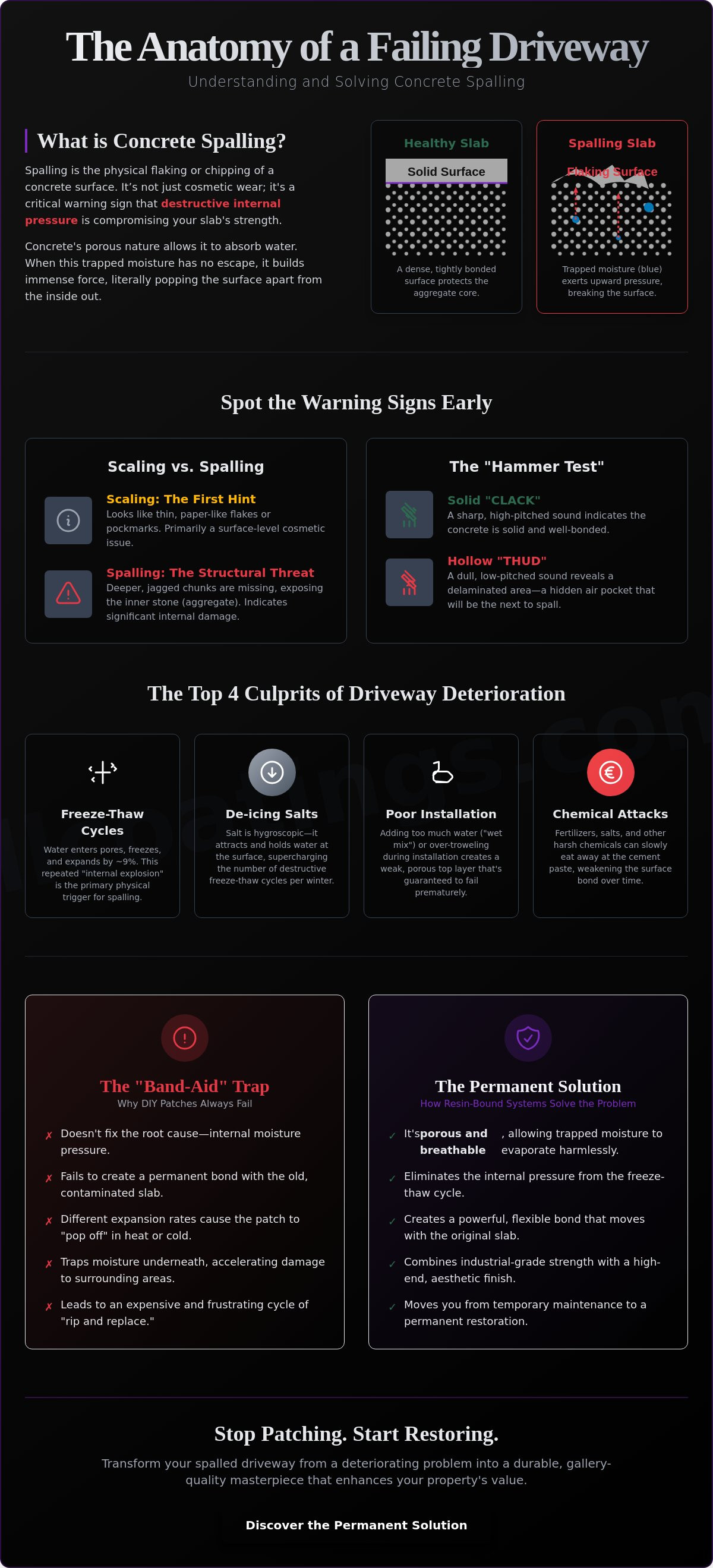
A healthy slab relies on a tight bond between the cement paste and the aggregate. Think of the paste as the glue and the aggregate as the bones. Over time, capillary action draws water deep into this structure like a straw. Concrete spalling is the result of internal hydraulic or crystalline pressure exceeding the tensile strength of the surface. Once that pressure builds up, the "glue" simply gives way, causing the surface to pop off in jagged, unsightly pieces.
Visual Indicators: Is Your Driveway Scaling or Spalling?
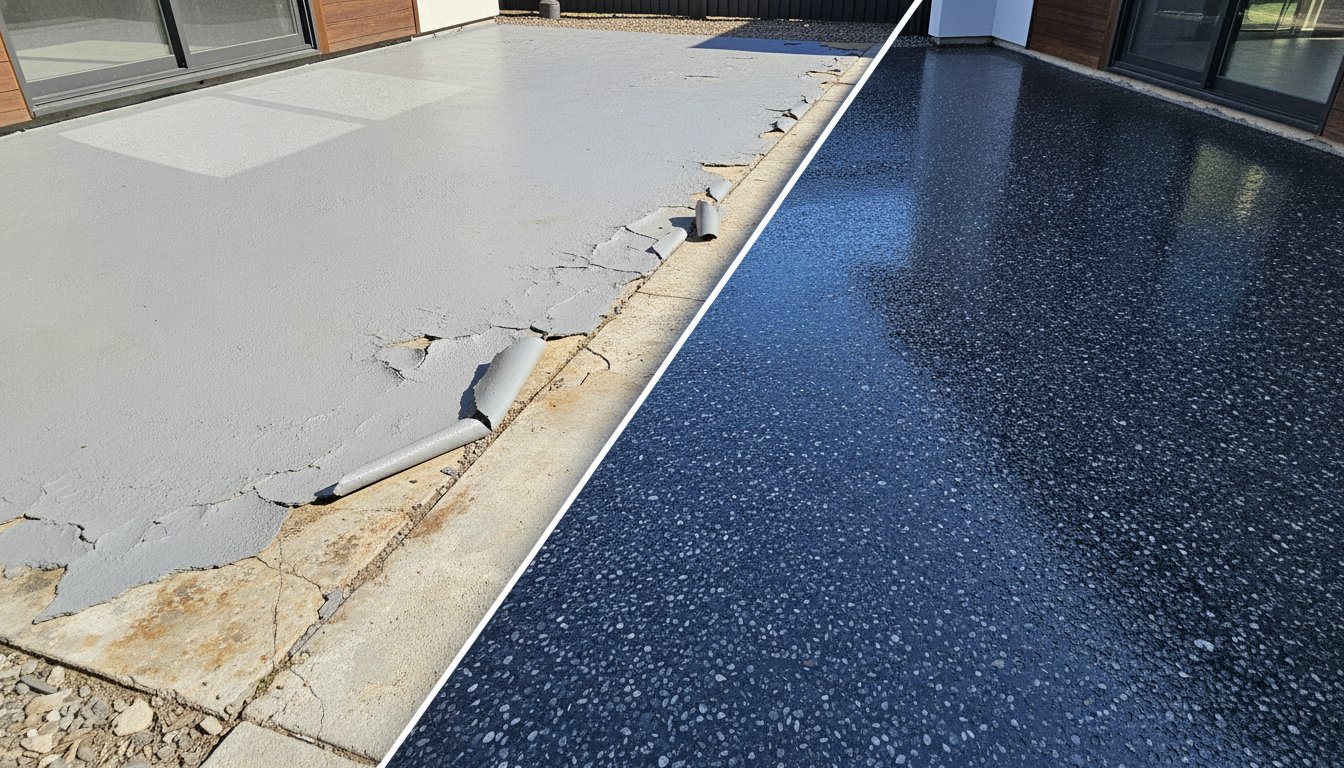
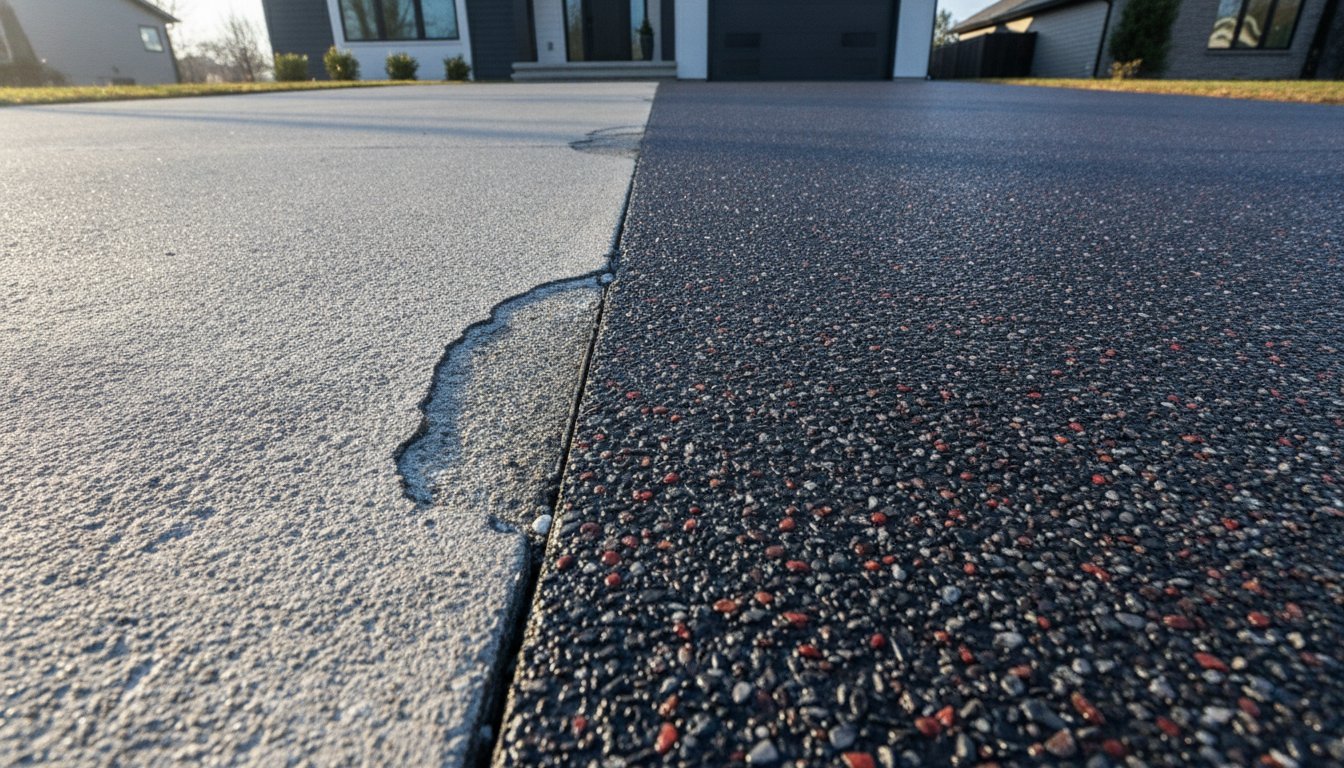
Don't confuse light scaling with true spalling. Scaling is usually the first stage; it looks like light pockmarks or thin, paper-like flakes peeling off the top. It's ugly, but it's mostly a surface-level battle. Spalling is the deeper, more aggressive cousin. If you can see the stones (aggregate) underneath and they feel loose to the touch, you're dealing with a structural failure that a simple bucket of patch material won't fix.
You can stay ahead of the damage with a simple "hammer test." Walk your driveway and lightly tap the surface with a hammer. If you hear a sharp "clack," the concrete is solid. If you hear a dull, hollow "thud," you've found a delaminated area. These hollow spots are the next sections to peel. Identifying these early is the only way to stop the "rip and replace" cycle before it consumes your entire entrance. We believe in catching these failures before they turn into a full-scale replacement nightmare.
Top 4 Culprits: What Triggers Driveway Deterioration?
If your driveway is crumbling, it's rarely a single event that caused the damage. It is usually a perfect storm of environmental pressure and mistakes made the very day the concrete was poured. When homeowners ask what causes concrete spalling on driveways, they're often surprised to learn it's a combination of chemistry and physics. Understanding these triggers is the first step toward moving past temporary fixes and toward a solution that actually lasts.
The biggest enemy is the freeze-thaw cycle. When water enters those microscopic tunnels in the slab and freezes, it expands by approximately 9%. That expansion creates an internal "explosion" that pops the surface off. Add de-icing salts to the mix, and the problem doubles. Salt is hygroscopic, meaning it attracts and holds water, keeping the concrete saturated for longer and increasing the number of freeze-thaw cycles your driveway endures every winter. According to the American Concrete Institute, following strict standards for Professional Restoration and initial pours is the only way to prevent these failures long-term.
The "Wet Mix" Problem and Over-Troweling
Many failures actually start on day one. This is the "original sin" of concrete work. If a crew adds too much water to the truck to make the concrete flow faster, they're essentially diluting the strength of the finished product. This excess water eventually evaporates, leaving behind a porous, brittle surface that can't handle the weight of your vehicles. Over-troweling the surface during finishing only makes it worse. It pulls the "fines" and water to the top, creating a weak, thin layer that looks good for a few years but eventually blisters and peels. These installation errors often stay hidden for 5 to 10 years before the first flakes appear.
Chemical Attacks: Salt and Fertilizers
Beyond the weather, your driveway faces a constant chemical barrage. Lawn fertilizers containing ammonium nitrates or sulfates can chemically react with the cement paste, weakening the bond that holds the aggregate together. Even sand, often thought of as a "safe" alternative to salt, can cause issues if it's not managed; it can clog the pores of the concrete and act as an abrasive under your tires. If you're tired of watching your entrance crumble, it's time to consider driveway resurfacing options that actually seal out these culprits and provide a gallery-quality finish that stands up to the elements.
Finally, there's the issue of rebar corrosion. If the steel reinforcement inside the slab wasn't buried deep enough, moisture and salt will eventually reach it. Rust occupies significantly more space than the original steel. As the metal expands, it exerts massive pressure from the inside out, literally forcing the concrete apart in large, jagged chunks. This isn't just an eyesore; it's a structural cry for help.
The "Band-Aid" Trap: Why DIY Patches Often Fail
It's tempting to grab a $15 tub of vinyl concrete patch from the local hardware store when you first notice those ugly pockmarks. You think it's a quick fix. However, understanding what causes concrete spalling on driveways reveals why these store-bought bandages almost always fail within a year. Standard concrete and repair patches are essentially biological enemies; they don't share a natural chemical bond. Without a professional bonding agent and industrial-grade surface preparation, that new material is merely sitting on top of the old slab rather than becoming part of it.
Thermal movement is the next silent killer. Every material has a specific coefficient of expansion. In the heat of a summer afternoon, your original driveway and that rigid DIY patch will expand at different rates. This creates a shearing force that snaps the weak bond. Once that happens, you've created an "ice wedge" effect. Moisture seeps into the tiny gap between the patch and the slab. When winter hits, that water freezes and expands, forcing the patch out and taking even more of your original driveway with it. You end up with a hole twice as large as the one you started with.
Beyond the physics of failure, there's the aesthetic cost. A driveway is a massive part of your home's curb appeal. DIY patches rarely match the color or texture of the surrounding concrete. This creates a "patchwork quilt" look that screams neglect. If you're trying to maintain property value, these mismatched splotches can be just as damaging as the original spalling.
The Failure of Thin-Set Overlays
Many homeowners try to hide the damage with a thin layer of new concrete. This is a recipe for disaster. A 1/4 inch layer of standard concrete has no structural integrity. It's too brittle to handle the weight of a two-ton SUV. Under the pressure of daily traffic, these thin overlays crack and delaminate almost immediately. Standard concrete patches lack the tensile strength to resist the same forces that caused the original spalling.
When DIY Becomes a Liability
True restoration requires precision. Professional services dedicate 70% to 80% of their labor costs to surface preparation; a step most DIYers skip or rush. If you leave behind a single layer of dust, oil, or old salt, your new repair is doomed from day one. You'll spend more money "doing it twice" than you would have spent on a professional one-time solution. Additionally, if you live in a neighborhood with strict standards, "good enough" patches often get rejected by HOA boards, leading to fines or forced replacements. We believe in doing the hard work once so your property remains a point of pride, not a source of frustration.
Professional Restoration: Beyond Traditional Concrete Replacement
Most general contractors will tell you that the only way to fix a flaking driveway is to tear it out and start over. This "rip and replace" mentality is often unnecessary and incredibly disruptive. A full replacement involves heavy machinery, weeks of downtime, and a massive environmental footprint. If your underlying slab is structurally sound, then spending thousands on a total demolition is a waste of resources. By understanding what causes concrete spalling on driveways, specifically the internal pressure from trapped moisture, we can move toward a smarter, more aesthetic solution that fixes the root problem without the sledgehammer.
Professional restoration is about more than just hiding the damage. It is about transforming a failing surface into a high-performance system. We utilize advanced materials like resin-bound stone to create a finish that is both beautiful and functional. Unlike traditional concrete, which acts like a solid, brittle sponge, these modern systems are designed to bridge the gaps in your existing slab and provide a durable, gallery-quality entrance that stands up to the harshest local weather. Research from industry experts suggests that in nearly 90% of cases, resurfacing is a more cost-effective and sustainable choice than full replacement.
Resin-Bound Stone (Vuba stone) vs. Standard Concrete
The secret to the success of resin-bound systems like Vuba stone lies in their porosity. Standard concrete traps moisture, which leads to the freeze-thaw "explosions" we discussed earlier. Resin-bound stone is different; it's a "breathable" surface. Water flows directly through the stone and resin matrix, reaching the ground below instead of staying trapped inside the material. This eliminates the internal hydraulic pressure that triggers spalling in the first place.
Flexibility is another massive advantage. Concrete is rigid, and when the ground shifts or temperatures change, it cracks. Resin-bound systems possess a level of elasticity that allows them to handle thermal expansion without snapping. You get a slip-resistant, visually stunning surface that offers a massive variety of colors and textures, far beyond the dull grey of a standard pour.
The Power of Concrete Grinding and Polishing
A permanent bond is impossible without the right foundation. This is why we prioritize grinding concrete over simple pressure washing. Pressure washing only cleans the surface; it doesn't remove the "dead," delaminated layers of the slab. Our professional process involves mechanical diamond grinding to strip away the weak upper crust and reveal the strong, healthy aggregate beneath. If you want your new coating to last for decades, then you must create a specific "profile" that allows the resin to lock into the pores of the slab. This mechanical prep ensures the new surface becomes a physical part of your driveway rather than a thin layer sitting on top. If you are ready to stop the cycle of decay and start your transformation, contact us today for a professional driveway resurfacing consultation.
Illuminated Coatings: Transforming Spalled Surfaces into Masterpieces
At Illuminated Coatings, we don't just patch holes; we redefine your home's first impression. We approach every project as blue-collar artisans, combining the grit of industrial-strength labor with a refined eye for high-end aesthetics. We understand that your home is your most significant investment. By identifying exactly what causes concrete spalling on driveways in our local climate, we have developed a restoration process that moves beyond the temporary and into the transformative. Our mission is to take your property from a maintenance headache to a genuine point of pride.
Our process is built on precision and accountability. We start by grinding concrete to remove every trace of delaminated "dead" material, ensuring we reach the healthy core of your slab. This isn't a surface-level cleaning; it is a surgical preparation. Once the profile is set, we apply our specialized resin-bound stone, known as Vuba stone. This system doesn't just sit on top of your driveway. It bonds with the slab to create a seamless, breathable, and incredibly durable surface that brings life and brilliance to previously dull spaces. We treat every square foot with the focus of a specialist because we know our professional survival depends on the quality of the finish we leave behind.
Why We Stand Behind Resin-Bound Solutions
We choose resin-bound stone because it is the only material that truly answers the moisture crisis inherent in local concrete. These systems are engineered to survive extreme weather, from blistering summer heat to the deepest winter freezes. Because the surface is porous, you won't deal with the standing water or internal pressure that triggers the "rip and replace" cycle. Maintenance is remarkably simple. You can finally say goodbye to the requirement of sealing your driveway every two years. Furthermore, we offer a level of customization that standard concrete cannot match. Whether your home is a modern masterpiece or a classic estate, we can match the stone texture and color to your specific architectural style, ensuring a gallery-quality finish that lasts.
Start Your Driveway Transformation
Every great transformation begins with an honest assessment. We don't believe in one-size-fits-all recommendations. Our consultation process involves a deep dive into the root cause of your surface failure, ensuring that the solution we provide actually fixes the problem for the long term. We operate with a singular priority: delivering a result that reflects our dedication to craftsmanship and your desire for excellence. If you are ready to stop the peeling and start the transformation, we are ready to work. Get a professional assessment for your driveway transformation here.
Reclaim Your Curb Appeal with Artisan Restoration
Understanding what causes concrete spalling on driveways is the first step toward a permanent solution. You now know that moisture pressure and thermal expansion are the real enemies, not just the age of your pavement. We've seen how standard patches fail to bond and why a full replacement is often an unnecessary expense. True transformation requires a specialist mindset that prioritizes industrial strength and high-end beauty. It is about choosing a breathable, flexible system that works with your slab rather than against it.
At Illuminated Coatings, we are a family-owned team of blue-collar artisans dedicated to professional excellence. We specialize in high-performance Vuba Stone and utilize expert mechanical grinding to ensure a superior, permanent bond with your existing slab. We don't just fix driveways; we bring life and brilliance to dull spaces. Don't settle for another season of crumbling concrete. Transform your worn-out driveway with a professional stone coating today and turn your entrance into a masterpiece you'll be proud of for decades. Your property deserves a finish that stands the test of time.
Frequently Asked Questions
Can I just pour new concrete over my spalled driveway?
You cannot simply pour a thin layer of new concrete over a spalled surface and expect it to last. New concrete requires a thick, structural pour to maintain its integrity; otherwise, it will crack and delaminate under the weight of your vehicles. If you skip the mechanical grinding and professional bonding process, you are essentially building on a foundation of dust and loose aggregate that will fail within a single season.
How much does it cost to fix spalling concrete vs. replacing it?
Resurfacing or repairing your existing slab is typically much more cost-effective than a full "rip and replace" demolition. Industry data shows that in 90% of cases, it's smarter to restore a structurally sound slab than to pay for total excavation and replacement. This approach saves you from massive labor costs and the long downtime associated with pouring and curing an entirely new driveway.
Does salt really cause concrete to peel?
Salt is a major contributor to what causes concrete spalling on driveways because of its hygroscopic nature. It acts like a magnet for moisture, pulling water deep into the pores of the slab and holding it there. This increases saturation levels and forces the concrete to endure more frequent and aggressive freeze-thaw cycles than it would naturally, leading to rapid surface failure.
Is spalling concrete a sign of a bad foundation?
Spalling is primarily a surface failure issue rather than a sign of a sinking foundation or structural collapse. It indicates that the top layer of the slab has lost its tensile strength due to moisture pressure, salt damage, or poor installation. However, ignoring these signs allows water to reach the internal reinforcement, which can eventually lead to more serious structural vulnerability if left unaddressed.
What is the best temperature to repair concrete spalling?
The ideal temperature for repairing concrete failure is generally between 50 and 80 degrees Fahrenheit. If it's too cold, the bonding agents won't cure properly; if it's too hot, the repair material dries too quickly and loses its strength. We carefully monitor local weather conditions to ensure every application happens during the perfect window for a permanent, artisan-grade bond.
How long does a resin-bound stone driveway last compared to concrete?
A high-performance resin-bound stone system offers a lifespan that rivals traditional concrete while eliminating the risk of surface flaking. While standard concrete often begins to show signs of scaling within a few years, resin-bound stone remains flexible and porous. This durability ensures your driveway stays beautiful and functional for decades without falling into the "rip and replace" cycle.
Can a spalled driveway be fixed if there is rebar showing?
You can certainly restore a driveway with exposed rebar, but the process requires specialized care to stop internal corrosion. The rust must be removed and the steel treated with a protective coating before the resurfacing begins. If you don't stop the rebar from expanding, the internal pressure will eventually force any new repair material to pop off the slab.
Will sealing my driveway prevent spalling from happening again?
Standard hardware store sealers won't stop spalling if the damage has already started. Sealing a failing surface can actually trap moisture inside the slab, accelerating the internal pressure that causes the concrete to peel. Professional restoration requires grinding away the damage and applying a breathable, high-performance system that allows moisture to escape rather than trapping it underneath a thin film.