Did you know that 80% of epoxy floor failures are actually caused by poor surface preparation rather than the quality of the resin itself? It's a gut-wrenching realization when your premium floor starts to peel or blister, leaving you to wonder when to repair vs replace epoxy floor to save your investment. You expected a gallery-quality finish that would stand the test of time, but instead, you're left worrying if you can patch the damage or if you have to grind it all off and start over. We know the frustration of a failing floor, especially when you're anxious about the cost of a total replacement and the health of the concrete underneath.
This guide provides the technical clarity you need to make an informed decision by identifying the specific signs of mechanical bond failure. You'll learn to distinguish between minor cosmetic wear and the systemic issues that demand a high-performance replacement. We're going to walk you through the professional indicators of floor health, the long-term ROI of expert resurfacing, and the steps required to transform a failing surface back into a masterpiece you'll be proud to show off.
Key Takeaways
- Identify the critical difference between surface-level aesthetic wear and systemic bond failure to avoid wasting budget on temporary bandages.
- Apply the professional 20% rule and adhesion testing to determine exactly when to repair vs replace epoxy floor for the best long-term ROI.
- Understand the science of Moisture Vapor Transmission (MVT) and why invisible forces might be pushing your current coating off the concrete substrate.
- Explore high-performance resurfacing alternatives like resin-bound stone (Vuba Stone) for breathable, gallery-quality results on outdoor surfaces.
- Master a specialist five-step transformation process that replaces blunt assessments with precision engineering for a durable, artistic finish.
Diagnosing Your Floor: Is It Surface Wear or Systemic Failure?
A failing floor is more than an eyesore; it's a breach of trust between the coating and the concrete beneath. To determine when to repair vs replace epoxy floor, you must first understand that epoxy isn't just a thick layer of paint. It's a high-performance system rooted in the complex polymer science that dictates how resins cross-link to create a mechanical and chemical bond with the substrate. When this bond is compromised, the floor transitions from a gallery-quality asset to a functional liability.
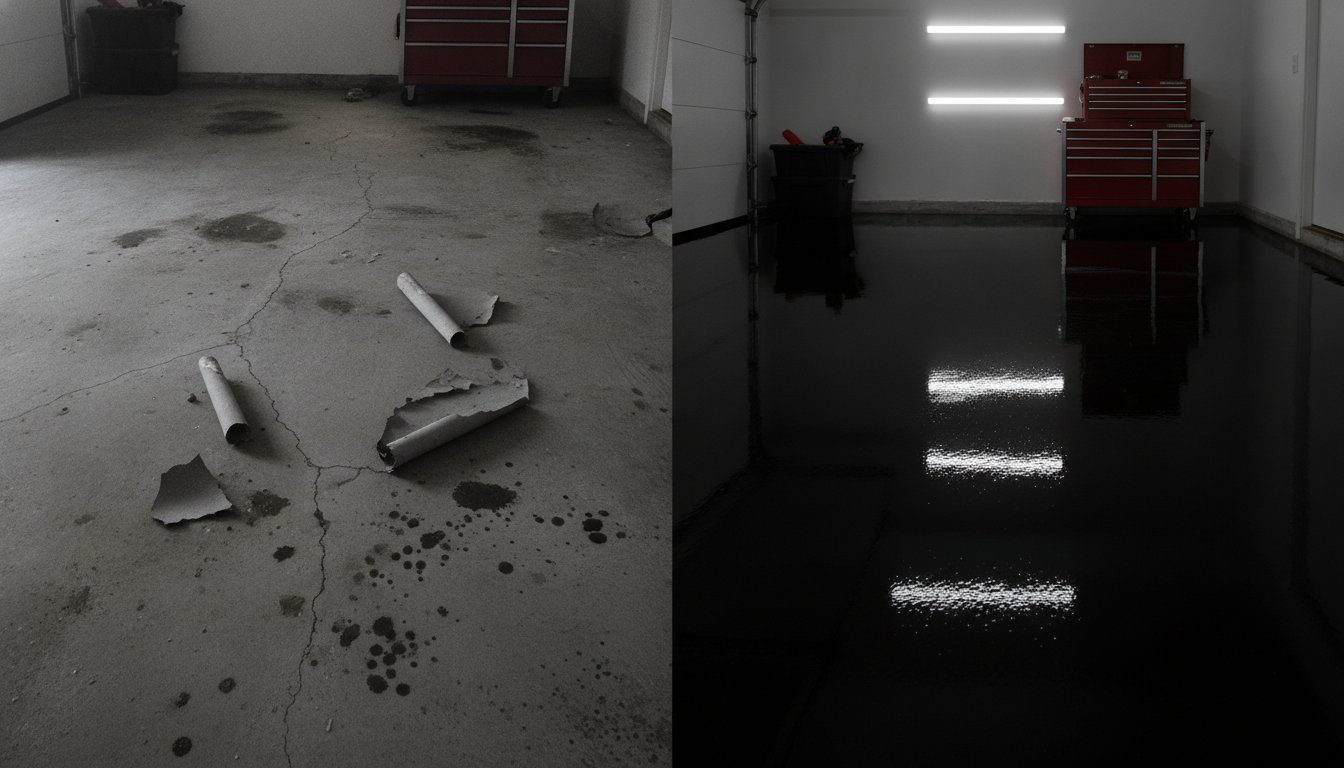
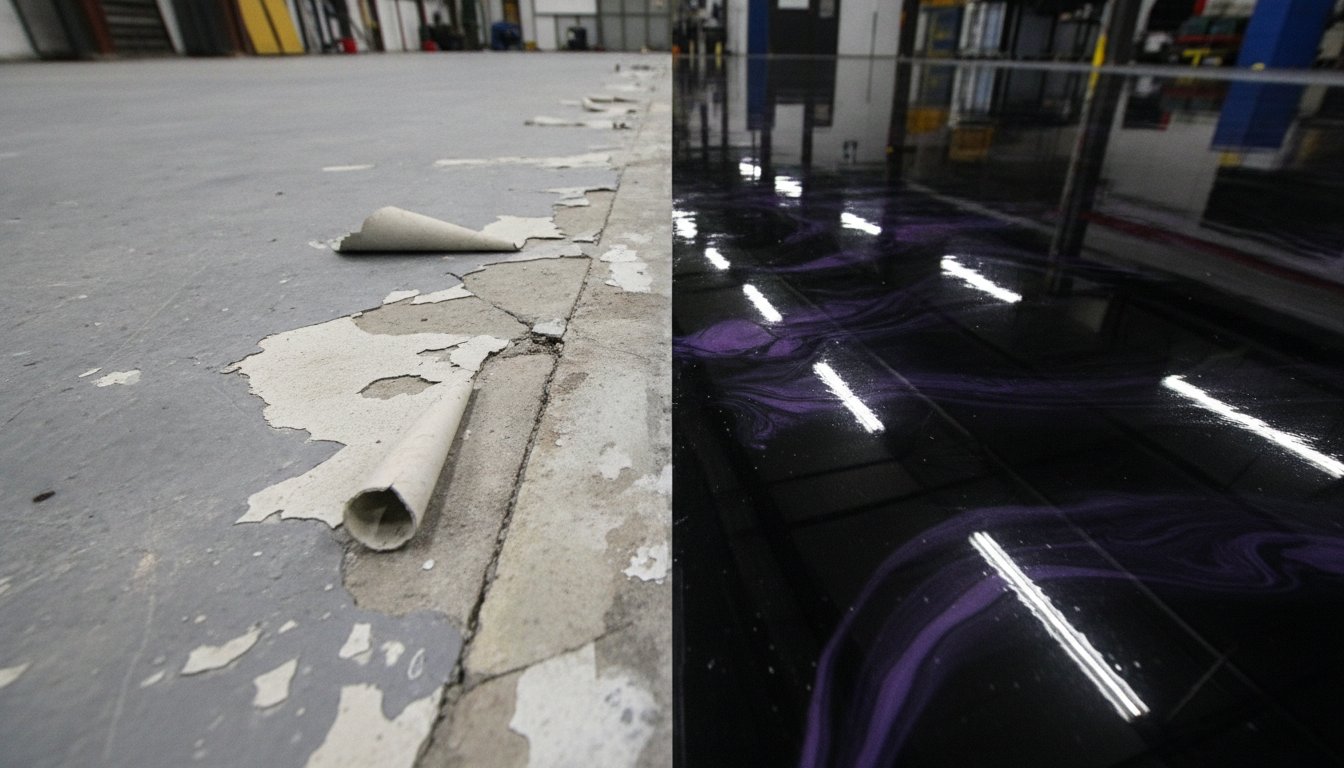
We distinguish between aesthetic wear and systemic failure. Aesthetic wear includes surface-level scratches, dulling from heavy foot traffic, or minor staining. These are cosmetic issues that don't threaten the integrity of the concrete. Functional failure, however, involves peeling, bubbling, or "delamination." If the coating is physically lifting away from the slab, the system has failed at the foundation. Ignoring these signs leads to "shedding," where a small chip rapidly expands into a massive, jagged hole as moisture and debris work their way under the remaining resin.
Try the 'Penny Test' for a blunt assessment of pitting. If you notice a hole in the surface, place a penny inside it. If the edge of the coin disappears below the resin line and you can see raw, porous concrete at the bottom, the protective barrier is gone. Deep pits like these allow oils and chemicals to soak into the slab, making future repairs nearly impossible without aggressive grinding.
Signs Your Epoxy Only Needs a Professional Repair
If the damage is localized, a surgical repair often provides the best ROI. You can typically opt for a repair if you see:
- Isolated hot tire pick-up: This happens when heat from tires pulls up the coating in a single, small patch where you park.
- Surface-level staining: If a chemical spill has discolored the topcoat but hasn't eaten through to the concrete, a professional deep-clean and reseal can restore the brilliance.
- Hairline settling cracks: If a thin crack appears due to the house naturally settling, it can be chased and filled without replacing the entire floor.
Signs Total Replacement is Your Only Viable Path
There are times when a patch is just a temporary bandage on a terminal problem. Total replacement is mandatory if you encounter:
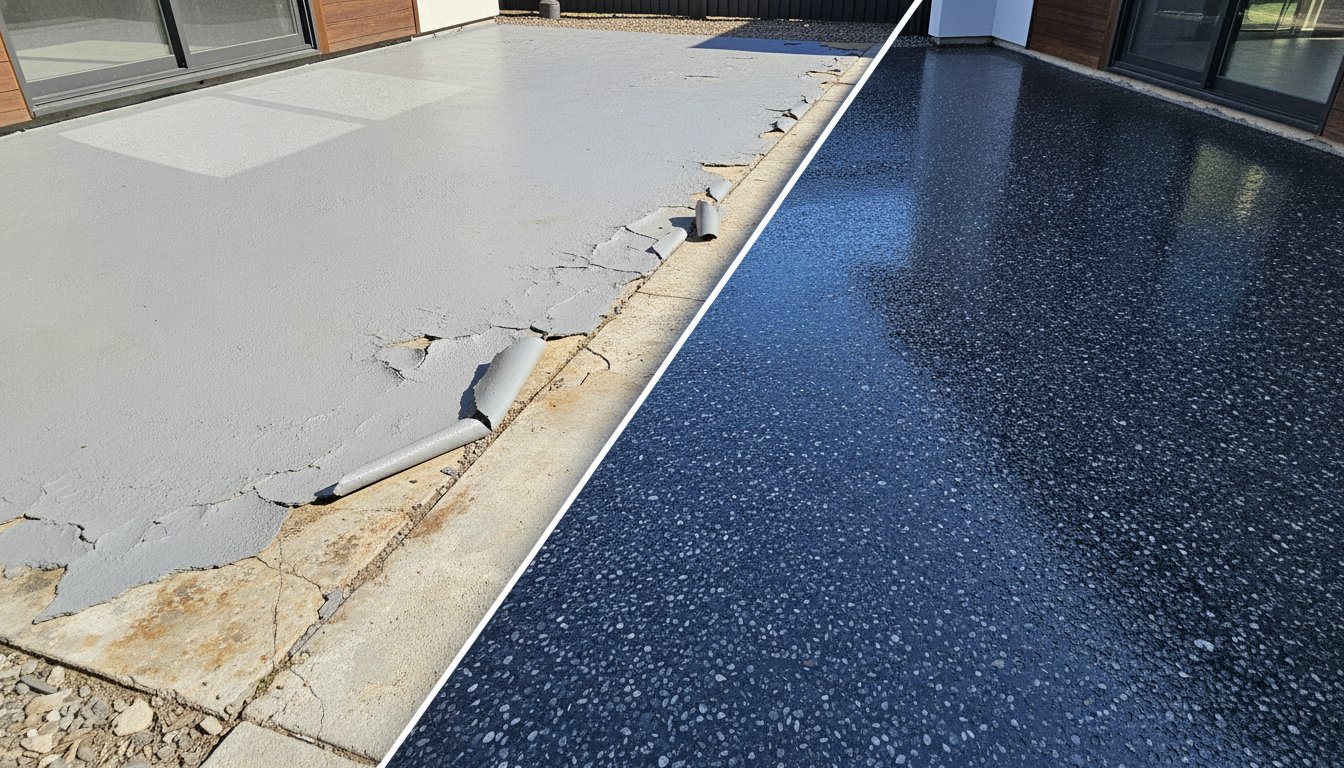
- Large-scale delamination: If the epoxy peels up in large sheets, it's a sign the original installers failed to prep the concrete correctly.
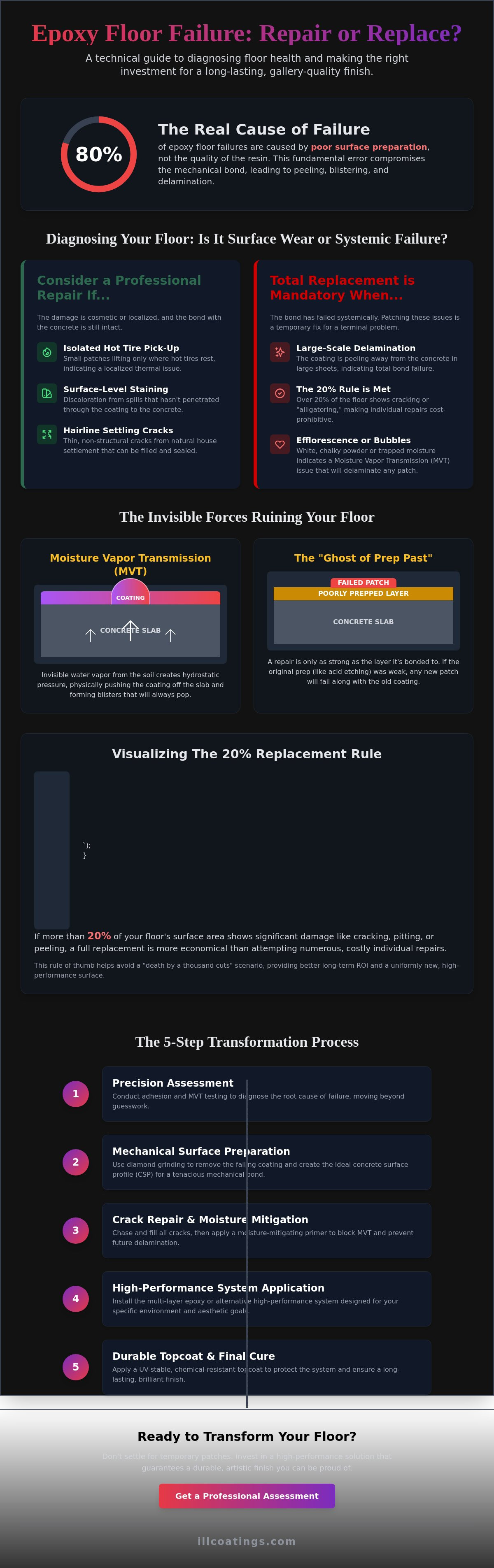
- The 20% Rule: If more than 20% of the floor shows signs of "alligatoring" or cracking, the cost of individual repairs will outweigh the price of a total high-performance replacement.
- Efflorescence: If you see white, chalky powder or moisture trapped under a bubble, your slab has a moisture vapor issue that will continue to push off any repair you attempt.
The Science of Coating Failure: Why Repairs Often Fail
Understanding the physics of your floor is the only way to decide when to repair vs replace epoxy floor without wasting your hard-earned money. Most homeowners think of epoxy as a high-strength glue, but in reality, it's a rigid plastic system that relies on a specific mechanical "key" to stay attached. Once the original resin has fully cured, it becomes chemically inert. This means you cannot simply pour new epoxy over the old and expect a chemical bond. Without aggressive mechanical grinding to open the pores of the old coating, your repair is essentially floating on the surface.
Moisture Vapor Transmission (MVT) is another invisible force that ruins simple patches. Concrete acts like a dense sponge, pulling moisture from the soil beneath your home. If your original floor was installed without a proper moisture barrier, that water vapor creates hydrostatic pressure. This pressure builds up until it physically pushes the coating off the slab. If you apply a repair patch over an area experiencing MVT, you're just creating a new blister that will eventually pop. Following industry standards for concrete coatings is the only way to ensure that the bond between the resin and the concrete can withstand these natural pressures.
We often see the "Ghost of Prep Past" haunting repair attempts. If the initial installer took shortcuts by using acid etching instead of diamond grinding, the foundation of your floor is weak. Any repair you bond to a poorly prepped floor is only as strong as that original, failing layer. Similarly, UV degradation isn't just a cosmetic issue. When epoxy "ambers" or turns yellow, the polymer chains are actually breaking down and becoming brittle. A new topcoat won't fix a brittle base; it will just crack along with it.
The Delamination Dilemma
Delamination is the physical separation of the coating from the concrete substrate due to a total loss of adhesion. If your concrete is saturated with oil or old automotive fluids, a repair patch will never find a clean surface to grab onto. Attempting to "sandwich" a new layer of resin over oil-soaked concrete or trapped moisture is a recipe for a much larger, more expensive failure. If you're seeing these signs, it's often better to consult with a specialist about a total transformation rather than throwing money at a patch.
Structural Concrete Issues vs. Coating Issues
Sometimes the epoxy isn't the problem; the concrete slab is the culprit. If your floor is "heaving" due to soil expansion, it will snap any rigid coating you apply. If the underlying concrete is spalling or flaking away, your repair is just a bandage on a crumbling bone. In these cases, you must stop the cycle of temporary fixes. Professional grinding is required to remove the failed system and reach sound, solid concrete before a new high-performance floor can be built.
The Decision Matrix: 5 Red Flags for Mandatory Replacement
Deciding when to repair vs replace epoxy floor shouldn't be a guessing game. It requires a specialist's eye and a blunt assessment of the current state of your space. While a minor scratch might just need a fresh topcoat, systemic issues signal that your floor's lifecycle has reached its end. We use a specific decision matrix to help homeowners and facility managers determine if their surface is salvageable or if it's time for a total structural transformation.
- Flag 1: The 20% Rule. If more than 20% of your total floor area shows signs of peeling, bubbling, or cracking, patching is no longer cost-effective. The labor required to prep dozens of small spots often exceeds the efficiency of a full-room grind.
- Flag 2: Adhesion Testing. If you can easily slide a putty knife under the edge of a chip and lift more coating, the entire bond is compromised. If it peels here today, it will peel there tomorrow.
- Flag 3: System Age. Most high-quality Advanced flooring materials have a functional lifespan of 10 to 15 years in industrial environments. If your floor is approaching its second decade, the resin has likely become too brittle for a reliable repair.
- Flag 4: Change of Use. If you're converting a storage area into a high-traffic workshop or parking heavy vehicles on a floor originally designed for light foot traffic, a repair won't provide the necessary durability. You need a higher-build system.
- Flag 5: Substrate Integrity. When the concrete underneath is "soft" or turning to dust, the epoxy has nothing to hold onto. You can't build a gallery-quality finish on a foundation of sand.
The Financial Reality of Patching
If you pay for three surgical repairs over five years, you've likely spent more than the cost of one professional replacement. Patching is a labor-intensive process that requires meticulous hand-work, whereas grinding concrete with industrial equipment is fast and thorough. A "patchwork" floor also carries a heavy aesthetic penalty. Visible seams and mismatched colors scream "maintenance issue" to potential buyers, significantly dragging down your property's resale value compared to a seamless, high-performance coating.
Safety and Liability Considerations
Safety is a non-negotiable priority. Aged epoxy floors lose their slip-resistance as the aggregate wears down, turning a damp garage into a skating rink. Uneven patches also create micro-ledges that act as tripping hazards, which is a massive liability in commercial settings. In environments like commercial kitchens or medical garages, a failing floor becomes a hygiene risk. Cracks and delaminated pockets trap bacteria and moisture that no amount of scrubbing can reach. When your floor can no longer be sanitized, a total replacement is the only responsible path forward.
Professional Resurfacing: The High-Performance Middle Path
Most homeowners feel trapped between the frustration of a temporary patch and the astronomical cost of ripping out a concrete slab. If you're stuck wondering when to repair vs replace epoxy floor, there is a third option that provides a permanent, gallery-quality result without the structural demolition. Professional resurfacing uses industrial-grade diamond grinding to surgically remove the failed coating and the top layer of compromised concrete. This process creates a fresh, porous canvas that allows new high-performance systems to achieve a permanent mechanical bond.
The "Grind and Seal" method is a favorite for those seeking an industrial-chic aesthetic. By grinding away the old resin, we reveal the natural beauty of the aggregate within your concrete. If the underlying slab is in good structural shape, we can polish it to a high gloss or apply a clear, professional-grade polyaspartic topcoat. These topcoats are vastly superior to standard DIY resins because they offer four times the abrasion resistance and won't yellow under UV exposure. It's a transformative approach that turns a failing floor into an architectural masterpiece.
Resin-Bound Stone (Vuba Stone) for Outdoor Surfaces
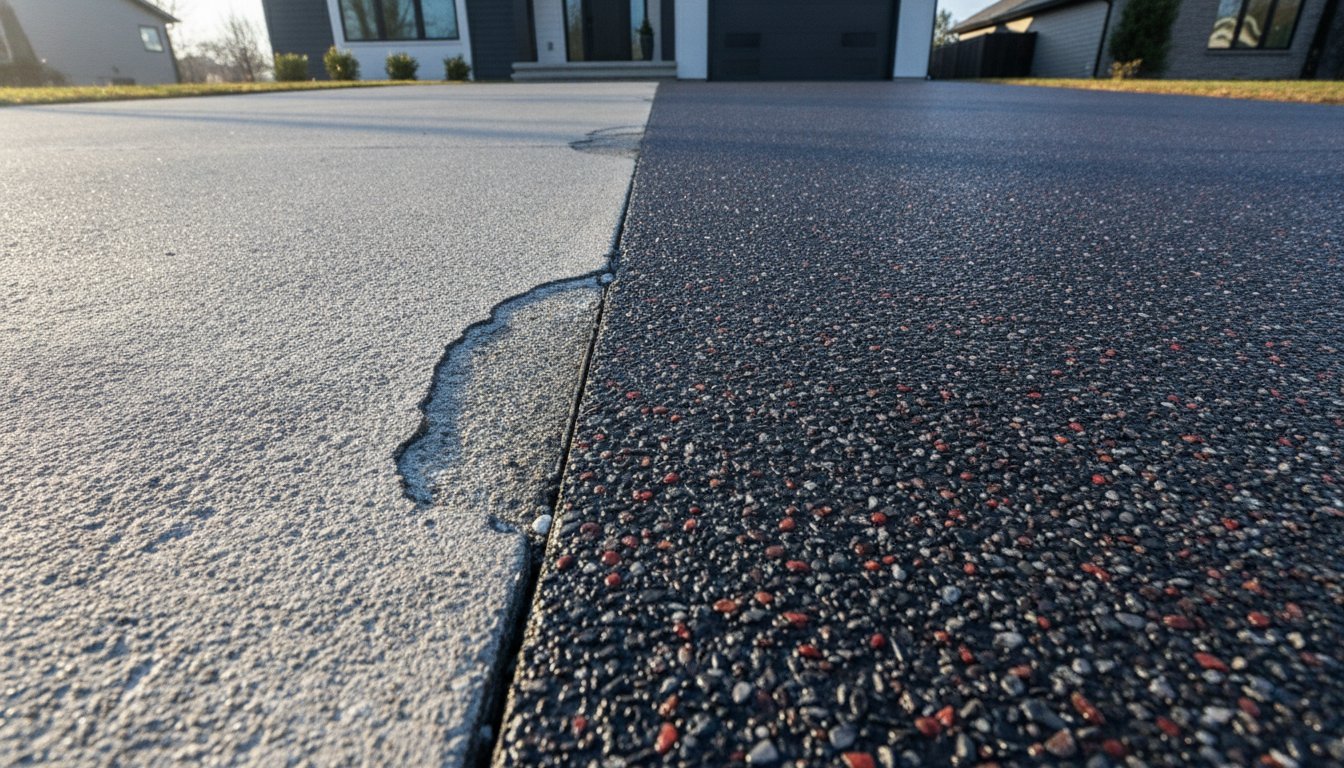
Traditional epoxy often fails on pool decks and patios because it's a non-breathable barrier. When moisture rises from the ground, it gets trapped and causes the coating to bubble. Resin-bound stone, specifically Vuba Stone, solves this by creating a porous, "permeable" surface. This system allows water to drain through the stone, preventing the hydrostatic pressure that ruins flat coatings. If your outdoor floor is peeling, this artisan-grade stone system masks minor concrete imperfections and provides a slip-resistant, natural finish that handles extreme weather with ease.
Concrete Polishing and Grinding
If you want a floor that will literally never peel again, concrete polishing is the definitive answer. Unlike topical coatings that sit on top of the slab, mechanical polishing hardens the concrete itself. We use progressively finer diamond grits to close the pores of the concrete until it shines like marble. The maintenance is incredibly simple; you only need a microfiber mop and water. For garages and high-traffic commercial spaces, this provides a durable, high-gloss finish that resists tire marks and chemical spills without the risk of future delamination.
Don't settle for a failing floor that causes you daily anxiety. If you're ready to move past temporary fixes, contact us today for a professional floor assessment and discover how we can restore your space to gallery-quality brilliance.
The Illuminated Coatings Approach: Beyond the Patch
At Illuminated Coatings, we don't believe in temporary band-aids. When you're deciding when to repair vs replace epoxy floor, you need a specialist who treats your concrete like a canvas rather than a generalist looking for a quick fix. We've built our reputation on the singular focus of transforming failing floors into gallery-quality masterpieces. Our business structure is rooted in the belief that the quality of our work is directly tied to our professional survival. This high-stakes commitment ensures that every square foot we grind and coat is a point of pride for both our team and your family.
Our five-step transformation process leaves nothing to chance. It begins with a blunt assessment of your current floor's health to identify exactly why the previous system failed. We then move into aggressive mechanical grinding to reach sound concrete, followed by structural repairs to any cracks or pits. Only then do we apply industrial-grade resins and finish with an artistic eye for detail. This rigorous method ensures a floor that doesn't just look brilliant but performs under pressure for decades.
Artisan Craftsmanship Meets Industrial Strength
We embrace a "blue-collar artisan" philosophy. This means we aren't afraid of the grueling work of grinding concrete to perfection, but we also possess a refined eye for the final aesthetic. We never sell DIY kits because professional-grade equipment and specialized materials are non-negotiable for a lasting bond. If you want a floor that reflects your standard of excellence, you need the industrial strength that only professional application can provide. We don't just apply resin; we Illuminated Coatings your space by bringing life and brilliance to dull, failing environments.
Taking the Next Step Toward Transformation
During a professional consultation, we do more than look at the surface. We perform moisture testing and adhesion checks to find the root cause of your floor's failure. This diagnostic approach allows us to present a clear technical verdict on when to repair vs replace epoxy floor for your specific environment. Stop worrying about the cost of failure and start envisioning the potential of your property. Schedule your professional floor assessment with Illuminated Coatings and let us bring life and brilliance back to your space.
Reclaiming Your Floor's Brilliance
Your floor is the foundation of your property's aesthetic and functional value. Don't let peeling resins or dull finishes diminish the pride you take in your home. We've explored how identifying the 20% failure threshold and understanding the science of moisture vapor transmission can save you from the cycle of endless, ineffective patching. Mastering the technical verdict on when to repair vs replace epoxy floor ensures that your investment results in a durable, industrial-strength surface rather than a cosmetic bandage.
As specialists in Vuba Stone and high-performance epoxy, our family-owned and operated business has been dedicated to artisan craftsmanship since 2021. We take personal stakes in every project because our professional survival depends on the integrity of your floor. Whether you need a surgical repair or a total high-gloss resurfacing, we bring a specialist mindset to every slab. It's time to move beyond the frustration of a failing floor and achieve a gallery-quality finish that stands the test of time.
Transform your failed floor with Illuminated Coatings and experience the brilliance of a truly professional transformation. We look forward to bringing life back to your space.
Common Questions About Epoxy Floor Restoration
Can I just pour new epoxy over my old, peeling epoxy floor?
No, you cannot simply pour new resin over a peeling floor because cured epoxy is chemically inert. New layers won't bond to old ones without aggressive mechanical grinding to create a "key" for the material to grab. If the original floor is already peeling, the bond to the concrete has failed, and adding more weight will only accelerate the delamination of the entire system.
How much does it cost to grind off a failed epoxy coating?
Industry standards for surface preparation often involve diamond grinding to remove failed coatings. While costs vary based on the thickness and type of the existing material, professional grinding typically adds between $2 and $4 per square foot to a project's preparation phase. This process is essential to reach the clean, porous concrete required for a permanent high-performance bond.
Is it possible to repair just one section of a garage floor epoxy?
Yes, surgical repairs are effective for isolated issues like a single "hot tire pick-up" spot or a small impact chip. However, you must determine when to repair vs replace epoxy floor by checking the surrounding area. If the coating lifts easily at the edges of the repair, the failure is systemic and a localized patch will not prevent the rest of the floor from eventually shedding.
What causes epoxy to bubble or blister shortly after installation?
Bubbles are usually caused by outgassing or Moisture Vapor Transmission (MVT). If the concrete slab wasn't properly tested for moisture or if the temperature fluctuated during the curing process, air or water vapor becomes trapped under the resin. This pressure physically pushes the coating off the substrate, creating the blisters you see on the surface.
How long should a professional garage floor epoxy coating last?
A professionally installed epoxy system is expected to last between 10 and 20 years with proper maintenance. In contrast, DIY epoxy kits often fail within 2 to 5 years. This massive difference in lifespan is due to the industrial-grade thickness of professional resins, which are typically 10 to 20 mils thick compared to the 2 to 4 mils found in water-based retail kits.
Why is my epoxy floor turning yellow or 'ambering'?
Ambering is a result of UV degradation within the epoxy's polymer structure. Standard epoxy resins aren't UV-stable and will break down when exposed to sunlight through windows or open garage doors. To prevent this, we recommend a polyaspartic topcoat, which is a premium alternative that offers superior UV resistance and prevents the brittle cracking associated with aged epoxy.
Can I use a DIY epoxy kit to repair a professional installation?
We strongly advise against using DIY kits for repairs because the materials are fundamentally different. Professional systems use high-solids resins that are much thicker and more durable than the water-based products found in home improvement stores. A DIY patch will look different, wear faster, and likely fail to bond with the high-performance coating already in place.
What is the difference between resurfacing and replacing concrete?
Replacing concrete involves jackhammering the entire slab and pouring new material, which is a massive structural undertaking. Resurfacing is the "middle path" where we use industrial grinders to remove the top few millimeters of damaged concrete and old coatings. This allows us to apply a new high-performance system like resin-bound stone or a fresh epoxy coating on a perfectly prepped foundation.