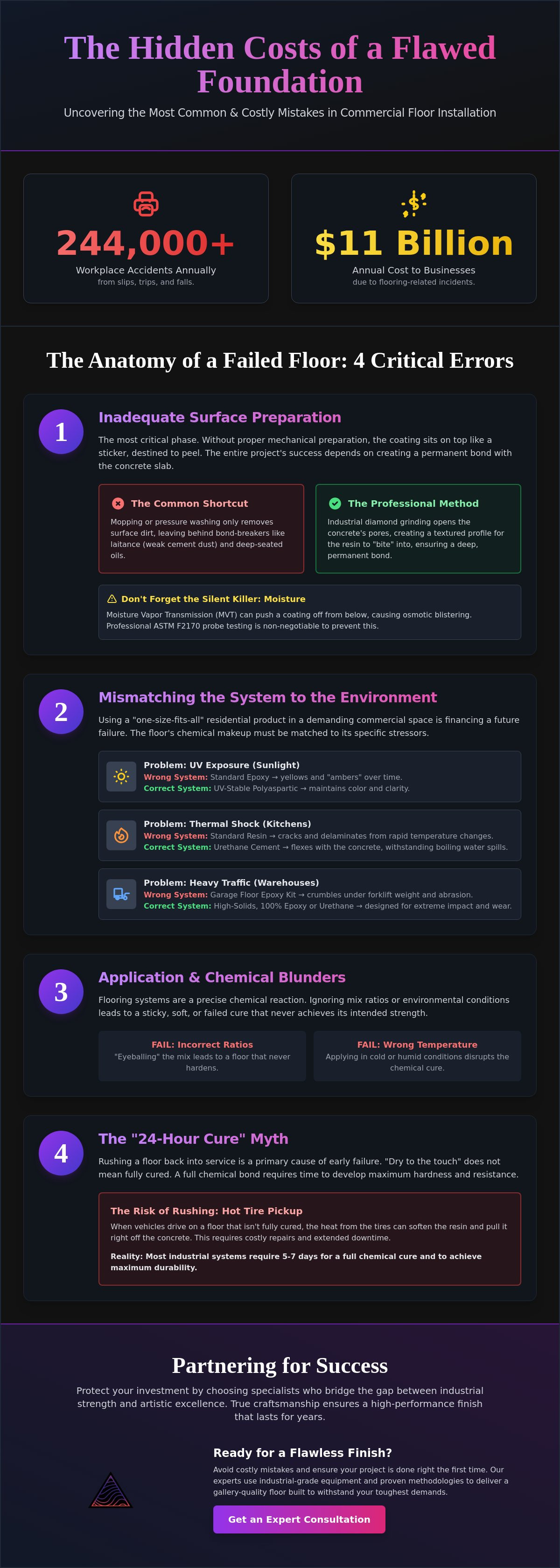
Workplace accidents from slips, trips, and falls occur more than 244,000 times per year, costing businesses approximately $11 billion annually. It's a staggering reality that often points back to a single point of failure: the ground beneath your feet. If you're skeptical of quick-fix solutions that promise the world but end up bubbling or peeling, you aren't alone. Most facility managers fear the high cost of repairs and the operational downtime that follows a failed project. These issues rarely stem from the materials themselves; they are almost always the result of common mistakes in commercial floor installation that ignore the complex chemistry of a successful bond.
You shouldn't have to settle for a surface that compromises your safety or your professional image. We believe in elevating manual labor into a form of craftsmanship, turning a standard concrete slab into a durable, aesthetic masterpiece. This guide identifies the hidden pitfalls in commercial projects so you can achieve a high-performance finish that withstands heavy traffic for years. We'll preview the technical requirements for subfloor preparation and moisture testing to ensure your facility investment delivers a true long-term ROI. By the end, you'll understand how to bridge the gap between industrial strength and artistic excellence.
Key Takeaways
- Learn why simple cleaning isn't enough and how mechanical grinding concrete creates the essential bond required for a high-performance surface.
- Understand the critical difference between residential and industrial systems to ensure your floor withstands heavy warehouse traffic and UV exposure.
- Identify the common mistakes in commercial floor installation related to chemical mix ratios and environmental factors that lead to sticky, failed coatings.
- Discover the truth behind the 24-hour cure myth to prevent early failures like hot tire pickup and ensure a full chemical bond.
- Learn why partnering with a specialist who uses industrial-grade equipment is the only way to achieve a gallery-quality finish that lasts.
Inadequate Surface Preparation: Why 'Clean' Concrete Isn't Enough
If you think a clean floor is just a matter of a mop and a bucket, you're setting yourself up for an expensive disaster. Surface preparation is the most critical phase of any project. It is the mechanical and chemical process of opening up concrete pores to receive a new system. Without this, the coating simply sits on top like a sticker waiting to peel. We treat this stage with the focus of an artisan because we know the entire transformation depends on it. If the resin can't penetrate the slab, then it can't create a permanent bond. This oversight is one of the most common mistakes in commercial floor installation, where the complexity of flooring and subfloors is underestimated by generalists.
Mopping or pressure washing might remove surface dirt, but it won't touch laitance or deep-seated oils. These contaminants act as bond-breakers. We use industrial grinding concrete equipment to create a specific "profile," or texture, that gives the coating something to bite into. Think of it like sanding wood before staining. If the profile isn't aggressive enough, you'll face immediate delamination or peeling within months. A failed floor isn't just an eyesore; it's a liability that halts your operations and drains your budget.
Ignoring Moisture Vapor Transmission (MVT)
Moisture is the silent killer of resinous floors. Even if the surface looks bone-dry, moisture trapped deep in the slab can migrate upward over time. This vapor pressure can literally blow the coating off from the bottom up. Osmotic blistering is a physical reaction where hydrostatic pressure forces moisture through the slab, creating high-pressure bubbles that detach the resin from the concrete. We insist on moisture testing via ASTM F2170 in situ probes before any resin application. It's the only way to ensure your facility investment is protected from the ground up.
The Dangers of Leaving Laitance and Contaminants
Laitance is that weak, milky layer of cement dust and sand that rises to the top of new concrete. It looks solid, but it has zero structural integrity. If you coat over it, the epoxy bonds to the dust rather than the slab. General contractors often underestimate the level of grinding required for industrial-grade systems. Oil, grease, and old sealers are equally dangerous. They soak deep into the concrete and must be mechanically removed to reach the "meat" of the slab. We don't cut corners here because your professional survival depends on a floor that actually stays put.
Mismatching the Flooring System to the Environment
One of the most expensive and common mistakes in commercial floor installation is treating all coatings as if they're interchangeable. If you apply a standard residential-grade epoxy in a high-traffic warehouse, you aren't saving money; you're just financing a future failure. Industrial environments demand a level of resilience that consumer-level kits simply can't provide. We view every slab as a unique challenge. A showroom floor requires a different chemical profile than a chemical processing plant or a sun-drenched outdoor patio. Matching the system to the specific stressors of your environment is where manual labor evolves into true craftsmanship.
Environmental factors like UV exposure and thermal shock are often ignored until the damage is visible. Traditional epoxy is notorious for "ambering" or yellowing when exposed to sunlight, which can ruin the aesthetic of a professional space within months. For areas with high window counts or outdoor exposure, we transition to polyaspartic coatings that offer superior UV stability. Similarly, in commercial kitchens, the floor must survive thermal shock. If you dump boiling water on a standard resin floor, the rapid temperature shift can cause the bond to snap. These spaces require specialized urethane cements that expand and contract at the same rate as the concrete beneath them. If you're unsure which system fits your specific needs, getting an expert consultation can prevent these costly mismatches.
The Limits of Garage Floor Epoxy in Heavy Industrial Use
Standard garage floor epoxy is excellent for light foot traffic and personal vehicles, but it will crumble under the weight of a five-ton forklift. High-stakes environments require systems with extreme tensile strength and impact resistance. You must also consider the specific fluids used in your facility. A floor that resists motor oil might dissolve when exposed to brake fluid or harsh acidic cleaners. We prioritize a specialist mindset, ensuring the chemical resistance of your coating is tailored to your operational reality.
Choosing Resin-Bound Stone (Vuba Stone) for Outdoor Commercial Spaces
Outdoor commercial areas like pool decks and patios face constant moisture and temperature swings that cause traditional concrete to crack and heave. Resin-bound stone, often referred to as Vuba stone, offers a porous solution that allows water to drain through the surface. This eliminates standing water and significantly improves slip resistance. However, a frequent error involves getting the stone-to-resin ratio wrong. If the mix is too "lean," the system suffers from ravelling, where stones break loose and the surface begins to disintegrate. We ensure every batch is precisely measured to guarantee a transformative finish that actually lasts.
Application and Chemical Blunders: The Science of Failed Bonding
If you treat a high-performance coating like a bucket of house paint, you're inviting a catastrophic failure. Commercial flooring isn't just about spreading liquid; it's about managing a precise chemical reaction. One of the most common mistakes in commercial floor installation occurs before the product even touches the concrete. We see it constantly: installers try to "eyeball" the mix ratio or rush the process without respecting the pot life of the resin. Once Part A and Part B meet, the clock starts ticking. If you ignore that countdown, the resin begins to "kick" in the bucket, leading to a compromised bond and an uneven finish that quickly turns into a logistical nightmare.
Inconsistent thickness is another silent killer of industrial surfaces. If the application is too thin, those "thin spots" become the first points of failure under heavy traffic or chemical exposure. If it's too thick, the material may not cure properly or could become brittle and prone to cracking. We approach this with the eye of an artisan, ensuring every square inch of your facility receives the exact mil-thickness required for industrial durability. Achieving a gallery-quality finish requires a specialist mindset that prioritizes precision over speed.
Improper Mixing Techniques and Ratios
Successful bonding requires more than just a quick stir. We use low-speed, high-torque mixers specifically to prevent entraining air bubbles into the mixture, which can lead to unsightly pinholes and craters. Side-scraping the mixing bucket is a non-negotiable step for any professional installer. If unmixed resin from the sides of the pail makes it onto your floor, you'll end up with "uncured spots" that remain tacky and soft forever. This isn't just a minor visual flaw; it's a structural failure that requires the entire area to be stripped and redone, causing the very downtime you're trying to avoid.
Environmental Interference: Humidity and Temperature
The atmosphere in your facility can be just as dangerous as a dirty slab. High humidity often causes "blushing," a milky, cloudy film that ruins the visual impact and surface hardness of your floor. We strictly follow the "Dew Point" rule: if the concrete temperature is within five degrees of the condensation point, we don't pour. Ambient temperature is the primary driver of chemical speed, as higher temperatures increase molecular kinetic energy and accelerate the cross-linking of epoxy molecules, while cold environments can stall the cure entirely. If the environment isn't perfect, we adjust our process. Your professional survival depends on a finish that is both brilliant and permanent.
The 24-Hour Cure Myth: Why Rushing Your Floor Leads to Early Failure
If you think your floor is ready for heavy equipment just because it's dry to the touch, you're risking the entire investment. One of the most dangerous and common mistakes in commercial floor installation is failing to distinguish between a surface that is "tack-free" and one that has reached a "full chemical cure." Many generalists will tell you that 24 hours is plenty of time to get back to business. This is a myth that leads to delamination and permanent damage. We treat every project with a sense of high stakes because we know that rushing the chemistry is a recipe for professional failure. A transformative finish requires patience to reach its peak industrial strength.
The danger of "hot tire pickup" is a perfect example of what happens when you rush. If you park heavy vehicles or forklifts on new epoxy before the 72-hour mark, the heat from the tires can actually pull the resin right off the slab. Similarly, premature chemical exposure can be devastating. If you use harsh cleaning agents on a floor that looks dry but hasn't fully cross-linked, you'll ruin the finish and compromise the bond. Accelerated products exist to speed up the timeline, but they require even more precision during application. If the timing is off by even a few minutes, the entire system can fail before it even hits the ground.
Curing vs. Drying: Understanding the Chemical Reality
Epoxy is a complex chemical reaction, not a drying process like standard paint. It doesn't rely on evaporation; it relies on molecules bonding together to create a rigid structure. The first 72 hours are the most critical for long-term durability and impact resistance. If the substrate temperature is cold, the cure slows down significantly. We monitor these conditions with technical focus to ensure the reaction completes as intended. If the slab is too cold, the floor may never reach its intended hardness. We don't guess; we measure.
The Hidden Costs of Rushing Operational Downtime
It's tempting to trade a few days of downtime for an earlier reopening, but that 2-day savings can lead to a 10-year reduction in floor life. We take a "Blue-Collar Artisan" approach to every job, which means we refuse to compromise on cure times. Our professional survival is tied to the quality of our work, and we won't put our name on a floor that isn't ready for the real world. Planning for staging is essential to manage a facility while a floor reaches full hardness. If you value long-term ROI over a quick fix, schedule a consultation with our specialists to plan your installation correctly.
Partnering for Success: How Professional Installation Protects Your Investment
Choosing the right partner is the final step in ensuring your project doesn't fall victim to the common mistakes in commercial floor installation we've discussed. A general contractor might be great at framing or electrical work, but they often lack the specialized industrial equipment needed for precision grinding concrete and concrete polishing. We use heavy-duty planetary grinders that a rental shop simply doesn't carry. This equipment is the difference between a surface that looks "good enough" and one that is structurally prepared for a lifetime of heavy use.
When you hire a specialist, you're buying more than just a service. You're buying a specialist mindset that understands the nuances of resin chemistry and slab mechanics. We don't just pour product; we engineer a solution. This level of focus ensures that every mil of thickness is consistent and every chemical bond is permanent. As a locally-rooted, family-owned business, our accountability is built into our name. We don't just offer a warranty; we offer the security of knowing our personal stakes are tied to the brilliance of your floor. We transform worn, dusty concrete into a long-lasting masterpiece through expert handiwork.
The 'Blue-Collar Artisan' Difference
We believe in elevating manual labor into a form of craftsmanship. To us, a warehouse floor or a commercial kitchen isn't just a job site. It's a canvas where industrial strength meets artistic excellence. This "blue-collar artisan" approach means we obsess over the details that generalists overlook. Our professional survival depends on the long-term performance of your floor. We move beyond basic construction to provide gallery-quality industrial finishes that become a point of pride for your business.
Long-Term Maintenance and Support
A professional installation doesn't end when the resin cures. We provide you with a comprehensive maintenance roadmap to protect your ROI. If you're ready to move past the risk of common mistakes in commercial floor installation, follow these essential steps:
- Use pH-neutral cleaners: Avoid harsh acids or alkalis that can etch the finish.
- Schedule periodic inspections: Catch minor wear before it requires a major repair.
- Avoid abrasive pads: Use soft microfibers to maintain the high-gloss brilliance.
We stay with you long after the final walkthrough to ensure your investment continues to shine. Transform your facility with the experts at Illuminated Coatings and experience the difference that true craftsmanship makes for your business.
Secure Your Facility with Concrete Confidence
Avoiding the high cost of floor failure starts with moving past the quick-fix mentality. We've explored how proper mechanical grinding and matching the right resin system to your specific environment are the pillars of a successful project. Rushing the cure or skipping moisture tests are among the most frequent common mistakes in commercial floor installation that lead to operational downtime and wasted capital. You deserve a floor that reflects the excellence of your business through a finish that is both brilliant and permanent.
As a family-owned team, we treat every slab with the dedication of a blue-collar artisan. We specialize in Vuba stone and high-performance epoxy coatings, bringing precision concrete polishing and industrial-grade equipment to every job. If you're ready to transform your facility into a gallery-quality masterpiece that lasts, we're here to help. Request a Professional Consultation for Your Commercial Flooring Project today. Let's build a surface that stands as a point of pride for your company.
Frequently Asked Questions
Can I install commercial epoxy over an existing floor coating?
You should generally avoid installing new epoxy over an existing coating. If the original layer begins to delaminate or peel, your new investment will fail right along with it. We recommend mechanical grinding to remove old materials and reach the bare concrete. This ensures a permanent, structural bond that only a clean, porous slab can provide.
How long does a commercial floor installation typically take?
Most professional installations require three to five days to complete correctly. This timeline accounts for essential stages like mechanical grinding, crack repair, and the chemical curing of multiple layers. If an installer promises a one-day turnaround for a large commercial space, they're likely cutting corners on the preparation or cure times that ensure long-term durability.
What is the difference between industrial epoxy and polyaspartic coatings?
Industrial epoxy is a durable workhorse known for its high-build thickness and impact resistance, though it can yellow when exposed to UV light. Polyaspartic coatings are UV-stable and cure significantly faster, often allowing for foot traffic within hours. We choose between these systems based on your facility's specific needs for chemical resistance and operational downtime.
Is it possible to install commercial flooring without shutting down my business?
We can often perform installations in phases or during off-hours to keep your operations running. If you utilize fast-curing polyaspartic systems, the floor can often handle light traffic the very next day. This phased approach allows you to achieve a transformative finish without the high cost of a total facility shutdown.
Why is my new commercial floor bubbling or peeling?
Bubbling and peeling are the most visible results of common mistakes in commercial floor installation, usually tied to moisture vapor or poor surface preparation. If the installer skipped moisture testing or failed to grind the concrete to a proper profile, the coating cannot maintain its grip. Hydrostatic pressure from beneath the slab will eventually force the resin to detach.
How do I know if my concrete substrate needs moisture mitigation?
You can't determine moisture levels by sight alone; you must use professional testing like the ASTM F2170 in situ probe method. If the relative humidity within the slab exceeds the coating's limits, a moisture vapor barrier is mandatory. We treat moisture testing as a non-negotiable step to protect the professional survival of your new floor.
What is the most durable flooring for a commercial kitchen or brewery?
Urethane cement is the superior choice for environments facing thermal shock and frequent washdowns. It expands and contracts at a similar rate to concrete, preventing the bond from snapping when exposed to boiling water or steam cleaning. Standard epoxy often fails in these high-stakes settings because it cannot handle rapid temperature fluctuations.
Can resin-bound stone be used for indoor commercial lobbies?
Resin-bound stone, often called Vuba stone, is an excellent option for creating a sophisticated, slip-resistant lobby. For indoor use, we typically apply a "closed" system to prevent dirt from migrating into the stone's pores. This creates a gallery-quality aesthetic that is easy to maintain while providing the industrial strength your high-traffic entryway demands.